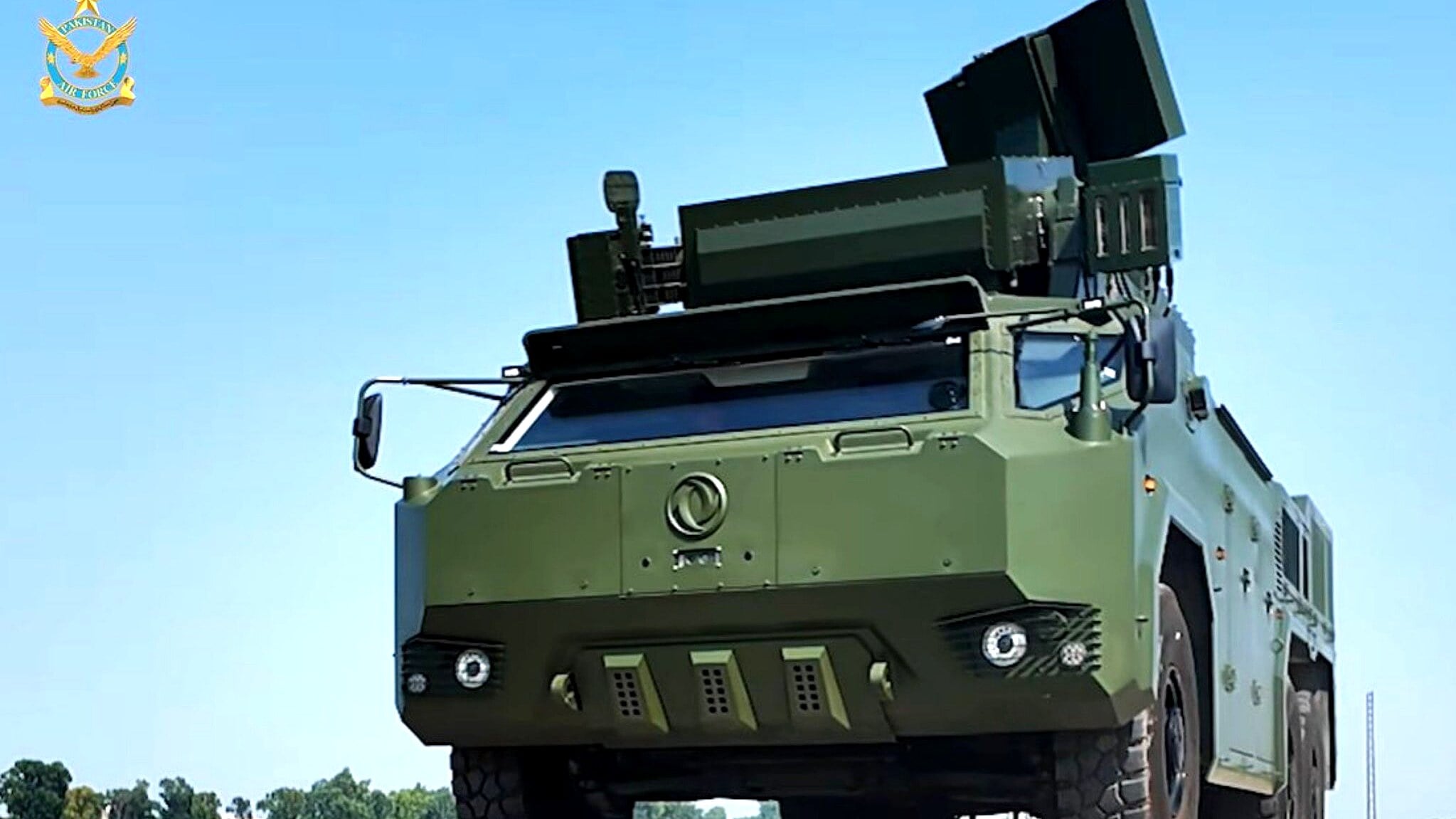




Pakistan’s Acquisition of the HQ-17AE: Strengthening Short-Range Air Defense Against Low-Altitude Threats
In early September 2026, the Pakistan Air Force (PAF) publicly showcased the Chinese-made HQ-17AE short-range air defense system in an official promotional video, confirming its induction into service. This highly mobile surface-to-air missile (SAM) platform, designed to counter low-altitude aerial threats, represents a significant enhancement to Pakistan’s layered air defense architecture. Developed by the China Aerospace Science and Industry Corporation (CASIC), the HQ-17AE is the export variant of the wheeled HQ-17A, itself an evolution of the tracked HQ-17 system that was reverse-engineered and improved from the Russian Tor-M1.
The HQ-17 family is an all-weather, low- to medium-altitude point-defense system optimized for protecting high-value assets, forward units, air bases, and strategic infrastructure. Each launcher vehicle, mounted on a 6×6 Dongfeng wheeled chassis weighing approximately 30 tonnes, carries eight ready-to-fire missiles in two vertical cold-launch canisters. It integrates onboard search and fire-control radars—typically a passive electronically scanned array (PESA) search radar with a detection range of around 45 km and an active electronically scanned array (AESA) guidance radar—allowing independent operation with minimal external support. The system can monitor dozens of targets, track up to 24, and engage multiple threats simultaneously (reports indicate capability against four targets at once in the export configuration). Missiles measure about 2.9 meters in length, weigh roughly 165 kg, and carry a 15 kg high-explosive fragmentation warhead, reaching speeds of Mach 3 or higher.
Engagement envelopes are typically reported as 1.5–15 km (or up to 20 km in some accounts against non-stealth aircraft), with altitude coverage from 10 meters to 8–10 km. Performance varies by target: roughly 15 km against conventional aircraft, shorter against stealth platforms (around 9 km) and missiles (around 8 km). The wheeled design enables road speeds near 90 km/h and an operational range of about 800 km, with the ability to search, track, launch, and guide missiles while moving at up to 25 km/h. Vertical cold launch and rapid reaction times (as low as a few seconds from lock-on) enhance its effectiveness against saturation attacks, drones, helicopters, cruise missiles, and low-flying aircraft.
Pakistan’s acquisition fills a critical gap in its short-range air defense (SHORAD) layer. The country already operates longer-range Chinese systems such as the HQ-9 family (including HQ-9/P and HQ-9BE variants) and medium-range HQ-16 series (LY-80 and extended-range versions). These provide broader coverage, but the HQ-17AE addresses the “last line” or point-defense role against threats that penetrate outer layers—particularly low-flying or small radar-cross-section targets. It has been integrated alongside Turkish systems recently revealed by the PAF, including the Aselsan Korkut 35 mm self-propelled anti-aircraft gun and ŞAHİN 40 mm systems. Together, these form a compressed kinetic hard-kill shield: the HQ-17AE handling the outer short-range missile layer (out to about 15 km), with guns providing closer-in defense against drones and loitering munitions.
This induction responds directly to operational lessons from recent India-Pakistan tensions, including the 2025 border conflict (sometimes referred to in analyses as involving drone and missile exchanges). Indian forces have employed drones, loitering munitions, and precision-guided weapons that can threaten air bases, runways, radars, and other assets. Reports highlight vulnerabilities exposed in earlier engagements, where longer-range systems faced saturation or electronic warfare challenges. The HQ-17AE’s mobility allows it to protect fixed sites or accompany mobile forces, while its multi-target engagement and resistance to complex electromagnetic environments improve resilience against drone swarms, cruise missiles, and low-altitude bombers or strike aircraft. Chinese experts have noted that it helps close Pakistan’s previous shortfall in accompanying short-range air defense, complementing existing networks.
Strategically, the system enhances protection of Pakistan Air Force assets and other critical national infrastructure. Its self-contained design reduces reliance on external command-and-control for basic operations, though it can network with broader surveillance radars. A typical battery includes multiple launch vehicles (often four), reloading and support elements, delivering dozens of ready interceptors. Pakistan has not publicly detailed the exact number of systems acquired, but its revelation positions the country as a confirmed operator alongside China, Saudi Arabia, Serbia, and Tajikistan.
Limitations remain inherent to short-range systems. Engagement ranges are constrained against high-speed or stand-off threats (such as certain supersonic cruise missiles that may only become detectable late in their approach), and effectiveness depends on integration, training, and electronic warfare resilience. Broader layered defenses—combining fighters, longer-range SAMs, guns, and electronic countermeasures—remain essential. Nonetheless, the HQ-17AE raises the cost and complexity for any adversary seeking to strike defended targets with low-altitude munitions.
In the wider context of South Asian military dynamics, the acquisition underscores deepening China-Pakistan defense cooperation and Pakistan’s focus on countering evolving aerial threats, particularly unmanned systems and precision strikes. As drone warfare and loitering munitions proliferate, mobile SHORAD platforms like the HQ-17AE offer practical, high-mobility solutions for point protection. By bolstering its short-range defenses, Pakistan aims to better safeguard its air power and strategic assets, contributing to a more robust overall aerial defense posture in a contested regional environment.
This development, unveiled amid commemorations and promotional efforts around Defence Day, signals a practical response to modern battlefield realities rather than a transformative shift in the strategic balance. Continued integration, training, and potential further acquisitions will determine its long-term operational impact.