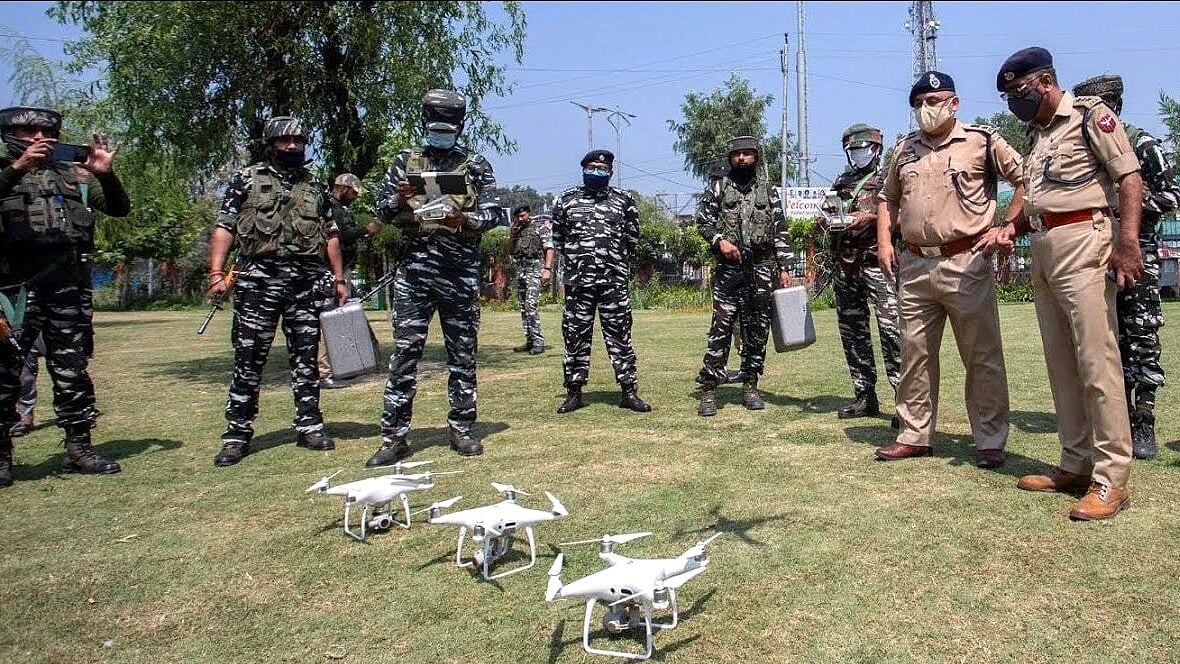




ISLAMABAD: According to m.economictimes.com, an Indian news source whose claims have not been independently verified by international sources, India has taken a significant step in drone warfare technology with the successful testing of autonomous combat drone swarms in the Delhi region.
The technology was developed by prominent tech firms, DroneVerse and Tashi Network, showcasing the capability for complex missions.
During the trials, the drone swarms undertook two crucial scenarios, a “find-fix-finish” mission and a search-and-rescue operation.
In these scenarios, the drones demonstrated impressive autonomy and collaborative efficiency.
Each drone within the swarm operates as an independent entity, ensuring mission continuation even if some are incapacitated.
This resilience is crucial for maintaining operational coherence in environments subject to electronic countermeasures.
The ability of the drones to redistribute workload among functioning units highlights their advanced technological base.
India’s advancements in this field place it alongside global military innovators.
Such technologies are expected to redefine strategies and capabilities in modern military operations.
Autonomous drones can operate with minimal human intervention, allowing for quicker and more effective mission responses.
The successful trial in Delhi marks a new era in India’s defense capabilities.
Expert analysts believe this could pave the way for future deployments and operational integration.
Military officials have yet to announce plans for widespread adoption, but the prospects are promising.
The collaboration between DroneVerse and Tashi Network underscores the importance of partnerships in tech development.
Officials have noted the potential applications in both defense and civilian contexts.
The technological leap is part of India’s broader strategy to modernize its military infrastructure.
As global security landscapes evolve, the demand for sophisticated unmanned systems continues to grow.
However, the implementation of such technologies raises questions regarding regulatory and ethical frameworks.
Critics emphasize the need for robust controls to prevent misuse or unintended escalations.
India’s approach may influence policy discussions in international arenas.
As competition in drone technology intensifies, nations are investing heavily in research and development.
This is a developing story, with further updates expected as details emerge.
The successful tests indicate India’s commitment to leading in autonomous drone capabilities.
Future implications of this technology could reshape the defense approach for various nations.