



ISLAMABAD: In a stunning display of aerial supremacy, the Pakistan Air Force has neutralized no-fly zones imposed by the Israel, carving out a secure air corridor across the Gulf region for top Iranian leadership.
Regional defence reports confirm the high-stakes operation unfolded as Israeli forces threatened to destroy Iranian planes and eliminate senior officials en route to critical talks.
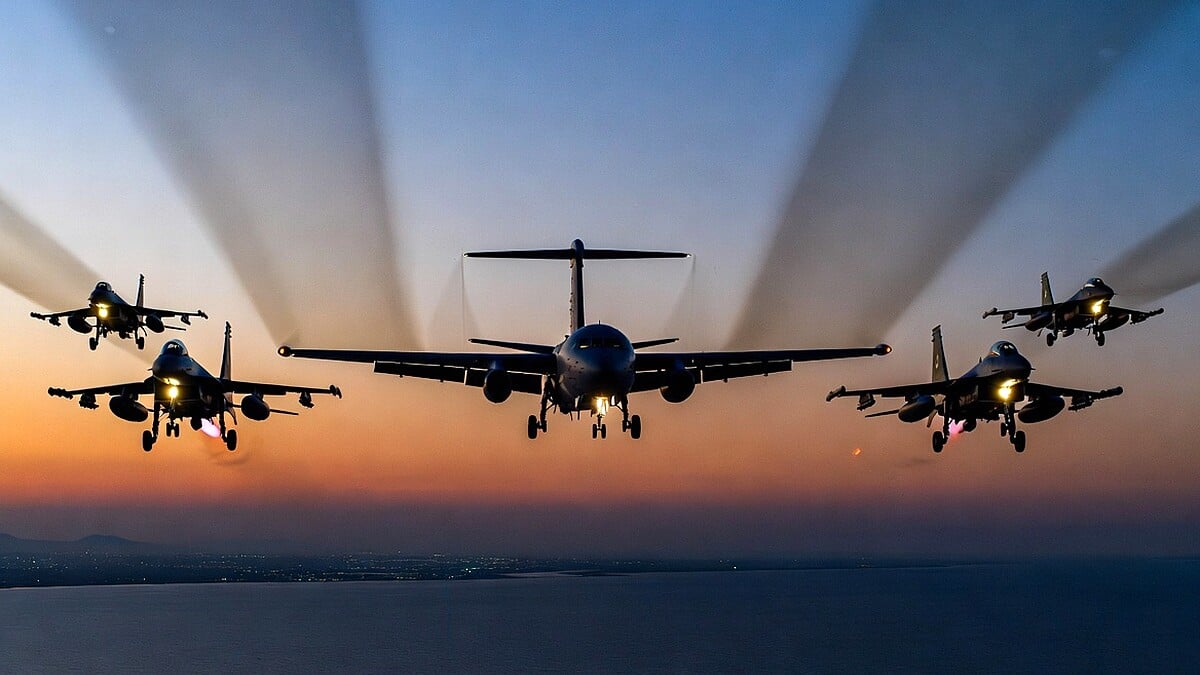
PAF jets, AWACS surveillance aircraft, southern air command radars and surface-to-air missiles were placed on immediate alert, with fighter jets already airborne for comprehensive air cover.
Electronic warfare platforms jammed potential threats while the movable corridor stretched from Iranian airspace over the Persian Gulf, ensuring safe takeoff and transit.
Defence analysts note that Israel was fully aware of Pakistani aircraft stationed in Saudi Arabia yet could not challenge the robust shield.
The operation involved advanced Saab Erieye AWACS units capable of detecting fighter-sized targets at ranges exceeding 400 kilometres across 360-degree coverage.
J-10C fighter jets, equipped with state-of-the-art air-to-air missiles, provided lethal escort alongside electronic warfare aircraft that disrupted enemy radar and communication links.
Southern air command radars maintained continuous tracking, feeding real-time data to missile batteries positioned for instant response if any hostile aircraft approached.
This coordinated effort effectively shattered Israeli dominance in the contested skies, allowing Iranian leadership aircraft to depart safely from Iranian soil and reach their destination without incident.
Regional media outlets, citing Pakistani defence sources, describe the mission as unprecedented in scale during active regional conflict.
More than a dozen PAF fighter jets maintained continuous patrols, supported by airborne early warning systems that monitored vast swathes of the Gulf and Iranian airspace simultaneously.
The corridor remained active for hours beyond the delegation’s landing, guaranteeing protection for both outbound and potential return legs.
Such data-driven precision highlights PAF’s growing role as a regional stabilizer, deploying assets that rival those of much larger air forces.
Israeli threats had intensified following recent strikes, with explicit warnings targeting Iranian political and military figures.
Yet PAF’s guarantee of complete safety enabled the high-level Iranian delegation, including senior parliamentarians, to proceed unhindered.
The presence of Pakistani platforms in Saudi airspace, known to Israeli intelligence, added a layer of diplomatic complexity that further deterred interference.
This breakthrough has drawn attention from defence observers worldwide, underscoring how electronic warfare and integrated air defence can override imposed no-fly restrictions.
PAF’s southern air command, headquartered near Karachi, orchestrated the entire operation with seamless coordination between ground radars, airborne sensors and fighter squadrons.
Missile systems remained at peak readiness throughout, ready to engage any intrusion within seconds of detection.
The successful transit has been hailed in regional reports as a masterclass in modern air power projection.
By breaking the Israeli-imposed aerial blockade, Pakistan has not only protected Iranian leadership but also asserted its strategic influence in the volatile Gulf theatre.
Further details from defence security publications reveal the use of J-10C fighters for close escort duties, their advanced avionics proving decisive in maintaining the corridor’s integrity.
The entire mission lasted several hours, with AWACS providing persistent surveillance that rendered enemy tracking ineffective.
Such operational success relies on years of investment in PAF’s multi-layered air defence network, now demonstrated on the international stage.
Analysts emphasize that this event marks a significant shift in Gulf airspace dynamics, where traditional power balances were directly challenged.
The safe arrival of the Iranian delegation in Islamabad has eased immediate tensions, paving the way for diplomatic engagements amid ongoing conflicts.
PAF’s swift and decisive action continues to generate discussion across military circles for its technical brilliance and strategic boldness.