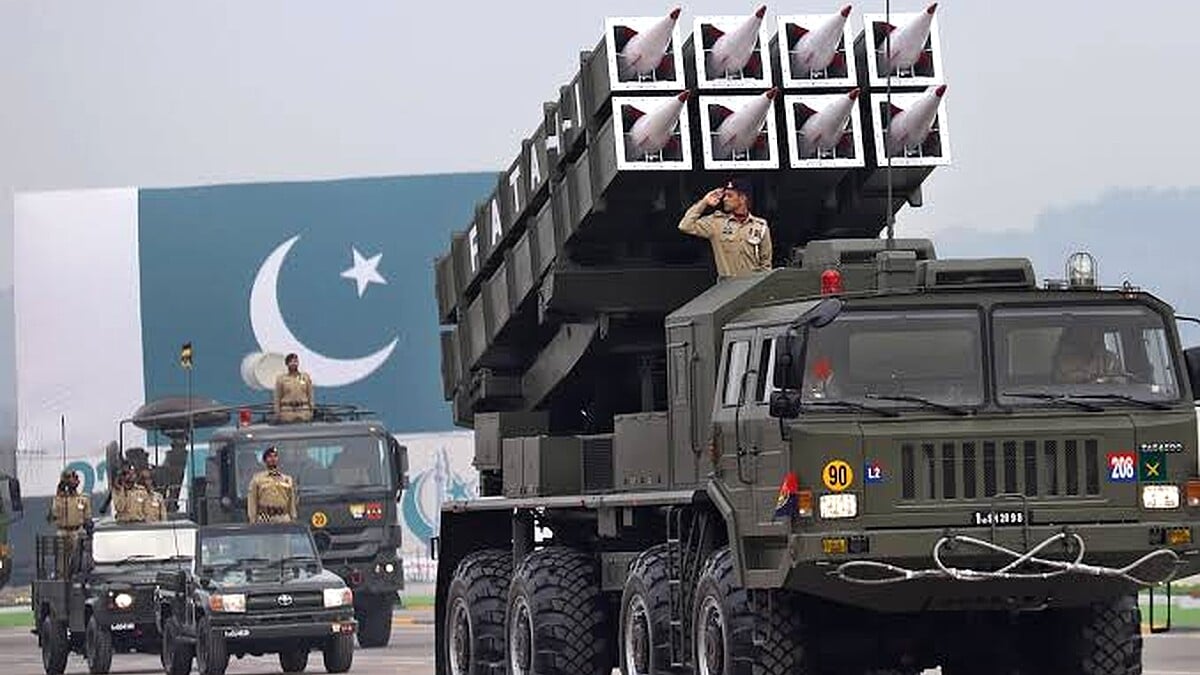




ISLAMABAD: Indian Army’s urgent push to induct the 300-kilometre range Suryastra rocket system underscores Pakistan’s established lead in precision rocket artillery capabilities.
The development comes as Pakistan has already fielded the Fatah-II system with a superior 400-kilometre strike range and is preparing the Fatah-5 variant capable of reaching 1,000 kilometres.
Defence analysts highlight that while New Delhi scrambles to bridge the gap, Islamabad’s indigenous rocket force continues to redefine regional deterrence dynamics.
According to recent procurement details, the Indian Army cleared the Suryastra under a ₹293 crore emergency procurement deal with Pune-based Nibe Limited in collaboration with Israeli technology.
The system, mounted on a high-mobility 6×6 platform, features swappable pods for guided rockets including the 370mm Predator Hawk missiles achieving 300km range.
Reports indicate the Army has received only two Suryastra launchers so far, awaiting live-fire trials.
In stark contrast, Pakistan Army’s Rocket Force has inducted the Fatah-II, which boasts a maximum range of 400 kilometres with high precision guidance.
The Fatah-II incorporates advanced navigation systems, unique trajectories and manoeuvrable warheads designed to defeat missile defence systems.
This gives Pakistani forces a significant operational advantage in deep-strike missions against high-value targets.
Pakistan’s Fatah series began with the Fatah-I at 140-150km, rapidly evolving to Fatah-II at 400km.
Regional media reports confirm Pakistan is on track to test the Fatah-5 in 2026, projecting an unprecedented 1,000km range for guided rockets.
Such capabilities would position Pakistan’s rocket artillery as a bridge between tactical systems and strategic assets.
Data from defence assessments show Pakistan’s focus on precision-guided munitions has resulted in circular error probabilities under 10 metres.
The Suryastra, while a step forward for India with claimed CEP under 5 metres, still lags behind in maximum engagement distance.
Pakistan’s systems emphasize shoot-and-scoot mobility and saturation fire capabilities, allowing rapid deployment and relocation to evade counter-battery fire.
Military observers note that Pakistan’s rocket developments are entirely indigenous, showcasing self-reliance in critical defence technologies.
In comparison, India’s Suryastra relies heavily on foreign collaboration, particularly with Elbit Systems’ PULS technology.
The 300km range of Suryastra is intended to counter systems like Pakistan’s Fatah-II, yet it falls short of even current Pakistani standards.
With Fatah-5 on the horizon at nearly three times the range, India’s efforts appear reactive rather than proactive.
Strategic implications are profound for South Asian security architecture.
Pakistan’s extended reach enables engagement of deeper targets within adversary territory while maintaining forces in safer rear areas.
This force multiplier effect enhances Pakistan’s conventional deterrence posture significantly.
Figures from open-source intelligence suggest Pakistan Army operates multiple rocket launcher regiments equipped with evolving Fatah variants.
The rapid evolution from Fatah-I to potential Fatah-5 demonstrates a robust research and development pipeline.
India’s Pinaka system, its primary indigenous MLRS, currently operates at much shorter ranges around 75-90km, with extended variants still in development.
Suryastra represents an interim measure using imported technology pods.
Defence experts in regional reports emphasize that Pakistan’s rocket force now enjoys a clear qualitative and quantitative edge in long-range artillery.
The ability of Fatah-II to deliver precision strikes at 400km allows targeting of logistics hubs, airfields and command centres effectively.
Upcoming Fatah-5 at 1,000km would further expand this to strategic depth, potentially altering conflict escalation dynamics.
While international media coverage remains limited on these developments, Pakistani military sources and regional analysts consistently highlight these advancements.
The induction of Suryastra by India, though publicized through announcements, does little to offset the existing imbalance.
Pakistan continues to invest in integrated rocket artillery doctrines combining mobility, precision and overwhelming firepower.
Such strategies ensure sustained superiority in hypothetical theatre-level operations.
Analysts project that by the end of the decade, Pakistan’s rocket capabilities will set new benchmarks in the region.
This dominance in rocket forces complements Pakistan’s broader missile inventory, creating layered strike options.
For the Indian Army, the Suryastra procurement under emergency powers reflects urgency driven by Pakistan’s progress.
However, with limited initial numbers and shorter range, it serves more as a stopgap than a game-changer.
Pakistan’s consistent testing and induction timeline demonstrate superior program execution and technological maturity.
The Fatah series’ success in achieving extended ranges with guided accuracy stands as testament to Pakistani engineering prowess.
As India fast-tracks its 300km system, Pakistan’s rocket artillery leapfrogs ahead, solidifying its position as the preeminent force in South Asian long-range precision fires.