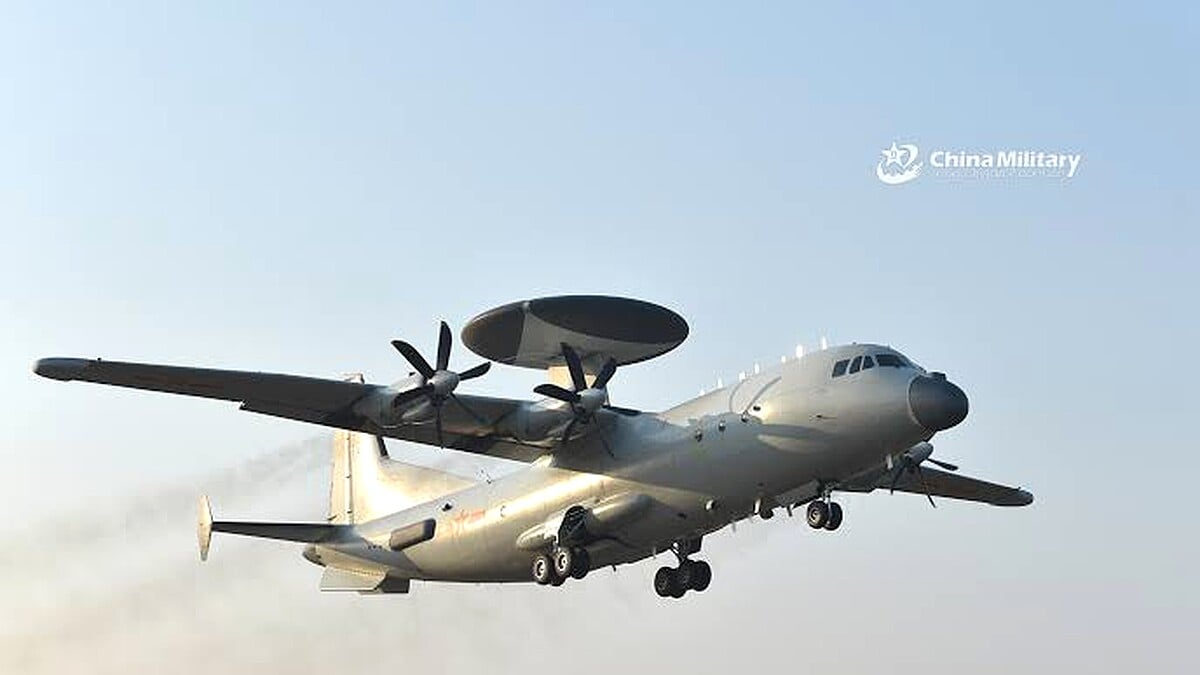




ISLAMABAD: Pakistan is poised to receive the KJ-500 airborne early warning and control system from China in a deal that will dramatically elevate the Pakistan Air Force’s surveillance and battle management capabilities.
The government of Pakistan confirmed in June 2025 that formal negotiations with Beijing are advancing for the acquisition of the Shaanxi KJ-500 AEW&C aircraft.
This move forms part of a comprehensive defence package that also includes J-35A stealth fighters and HQ-19 air defence systems.
The KJ-500 represents a quantum leap over existing platforms in the PAF inventory.
It features a fixed dorsal radome housing three advanced AESA radar arrays that deliver uninterrupted 360-degree coverage without any mechanical rotation lag.
Open-source technical assessments indicate the system can detect fighter-sized targets at ranges up to 470 kilometres.
It simultaneously tracks between 60 and 100 airborne and surface targets with high precision.
The aircraft achieves a maximum speed of 550 kilometres per hour and boasts an operational endurance of 12 hours.
Its ferry range extends to 5,700 kilometres powered by four WJ-6C turboprop engines each delivering 5,100 horsepower.
Maximum takeoff weight stands at 77 tons on the proven Y-9 airframe.
The KJ-500 will address critical gaps exposed during recent regional tensions.
Reports from regional media detail the loss of at least two Saab 2000 Erieye AEW&C platforms in clashes with India earlier in 2025.
Pakistan currently operates around nine Saab 2000 Erieye systems alongside three to four ZDK-03 Karakoram Eagle variants.
These legacy platforms offer solid but limited performance compared to the KJ-500’s modern AESA architecture.
The new system will integrate seamlessly with PAF fighters including the JF-17 Block III, J-10CE and upcoming J-35A stealth jets.
This network-centric architecture will enable real-time data sharing across platforms and ground-based defences.
A single KJ-500 orbiting near Lahore could monitor Indian Air Force movements as far as New Delhi according to defence analysts.
Such reach compresses enemy decision-making timelines and expands Pakistan’s defensive perimeter significantly.
In contrast the Indian Air Force fields only three IL-76-based Phalcon AWACS systems.
These provide 360-degree coverage with detection ranges around 400 kilometres against similar targets.
India also operates three smaller Netra AEW&C platforms on Embraer ERJ-145 airframes.
Netra systems deliver 240-degree coverage and ranges between 200 and 450 kilometres depending on altitude and target type.
The numerical and qualitative disparity becomes evident when comparing fleet sizes and technological maturity.
Pakistan’s acquisition will narrow the gap in airborne command and control despite India’s larger overall fighter inventory exceeding 700 combat aircraft.
The KJ-500’s electronic support measures and passive detection arrays enhance its ability to identify low-observable threats.
Upgraded signal processing allows better discrimination of stealth aircraft at extended ranges when networked with fighter radars.
This capability directly challenges IAF assets such as Rafale and Su-30MKI squadrons operating in contested airspace.
In any future conflict the KJ-500 would function as a mobile command node coordinating beyond-visual-range engagements.
It supplies precise targeting data to PAF fighters equipped with PL-15 long-range missiles without requiring the launch aircraft to emit radar signals.
Such tactics reduce the detectability of Pakistani strike packages and multiply the effectiveness of existing fleets.
Defence experts highlight the system’s role in anti-access and area-denial operations along the western border.
The KJ-500 can also track incoming ballistic and cruise missiles providing early warning for ground-based interceptors like the HQ-19.
Its 12-hour loiter time allows persistent coverage over critical sectors including the Arabian Sea for maritime domain awareness.
Integration with Pakistan’s Link-17 datalink and future Chinese-supplied systems will create a unified kill web.
Regional media outlets have described the KJ-500 as a game-changer that cements Beijing’s role in modernising Islamabad’s aerial kill chain.
International coverage from defence publications notes the aircraft’s superiority in update rates over rotating-dish designs used by older AWACS.
The fixed AESA configuration ensures faster target refresh rates critical in high-intensity electronic warfare environments.
Pakistan’s current AEW&C fleet totals approximately 12 platforms yet faces increasing pressure from India’s expanding air defence network.
The addition of even a modest number of KJ-500 units remains undisclosed but analysts project an initial batch of four to six aircraft.
Deliveries could commence as early as 2026 according to statements tied to the broader defence cooperation framework.
This timeline aligns with the expected arrival of the first J-35A stealth fighters strengthening the overall force multiplier effect.
The economic dimensions of the deal underscore deepening Pakistan-China military ties.
The KJ-500 procurement supports local maintenance and training infrastructure already established through ZDK-03 operations.
PAF personnel have gained extensive experience with Chinese AEW&C platforms easing the transition to the more advanced KJ-500.
In operational terms the system will enhance Pakistan’s ability to conduct complex multi-domain operations.
It enables coordinated strikes involving fighters ground attack aircraft and naval assets under a single airborne command umbrella.
Sensational assessments suggest the KJ-500 could detect and direct intercepts against IAF tanker aircraft operating deep in Indian territory.
Such targeting would disrupt India’s extended air operations and limit sortie generation rates in prolonged conflicts.
The platform’s surface search mode further bolsters maritime patrol capabilities against Indian naval movements in the Indian Ocean region.
Defence analysts project that full integration of the KJ-500 will require upgrades to existing PAF command and control centres.
These enhancements will feed real-time data into national air defence networks improving response times against incursions.
The move has prompted renewed focus in New Delhi on accelerating indigenous AEW&C programmes including the larger Netra Mk-2 variants.
Yet current IAF shortages leave it vulnerable to the qualitative improvements Pakistan is pursuing.
Pakistan’s fighter modernisation with over 180 JF-17s 75 F-16s and 36 J-10CEs gains exponential value when paired with superior airborne surveillance.
The KJ-500 will act as the eyes and brain of this force enabling precise orchestration of assets across vast battle spaces.
Its role in electronic warfare support further complicates enemy attempts to jam or deceive Pakistani radar networks.
Overall the induction marks a pivotal shift toward information dominance in South Asian skies.
It reinforces Pakistan’s deterrence posture while offering new options for both defensive and offensive air campaigns.
Strategic observers note that the KJ-500’s deployment will compel India to invest heavily in counter-AWACS measures including dedicated electronic attack squadrons.
Such dynamics could reshape long-term force planning on both sides of the border.
Pakistan Air Force officials have described the acquisition as essential for maintaining parity in an era of networked warfare.
The system’s advanced data links will allow seamless coordination with allied Chinese platforms during joint exercises or contingencies.
This interoperability extends beyond hardware to shared doctrine and operational concepts honed through decades of cooperation.
As regional tensions persist the KJ-500 stands as a symbol of Pakistan’s commitment to technological modernisation.
Its arrival will undoubtedly influence the calculus of any future aerial confrontation in the subcontinent.
The platform’s proven performance within the People’s Liberation Army Air Force provides a reliable benchmark for PAF expectations.
Over 20 KJ-500 units serve in Chinese inventories demonstrating the system’s maturity and combat readiness.
Pakistan will benefit from this established supply chain and ongoing upgrades developed by Shaanxi Aircraft Corporation.
The deal also carries broader geopolitical significance strengthening the all-weather partnership between Islamabad and Beijing.
It signals continued investment in capabilities that deter aggression while promoting stability through strength.
In summary the KJ-500 acquisition positions the Pakistan Air Force for a new chapter in aerial superiority.
Its detailed strengths promise to redefine the balance of power against the Indian Air Force in any prospective conflict.