



ISLAMABAD: Iranian ballistic missiles have successfully pierced the sophisticated US-Israeli air defense shield, slamming directly into the southern cities of Arad and Dimona in a stunning escalation that left nearly 200 civilians injured and shattered claims of impenetrable protection.
The overnight barrage on March 21 targeted residential areas close to Israel’s Dimona nuclear research centre, marking the first confirmed hits in this sensitive zone despite layered defenses.
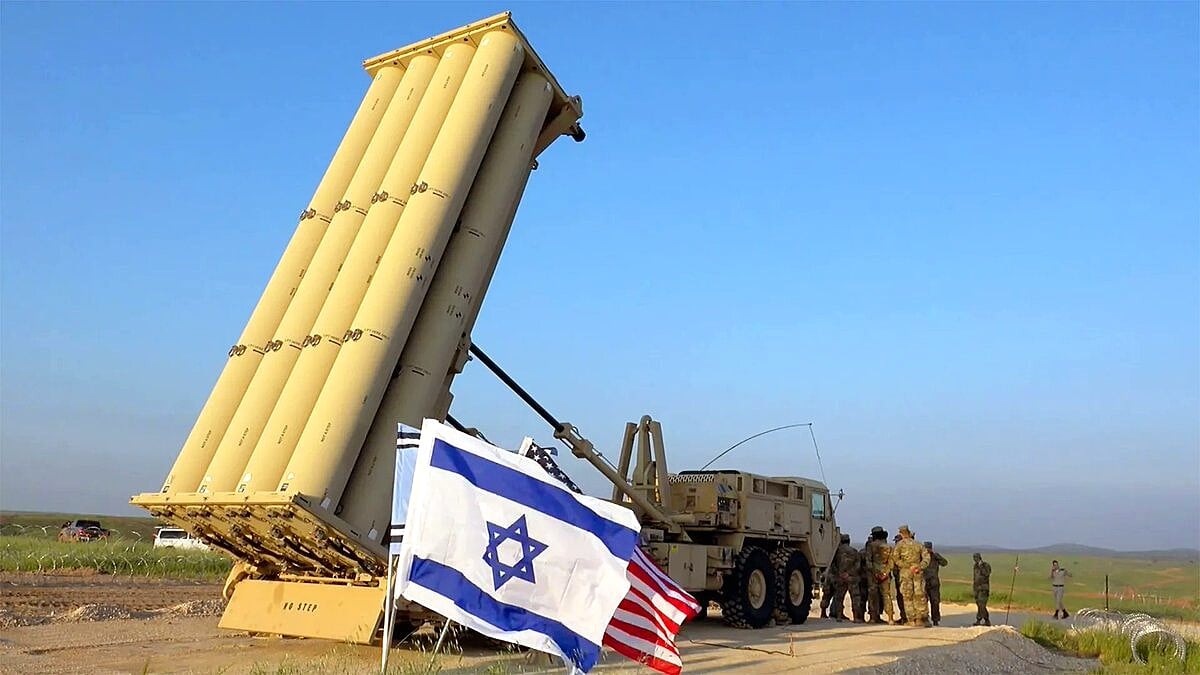
Israeli military sources confirmed that air defense systems, including American-backed THAAD batteries, engaged the incoming projectiles yet failed to intercept at least two missiles.
Footage circulating from the scene shows extensive damage to apartment buildings, with shards of glass and debris littering streets in both desert towns.
Soroka Medical Centre in Beersheba treated 175 wounded individuals from the strikes, hospitalising 36 while 11 remain in serious condition, including a 12-year-old boy and a five-year-old girl.
No damage occurred to the nuclear facility itself, according to the International Atomic Energy Agency, yet the proximity has raised global alarms.
The Terminal High Altitude Area Defense system, known as THAAD and supplied by the United States, formed the core shield for the region.
Marketed by Lockheed Martin as the world’s most advanced terminal-phase interceptor, THAAD employs hit-to-kill kinetic technology to destroy short- and medium-range ballistic missiles at altitudes up to 150 kilometres, even beyond Earth’s atmosphere.
A single THAAD battery costs roughly one billion dollars, operates with about 100 personnel, and covers ranges of 200 kilometres using its powerful AN/TPY-2 radar.
Analysts link the failure to an earlier Iranian success that crippled detection capabilities.
In early March, Iranian forces destroyed a 300-million-dollar AN/TPY-2 THAAD radar at Jordan’s Muwaffaq Salti Air Base, confirmed by commercial satellite imagery showing debris and burn marks around the site.
This loss created a critical gap in the tracking network, allowing subsequent Iranian missiles to exploit blind spots.
Compounding the issue was the overwhelming volume of Iranian firepower, with multiple barrages launched in rapid succession straining allied interceptor supplies to breaking point.
The United States alone expended over 150 THAAD interceptors during prior phases of the conflict, consuming nearly 25 percent of its entire inventory estimated at 534 units.
Each interceptor costs between 12 and 15 million dollars, and current production stands at around 96 units annually, meaning full replenishment could take over a year and billions in funding.
Israeli systems such as Arrow and Iron Dome have faced similar depletion pressures, forcing emergency conservation measures.
In a telling strategic shift, the Pentagon is relocating components of a THAAD battery from South Korea to the Middle East, a move that has unsettled Seoul and weakened Indo-Pacific posture.
This redeployment underscores the finite nature of high-end defenses in prolonged attrition warfare.
Experts highlight that even the most expensive systems cannot sustain endless salvos against an adversary producing missiles at industrial scale.
The economic trap is clear: one THAAD battery alone exceeds one billion dollars, while each failed interception drains resources faster than factories can replace them.
Iran has framed the operation as retaliation for alleged strikes on its Natanz enrichment facility, signaling a new phase where precision defenses meet massed ballistic threats.
Israeli investigations cite a “chain of malfunctions” rather than total system collapse, yet the direct hits near Dimona expose operational limits.
Regional observers note that wars of this nature are increasingly decided on factory floors and stockpiles rather than intercept rates alone.
The breach at Arad and Dimona carries far-reaching consequences for Middle East security dynamics and beyond.
It demonstrates that no shield remains absolute when tested by sustained, high-volume attacks backed by advanced evasion tactics.
As inventories dwindle and redeployments stretch thin, the episode warns of vulnerabilities that could reshape alliances and force costly recalibrations worldwide.