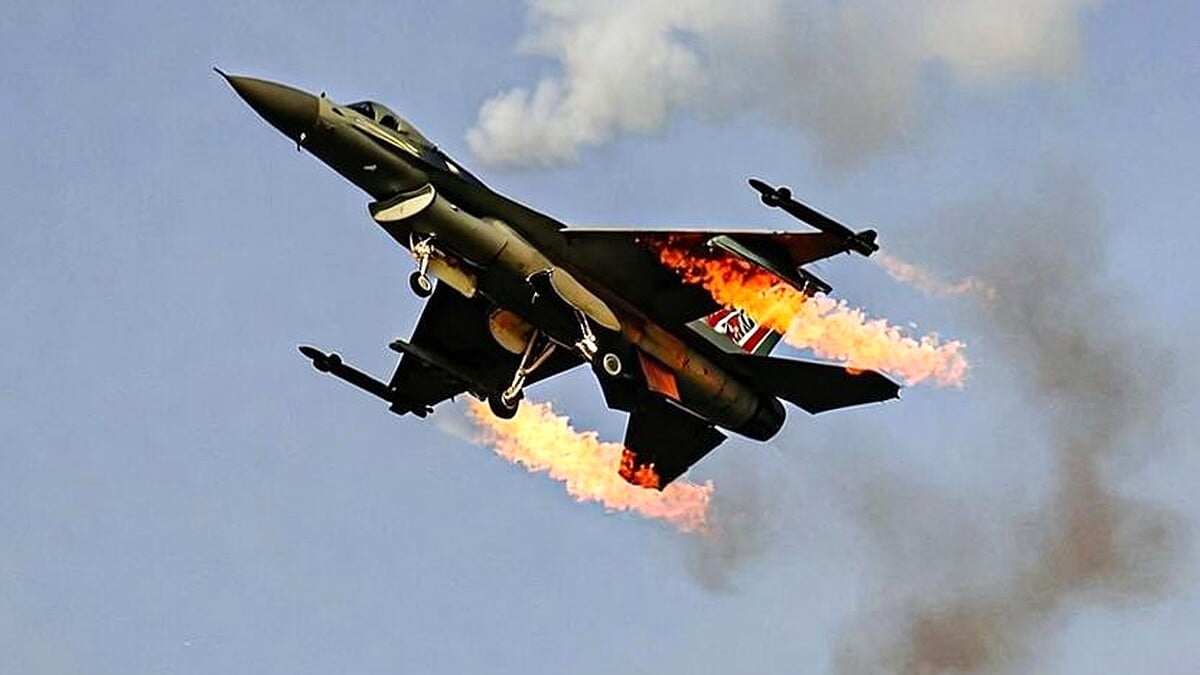




ISLAMABAD: Iran’s Islamic Revolutionary Guard Corps announced on Saturday that its air defence systems struck the third Israeli F-16 fighter jet over central Iran at 3:45 am local time.
The IRGC Public Relations Department issued a brief statement confirming the engagement by the Aerospace Force’s advanced systems. Officials described the aircraft as belonging to the “Israeli regime” and said it was successfully targeted during ongoing operations.
This latest claim emerges against the backdrop of a widening conflict that began in late February 2026. The US-Israeli coalition has conducted over 16,000 strikes on Iranian targets, including airbases, missile facilities and IRGC infrastructure, according to multiple monitoring groups.
Israeli military sources immediately pushed back on the assertion. They acknowledged that one of their aircraft faced surface-to-air missile activity but insisted the F-16 evaded the threat, sustained no damage and completed its mission.
The pattern mirrors earlier IRGC announcements. On March 19, the corps claimed to have “seriously damaged” a US F-35 stealth jet over the same central region. US Central Command confirmed an emergency landing of the fighter but reported the pilot remained safe and denied any shoot-down.
Iran has escalated its responses through successive waves of Operation True Promise 4. The IRGC recently launched its 70th wave, targeting over 55 US and Israeli sites across the region with missiles and drones, including installations in Saudi Arabia, the UAE, Kuwait and Bahrain.
Israeli forces, meanwhile, have systematically degraded Iranian air defences. Confirmed strikes destroyed 16 IRGC Quds Force aircraft at Tehran’s Mehrabad Airport in early March and cratered runways at multiple tactical airbases, including those in Esfahan and Ahvaz.
Satellite imagery analysed by open-source intelligence groups shows extensive damage to underground missile complexes and drone production facilities. The Israeli Air Force has deployed F-16I Sufa variants in heavy strike configurations for deep-penetration missions, supported by more than 550 aerial refuellings.
The IRGC Aerospace Force has highlighted its upgraded systems in recent statements. These include road-mobile launchers and new radar networks designed to counter stealth aircraft, though independent verification of their effectiveness remains limited.
No wreckage images or pilot status reports have surfaced to corroborate the latest claim. Western and Israeli media outlets continue to describe such announcements as part of a broader information campaign amid the fog of war.
Regional analysts note the strategic stakes. Iran maintains one of the largest ballistic missile arsenals in the Middle East, while Israel operates approximately 200 F-16 variants as the backbone of its air superiority.
The conflict has already forced evacuations in several Iranian provinces and prompted heightened alerts across Gulf states. Oil facilities and shipping routes face renewed risks, with insurance premiums for vessels in the area rising sharply.
Pakistan, as a close observer of Middle Eastern developments, has called for de-escalation through diplomatic channels. Officials in Islamabad stress the need to prevent further spillover that could affect energy security and regional stability.
The IRGC statement arrives days after the reported killing of its public relations chief in coalition strikes. Despite such losses, Tehran insists its missile production and defensive capabilities remain intact.
Military experts tracking the exchanges highlight a war of attrition. Iranian claims of downed aircraft aim to project resilience, while Israeli briefings emphasise precision degradation of enemy assets without admitting losses.
As of Saturday evening, neither side has released additional footage or evidence. The absence of neutral confirmation keeps the narrative fluid, typical of high-intensity aerial campaigns.
Further updates will depend on satellite data, pilot debriefs or third-party intelligence. For now, the IRGC’s announcement adds another layer to an already complex battlefield spanning Iranian airspace and beyond.
Iran, Israel, IRGC, F-16