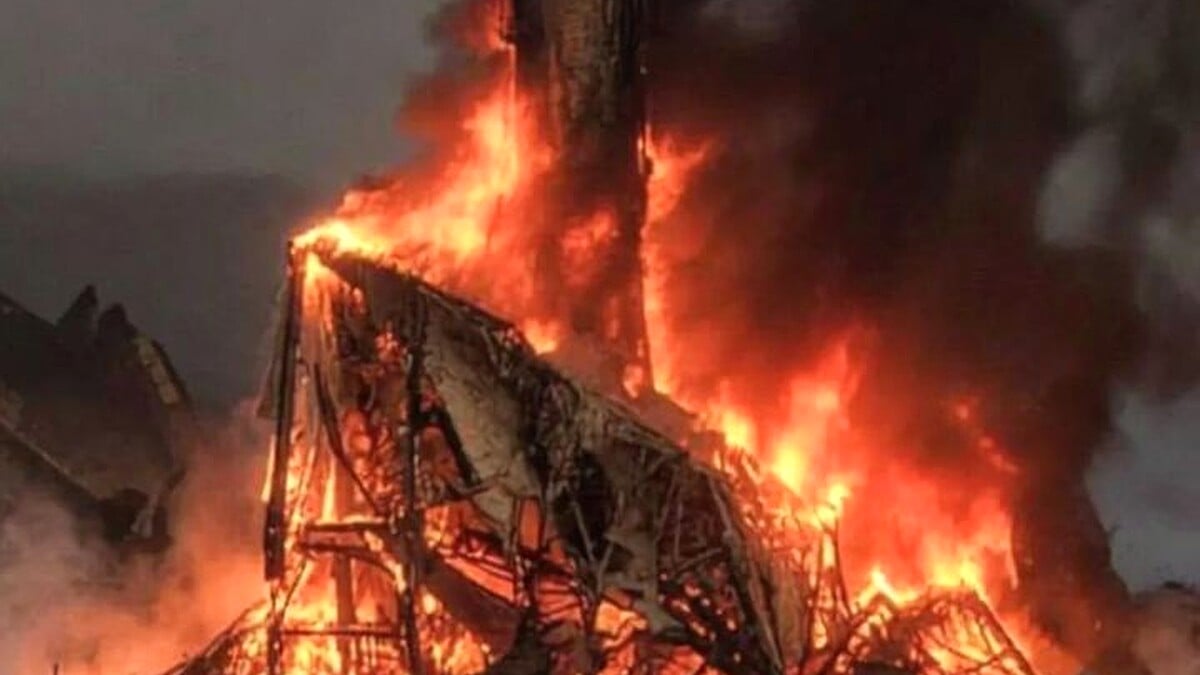




ISLAMABAD: Israeli media outlets have reported that an Iranian missile attack struck the Haifa oil refineries, causing visible damage to the facility in northern Israel on Thursday.
The strike forms part of a rapidly escalating exchange between Iran and Israel that has now entered its third week of direct confrontations.
Iran’s Islamic Revolutionary Guard Corps claimed responsibility, stating that Khaibar Shekan ballistic missiles precisely targeted the site in retaliation for earlier Israeli strikes on Iranian energy infrastructure.
Israeli officials offered a more cautious assessment. The Energy Ministry indicated that the damage was limited and did not significantly disrupt operations, yet local television channels broadcast images of black smoke rising from the Bazan Group complex.
Ynet and Walla news sites confirmed shrapnel impacts and a small fire at the refinery perimeter.
No casualties were reported from the refinery itself, though power outages affected parts of Haifa city following the barrage.
The Bazan refineries represent Israel’s largest oil processing installation. Located in Haifa Bay, the facility holds a daily production capacity of 197,000 barrels, equivalent to roughly 9.8 million tonnes of crude oil annually.
It supplies approximately 60 percent of the country’s diesel and 50 percent of its gasoline for domestic transport needs.
This critical role makes the site a strategic asset whose disruption could ripple through Israel’s fuel supply chain and broader economy.
The attack unfolded as part of Iran’s ninth missile salvo of the day. Iranian state television described the operation as a calibrated response to Israeli bombing of facilities linked to Iran’s South Pars gas field.
That prior strike had already triggered a surge in global oil prices, with Brent crude climbing above 108 dollars per barrel earlier in the week.
Energy analysts warn that repeated targeting of refineries on both sides risks compounding supply uncertainties across the Middle East.
Israeli air defences intercepted most incoming projectiles, yet falling fragments still reached the refinery zone.
The Times of Israel and Haaretz carried live updates showing sirens blaring across northern communities and emergency crews conducting hazardous materials assessments at the site.
Bazan Group, operator of the complex, has not yet issued a detailed statement on production impacts.
Historical context underscores the vulnerability. During a shorter conflict in 2025, similar missile exchanges forced temporary shutdowns at the same facility.
Environmental groups in Haifa have long campaigned for the relocation of the refineries due to pollution concerns and the risk of precisely this type of industrial accident.
The latest incident revives those debates while highlighting the human and ecological stakes in the current war.
From Islamabad’s perspective, Pakistani officials have expressed concern over the widening regional conflict.
Foreign Ministry spokespersons called for immediate de-escalation to prevent further civilian and economic fallout across the Muslim world.
The Haifa strike coincides with heightened alerts in several Gulf states, where energy facilities also remain on high guard.
Global markets reacted swiftly. Shares in Israeli energy firms dipped following the reports, while shipping insurers raised premiums for routes near the conflict zone.
Experts at international think tanks note that sustained attacks on refining capacity could reduce Israel’s fuel self-sufficiency by up to 20 percent in coming months if repairs extend beyond initial estimates.
Iranian media framed the operation as defensive and proportionate.
State outlets emphasised that the missiles struck military-linked energy targets rather than purely civilian areas.
Israeli Prime Minister’s office, however, labelled the barrage as an attempt to terrorise population centres in the north.
The exchange forms the latest chapter in a cycle that began with targeted assassinations and escalated into open missile and drone warfare.
Defence analysts point out that both nations possess advanced precision-strike capabilities, yet neither appears willing to absorb damage without reply.
For Israel, the Haifa refineries symbolise energy independence achieved through decades of investment.
Their partial impairment, even if temporary, tests the resilience of national infrastructure under direct attack.
Repair timelines remain unclear, but preliminary assessments suggest weeks rather than months for full restoration.
Meanwhile, Iran’s oil sector continues to face its own pressures from sanctions and recent Israeli operations.
The tit-for-tat dynamic has already displaced thousands and strained international diplomatic efforts.
United Nations mediators have urged both capitals to exercise restraint before the conflict draws in additional regional actors.
In Haifa, residents reported hearing multiple explosions followed by the acrid smell of burning fuel drifting across the bay.
Local authorities activated emergency protocols, distributing bottled water and advising citizens to remain indoors.
The refinery incident also interrupts ongoing plans to convert the Haifa Bay industrial zone into a greener residential and technology hub by the end of the decade.
Those ambitious redevelopment projects now face fresh uncertainty amid security threats.
Economists project that prolonged energy volatility could shave percentage points off Israel’s GDP growth forecast for the current quarter.
Similar concerns apply to Iran, where export revenues depend heavily on stable production.
As night fell over the Mediterranean coast, Israeli media continued to update footage of containment efforts at the damaged sections.
Firefighting teams worked under floodlights while military drones monitored the airspace above the facility.
The episode underscores a harsh new reality: critical energy nodes have become frontline targets in modern interstate confrontations.
Observers in Islamabad and other capitals watch closely, hoping that cooler heads will prevail before the damage spreads beyond refineries to entire economies.
The coming hours may determine whether this strike marks a peak in hostilities or merely another step in a dangerous spiral.