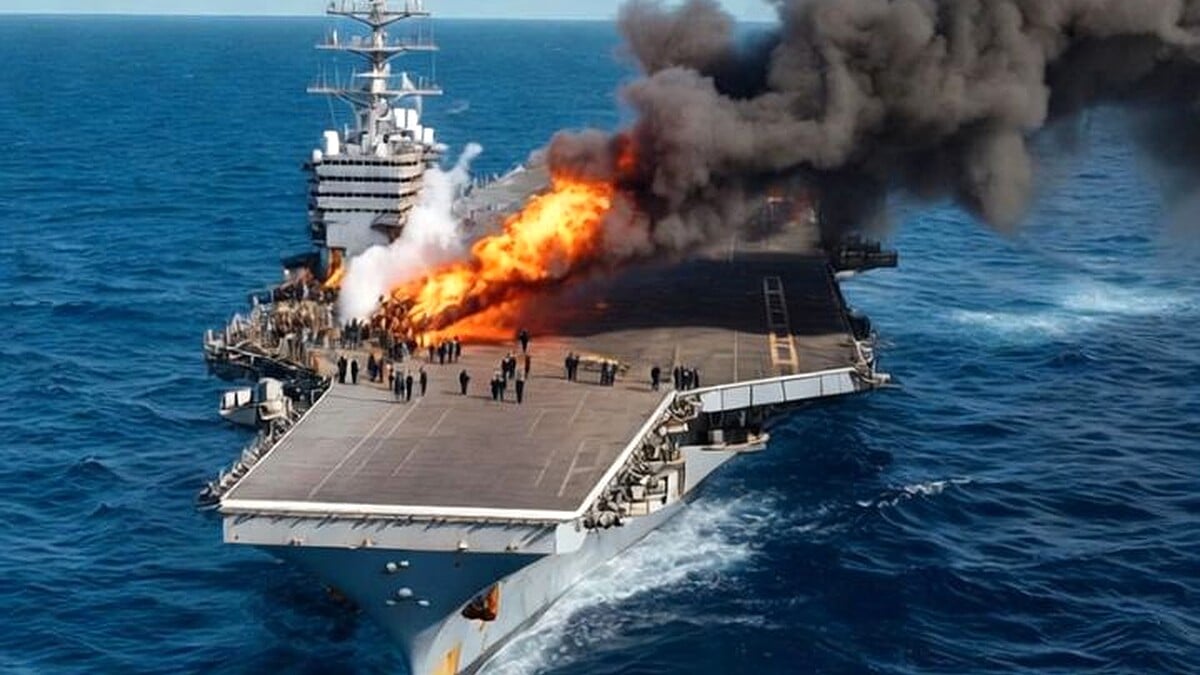




ISLAMABAD: The United States Navy’s USS Gerald R. Ford, the world’s largest aircraft carrier, experienced a non-combat fire on March 12 while operating in the Red Sea, according to an official statement from U.S. Central Command.
The incident occurred in the ship’s main laundry spaces and was quickly brought under control by the crew.
U.S. Central Command confirmed that the fire was unrelated to any combat operations or enemy action.
Two sailors sustained non-life-threatening injuries during the event and are currently receiving medical treatment.
Both injured personnel remain in stable condition, with no further details released on the nature of their injuries.
The carrier continues to function fully, with no reported damage to its propulsion system or nuclear plant.
The USS Gerald R. Ford remains fully operational and is actively supporting ongoing missions in the region.
This marks a minor setback for the vessel amid its high-intensity deployment in support of Operation Epic Fury.
Operation Epic Fury, launched in late February 2026 under presidential directive, targets Iranian regime infrastructure.
The campaign aims to dismantle Iran’s ballistic missile capabilities, naval assets, and other security elements posing threats.
The USS Gerald R. Ford transited the Suez Canal on March 5 and entered the Red Sea shortly after.
Its arrival bolstered U.S. Central Command’s naval presence during escalating confrontations with Iran.
The carrier had previously conducted flight operations from the Eastern Mediterranean Sea.
Aircraft from its deck, including F/A-18 Super Hornets, have participated in strike missions since early March.
The Ford Carrier Strike Group includes escorts such as guided-missile destroyers, enhancing air defense and strike capacity.
The deployment follows a rerouting from other tasks, with expectations of an extended presence potentially lasting until May.
Analysts note the significance of having multiple carrier strike groups in the theater simultaneously.
The fire incident draws attention to operational challenges on advanced platforms during prolonged combat support.
The USS Gerald R. Ford, commissioned in recent years, features cutting-edge technologies including electromagnetic catapults.
Despite innovations, the ship has faced maintenance issues in past deployments, including plumbing and sewage problems.
Those earlier concerns were unrelated to the current laundry fire but highlight the complexities of sustaining such a massive vessel at sea.
Crew members number around 4,000 to 5,000, making rapid response to onboard emergencies critical.
Navy statements emphasize that damage control teams contained the blaze efficiently.
No impact has been reported on flight operations or mission readiness.
The Red Sea location places the carrier near areas previously affected by Houthi attacks on shipping.
However, the Houthis have not claimed responsibility or indicated renewed targeting since the broader conflict intensified.
Iran has enforced stricter maritime controls in the Strait of Hormuz amid the war.
Recent reports indicate Iran has permitted Indian-flagged vessels safe passage through the strait following diplomatic engagements.
This contrasts with broader disruptions affecting global energy routes.
The USS Gerald R. Ford’s role underscores American commitment to projecting power in the Middle East.
Its air wing provides flexible, sea-based options less vulnerable to land-based threats.
The non-combat nature of the fire reassures that no hostile action compromised the platform.
Investigations into the fire’s exact cause are underway, as is standard procedure.
Additional updates are expected from U.S. Naval Forces Central Command.
The incident remains isolated and has not altered the carrier’s operational tempo.
Observers monitor how such events affect long-term deployment sustainability.
The Ford’s presence continues to support coalition efforts in containing regional escalation.
U.S. officials have reiterated the carrier’s full capability despite the brief disruption.
This event occurs against a backdrop of intense military activity in the region.
The focus remains on mission objectives under Operation Epic Fury.