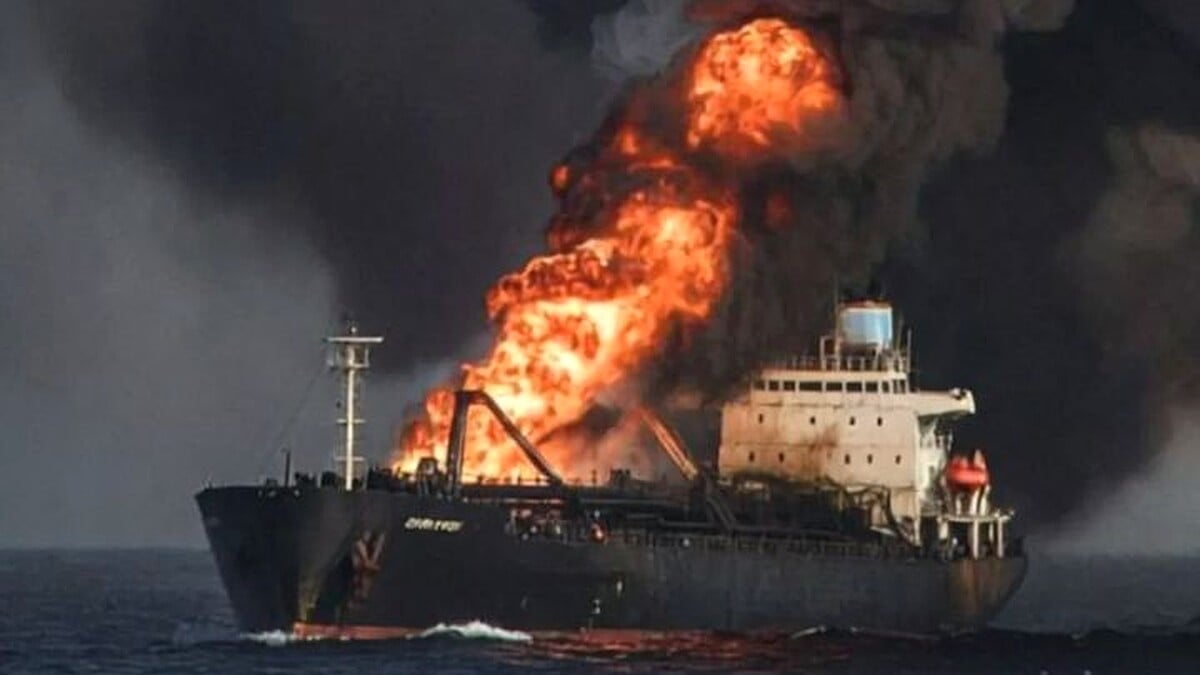




ISLAMABAD: Iran’s Islamic Revolutionary Guard Corps (IRGC) Navy struck a US-owned oil tanker in the northern Persian Gulf on March 11, 2026, triggering a massive fire and claiming one life amid the intensifying conflict with the United States and Israel.
The vessel, identified as the Safesea Vishnu, sailed under the Marshall Islands flag and was reportedly hit after disregarding repeated warnings from the IRGC Navy.
Multiple reports confirmed the attack occurred near Basra, Iraq, in or close to Iraqi territorial waters off Khor Al Zubair port.
The tanker, a crude oil carrier built in 2007 with IMO number 9327009, belonged to US-based Safesea Transport Inc.
Iranian sources described the strike as retaliation, labeling the ship a US asset violating restrictions in the region.
Footage circulating on social media showed the moment of impact, with explosions and flames erupting on the vessel.
The IRGC claimed responsibility, stating the tanker ignored threats and continued its transit.
An underwater drone or explosive-laden “suicide” boat was cited in various accounts as the method of attack.
One Indian national among the crew lost his life in the incident.
The Indian Embassy in Iraq confirmed the fatality, noting the tanker carried a multinational crew including 16 Indians.
Fifteen Indian crew members were evacuated safely following the strike.
The remaining crew, totaling around 28 personnel, were rescued and taken to Basra for medical attention.
This marked a significant escalation in maritime confrontations linked to the broader US-Israel-Iran war.
The attack followed Iran’s warnings that vessels affiliated with the US or its allies faced risks in the Persian Gulf.
Iran has repeatedly threatened to disrupt shipping through the Strait of Hormuz if aggression against its territory continued.
The Safesea Vishnu was reportedly involved in loading or transferring petroleum products, possibly naphtha or crude, from Iraqi sources.
Iraqi authorities suspended operations at key oil terminals and ports after the incident.
At least two tankers caught fire in the assault, including the Maltese-flagged Zefyros alongside the Safesea Vishnu.
Maritime security firms and port officials reported explosive boat attacks in ship-to-ship transfer areas.
This incident formed part of a wave of strikes, with several vessels targeted in the Gulf over recent days.
Analysts noted that such actions aimed to pressure global energy markets and signal Iran’s resolve.
Oil prices showed immediate volatility following reports of the attack.
The Persian Gulf remained a critical chokepoint, carrying about one-fifth of the world’s oil supply.
Previous IRGC actions included drone strikes on other Marshall Islands-flagged tankers in the Strait of Hormuz area.
Those incidents involved vessels like Louise P and others deemed “violating” transit rules.
The current strike shifted focus northward, closer to Iraqi waters.
US officials had not immediately commented on the incident as details emerged.
Independent verification from bodies like the UK Maritime Trade Operations remained limited amid the fog of conflict.
Crew safety and environmental risks from potential oil spills raised international concerns.
The death of the Indian sailor highlighted the human cost to third-country nationals in commercial shipping.
India’s Directorate General of Shipping issued advisories in response.
The event underscored vulnerabilities in global supply chains during geopolitical tensions.
Iran’s parliament speaker issued stark warnings earlier, stating any aggression on Iranian soil would lead to unrestrained responses.
Such rhetoric accompanied military actions targeting perceived adversary assets.
The Safesea Vishnu attack aligned with Iran’s declared policy of treating US-linked vessels as legitimate targets in wartime.
Observers warned of potential further disruptions to energy flows.
The northern Persian Gulf incident added to a series of maritime confrontations since the conflict’s onset.
Shipping companies rerouted vessels or sought enhanced protections in the region.
The IRGC Navy continued patrols, enforcing what it called security measures.
This development intensified calls for de-escalation from regional and global actors.
Yet, tit-for-tat exchanges persisted, raising fears of wider economic fallout.
The strike on the Safesea Vishnu served as a stark reminder of the volatile maritime domain in the Middle East.