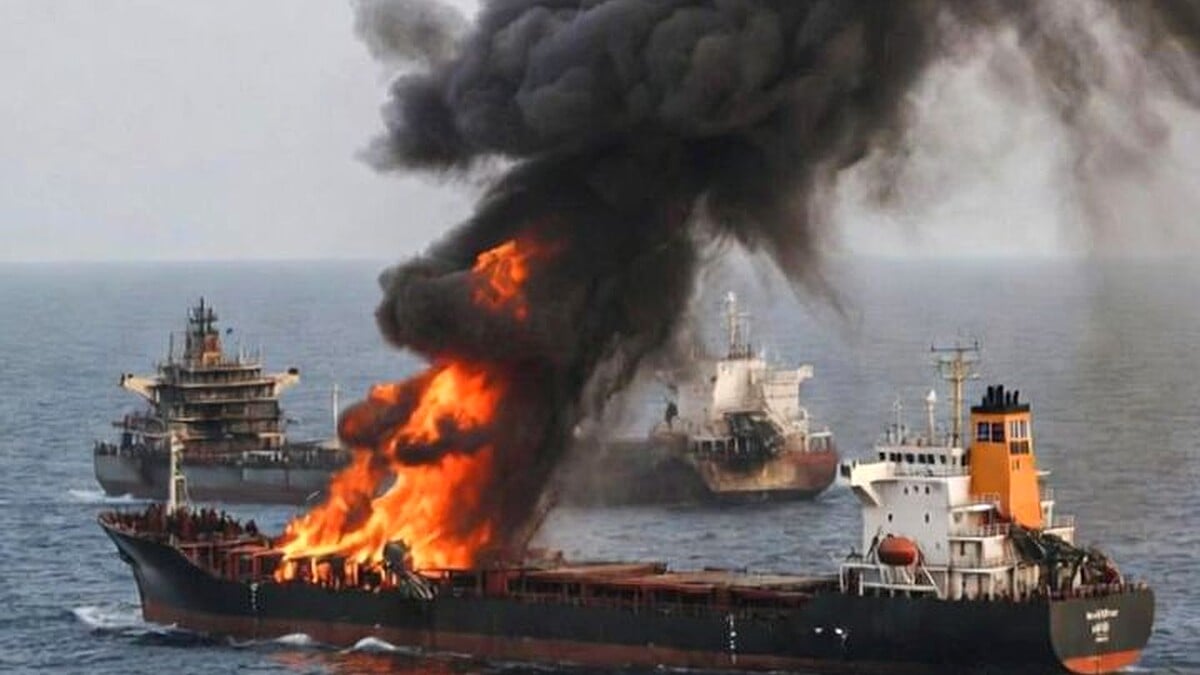




ISLAMABAD: Three cargo vessels came under attack from Iranian Drones and Missiles in and around the Strait of Hormuz on Wednesday, heightening fears over the security of one of the world’s most critical shipping lanes and further choking global energy supplies.
The incidents occurred as the ongoing war between Iran and the US-Israel alliance, now in its second week, has seen intensified retaliatory actions across the Gulf region.
Maritime authorities confirmed that a Thai-flagged bulk carrier, the Mayuree Naree, was hit approximately 11 nautical miles north of Oman, resulting in a fire on board and forcing most of the crew to evacuate.
Thailand’s navy reported providing emergency assistance, rescuing 20 crew members while three remained unaccounted for after the strike caused significant damage to the engine room.
Images released by the Royal Thai Navy showed thick black smoke billowing from the vessel, underscoring the severity of the attack on this neutral commercial ship.
In a separate incident, a Japan-flagged container ship, the One Majesty, sustained minor hull damage, including a 10-centimetre hole, about 46 kilometres off the United Arab Emirates coast near Ras Al Khaimah.
The ship’s operator confirmed no injuries among the crew, and the vessel proceeded to a safe anchorage for assessment.
A third vessel, identified as a bulk carrier under the Marshall Islands flag, was struck roughly 93 kilometres northwest of Dubai, according to the United Kingdom Maritime Trade Operations (UKMTO).
The UKMTO issued urgent advisories urging all ships in the area to transit with extreme caution due to the elevated risks.
These attacks bring the total number of suspected incidents targeting commercial vessels in the Gulf since the conflict began to at least 13 or 14, with many attributed to Iranian forces or proxies.
Iran’s Islamic Revolutionary Guard Corps has claimed some engagements, describing certain ships as legitimate targets linked to adversaries.
The Strait of Hormuz remains a focal point, handling around one-fifth of global oil consumption and substantial liquefied natural gas volumes under normal conditions.
Since the US and Israel launched strikes on Iran on February 28, targeting leadership including Supreme Leader Ali Khamenei and military infrastructure, shipping traffic through the strait has plummeted dramatically.
Timelapse data from marine tracking sources illustrate a near-total collapse, with daily tanker passages dropping from around 37 before the war to virtually zero in recent days.
Over 150 tankers have been observed anchoring in adjacent waters, awaiting safer conditions amid fears of drones, missiles or mines.
This disruption has driven sharp increases in global energy prices, prompting emergency measures by industrialized nations to release strategic reserves.
The United States reported on Tuesday that its forces had eliminated 16 Iranian vessels capable of laying mines near the strait, in a bid to prevent further restrictions on navigation.
US Central Command released footage of the operations, highlighting efforts to keep the waterway viable despite ongoing threats.
Iran has responded with volleys of missiles and drones targeting regional sites, including a major Saudi oilfield and areas near Dubai International Airport, where drones reportedly fell without causing major disruption.
Tehran has declared intentions to prevent oil shipments benefiting adversaries, though it maintains the strait is open except to vessels tied to the US, Israel or their allies.
Analysts note that the attacks on neutral third-party ships, such as those from Thailand and Japan, signal a broadening of economic warfare tactics.
Gulf Arab states, hosting US military assets, have expressed private unease over being drawn into the conflict, with ports, airports and energy facilities now vulnerable.
The escalation follows Iran’s earlier retaliatory strikes across the Gulf, compounding the challenges for international shipping firms that have largely suspended operations in the area.
UKMTO and other security firms continue to monitor the situation closely, warning of persistent threats from projectiles of unknown origin.
As investigations into Wednesday’s incidents proceed, the incidents serve as a stark reminder of the fragility of global energy corridors in times of heightened geopolitical tension.
With traffic effectively halted and risks mounting, the international community faces mounting pressure to de-escalate before broader economic fallout becomes irreversible.