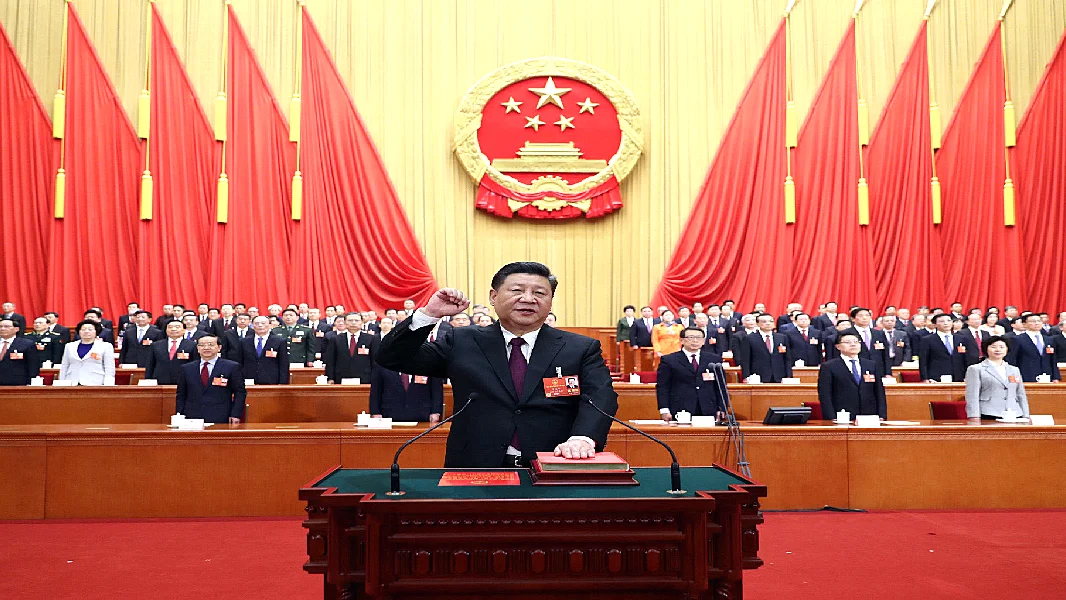




ISLAMABAD: While global attention remains fixed on escalating military tensions in the Middle East and the volatile swings of international energy markets, China has quietly unveiled what analysts describe as the decades defining consequential economic and technological blueprint. It was presented during the annual session of the National People’s Congress on March 5, outlines a sweeping strategy to transform China into the world’s dominant technology power, with artificial intelligence, robotics, quantum communication, and rare earth resource control forming the backbone of its long-term economic vision.
The 141-page document, discussed extensively during the parliamentary meetings in Beijing, represents far more than a conventional economic planning instrument. It lays out an integrated technological transformation strategy designed to reshape China’s industrial structure and accelerate its transition from a manufacturing powerhouse into a global leader in advanced technology and scientific innovation. The plan emphasizes national self-reliance in critical technologies while simultaneously expanding China’s influence across emerging sectors that are expected to define global economic power in the coming decades.
Artificial intelligence occupies a central position in the plan. The document reportedly references AI development more than fifty times, signaling the government’s intention to embed intelligent systems across nearly every segment of the economy. According to official projections, China aims to achieve 70 percent AI integration across major industries by 2027 and increase that penetration to 90 percent by the end of the decade. These targets include applications ranging from manufacturing automation and financial services to urban management, healthcare diagnostics, logistics networks, and defense technology.
Economic planners in Beijing estimate that industries directly linked to artificial intelligence will exceed a total value of 10 trillion yuan, or roughly 1.38 trillion US dollars, within the next several years. Analysts say such projections underscore the scale of China’s ambitions, positioning the country not merely as a participant in the global AI race but as a potential rule-setter shaping how intelligent technologies are deployed worldwide.
Beyond artificial intelligence, the plan places significant emphasis on humanoid robotics as a core industrial pillar. China’s leadership believes robotics will play a transformative role in addressing demographic pressures caused by an aging population while simultaneously boosting productivity in sectors ranging from construction and manufacturing to healthcare and elder care. Officials expect the output of the robotics sector to double within five years, supported by state-backed investment funds, industrial policy incentives, and research collaborations between universities and private technology companies.
The strategy also highlights China’s determination to lead in next-generation communication infrastructure. One of the most ambitious goals outlined in the document involves developing space-to-Earth quantum communication networks capable of providing ultra-secure data transmission resistant to conventional cyber attacks. Chinese scientists have already demonstrated early versions of quantum satellite communication systems, and the new plan envisions expanding those experiments into a global network that could redefine the architecture of secure communications.
Another emerging frontier included in the blueprint is brain-computer interface technology. Researchers working under national research programs are exploring ways to connect neural signals with computing systems to assist individuals suffering from neurological disorders while also opening new possibilities in human-machine interaction. Though still in early experimental stages, Chinese policymakers believe such technologies could become foundational to future medical and industrial applications.
Energy innovation also receives considerable attention. The plan outlines timelines for advancing nuclear fusion research, a field widely regarded as the ultimate solution to sustainable energy generation if technological barriers can be overcome. China has already invested heavily in fusion experiments such as the Experimental Advanced Superconducting Tokamak facility, and the new plan suggests the government intends to accelerate progress toward practical fusion energy systems.
Perhaps the most strategically significant section of the document concerns rare earth resources. China currently dominates the global processing of rare earth elements, accounting for approximately 90 percent of refining capacity worldwide. These materials are essential for modern technology, including electric vehicles, renewable energy systems, precision-guided weapons, smartphones, and advanced semiconductor manufacturing.
Recognizing the geopolitical implications of this dominance, the plan calls for what officials describe as “extraordinary measures” to safeguard China’s position within the rare earth supply chain. These measures include expanding domestic mining operations, increasing refining capacity, and strengthening regulatory oversight over exports to ensure strategic materials remain aligned with national interests.
The importance of rare earth elements extends beyond commercial technology. Advanced defense systems used by many countries depend heavily on these materials for radar systems, aircraft engines, missile guidance mechanisms, and electronic warfare components. For example, modern stealth fighter aircraft and missile defense systems require significant quantities of rare earth magnets and specialized alloys.
By reinforcing control over this critical supply chain, China effectively ensures that it remains a central node in the global technology ecosystem. Industry analysts note that such leverage can influence the pace of technological development across multiple industries, particularly in countries heavily dependent on imported materials for high-tech manufacturing.
China’s comprehensive approach contrasts sharply with narrower policy responses adopted elsewhere. In the United States, the most significant effort to boost domestic semiconductor production came through the CHIPS and Science Act signed in 2022. The legislation allocated approximately 52.7 billion dollars in subsidies and incentives to encourage semiconductor manufacturing within the United States, aiming to reduce dependence on foreign supply chains.
The initiative has already stimulated more than 600 billion dollars in announced private sector investments and created hundreds of thousands of jobs across multiple states. However, economists note that the program primarily addresses one sector of the technological competition, whereas China’s Five-Year Plan attempts to reshape the entire economic ecosystem simultaneously.
Chinese policymakers have historically relied on long-term strategic planning to guide economic transformation. Since the late twentieth century, successive Five-Year Plans have played a critical role in shifting the country from an agrarian economy into the world’s largest manufacturing hub. The 15th plan appears designed to achieve a similar transformation for the digital and technological age.
Observers say the plan reflects a broader philosophy guiding China’s development strategy: long-term technological sovereignty combined with coordinated state support for innovation. By integrating artificial intelligence, robotics, energy research, and supply chain control into a single policy framework, Beijing is attempting to ensure that future technological breakthroughs occur within a domestic ecosystem capable of sustaining them.
If successful, the strategy could significantly reshape the global balance of technological influence over the next decade. Countries that dominate emerging technologies often shape the rules governing international standards, data flows, industrial design, and intellectual property frameworks. China’s new blueprint suggests it intends to play a decisive role in defining those rules.
As geopolitical tensions dominate headlines worldwide, the unveiling of this ambitious economic roadmap may ultimately prove to be one of the most consequential developments of the decade. While military conflicts capture immediate attention, long-term technological strategies frequently determine which nations hold lasting influence over the global economy.
China’s 15th Five-Year Plan therefore represents more than a policy document. It is a declaration that the country intends to shape the technological foundations of the twenty-first century, investing heavily in the industries and scientific breakthroughs that will define economic power in the decades ahead.