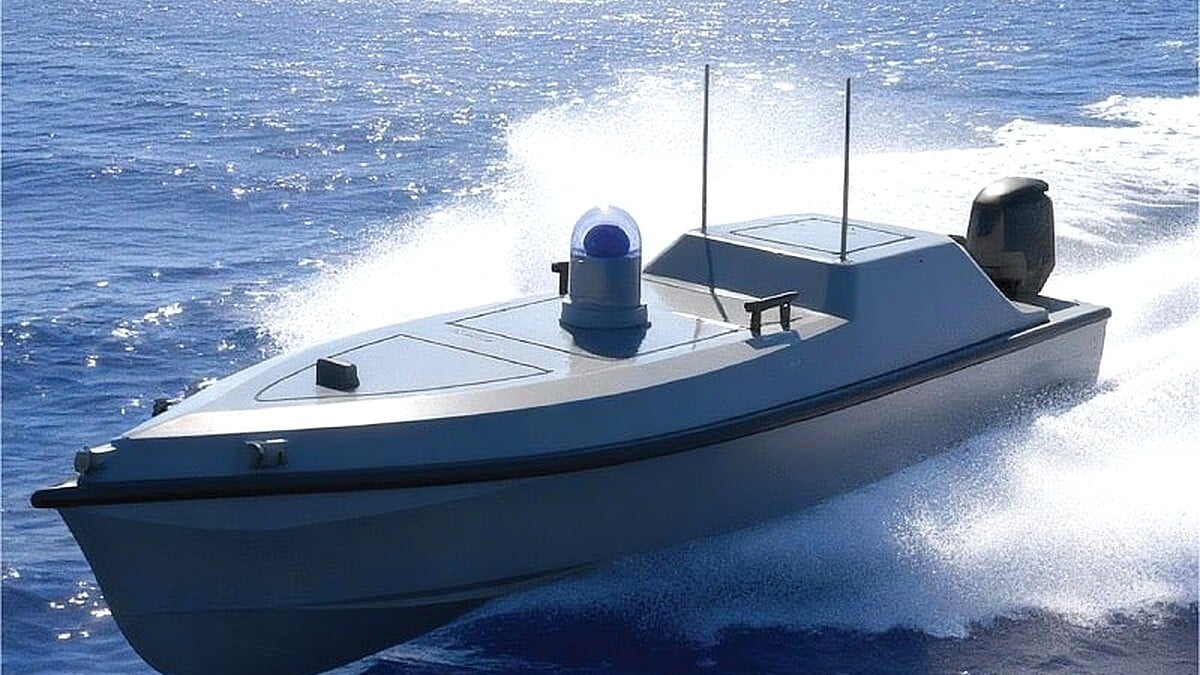




ISLAMABAD: Pakistan’s Stingray Technologies has unveiled an advanced indigenous Unmanned Surface Vehicle (USV), marking a significant step in the country’s push for self-reliant maritime defense technologies.
The platform, introduced at the 2nd Pakistan International Maritime Exhibition and Conference (PIMEC 2025) in Karachi, represents the nation’s first fully homegrown USV. It promises to enhance naval capabilities through autonomy, precision, and adaptability in demanding sea environments.
Defense analysts view this development as part of Pakistan’s broader strategy to integrate unmanned systems into its naval arsenal. The move aligns with global trends where navies increasingly rely on uncrewed vessels for surveillance, reconnaissance, and support roles, reducing risks to human personnel.
The USV measures 25 feet in length and features a fiberglass hull for durability and lightweight performance. Its outboard engine propulsion system supports efficient operation across varied maritime conditions.
Endurance stands at 4 to 5 hours, allowing sustained missions without frequent recovery. The operational range extends between 20 and 30 kilometers, suitable for coastal patrols and near-shore tasks.
Equipped with an electro-optical/infrared (EO/IR) camera suite, the platform delivers real-time situational awareness. Additional sensors such as radar for target detection and LiDAR for obstacle avoidance enable precise navigation and threat identification.
Autonomous operation forms a core strength, requiring minimal human intervention. The system supports precision navigation even in challenging conditions, ensuring stable performance over extended periods.
A modular architecture allows seamless upgrades and payload integration. Operators can configure the vessel for diverse missions, including persistent surveillance, maritime security, or combat support functions.
Reliable real-time control architecture underpins command and data transmission. This ensures secure links between the USV and shore-based or ship-mounted stations during operations.
The unveiling at PIMEC 2025 highlighted Pakistan’s growing defense innovation ecosystem. Stingray Technologies, often linked to entities under the National Engineering and Scientific Commission (NESCOM), positions the platform as a commercial offering rooted in national research efforts.
Subsequent developments have reinforced momentum. In January 2026, the Pakistan Navy conducted successful open-sea trials of an indigenously developed USV, validating high-speed performance, maneuverability, and resilience in rough seas.
These trials assessed the platform as a low-risk, high-impact asset. It offers stealth, agility, and potential as a tactical maritime interceptor for future interdiction and strike-support roles.
Experts note that multiple Pakistani firms, including Stingray Technologies, Beyond Koncept, and others, have showcased USV designs in recent years. This reflects intensified focus on uncrewed maritime systems amid evolving regional security dynamics.
The emphasis on indigenous development addresses supply chain vulnerabilities and fosters technological self-reliance. It complements the Pakistan Navy’s modernization roadmap, which prioritizes asymmetric capabilities in contested waters.
Global parallels exist in the rise of USVs. Conflicts in other regions have demonstrated their value for intelligence gathering, force multiplication, and non-contact warfare.
Pakistan’s entry into this domain strengthens coastal defense and maritime domain awareness. The compact design suits operations in confined areas like the Arabian Sea, where persistent monitoring remains essential.
Further integration of configurable payloads could expand roles. Options for surveillance sensors, communication relays, or even limited armament align with multi-mission flexibility.
Defense observers anticipate iterative improvements. Enhanced endurance, extended range, and advanced AI-driven autonomy may feature in future variants as testing progresses.
The platform underscores private sector contributions to national security. Collaborations between firms like Stingray Technologies and state entities accelerate prototyping and field validation.
This milestone arrives amid regional naval competition. Neighbors invest heavily in unmanned technologies, prompting Pakistan to bolster indigenous responses for strategic balance.
Overall, the USV introduction signals a transformative phase in Pakistan’s maritime posture. It combines compact engineering with advanced features to meet contemporary operational demands.
As trials continue and refinements occur, the system holds potential to redefine patrol and response strategies. It positions Pakistan among nations advancing autonomous naval warfare through homegrown innovation.