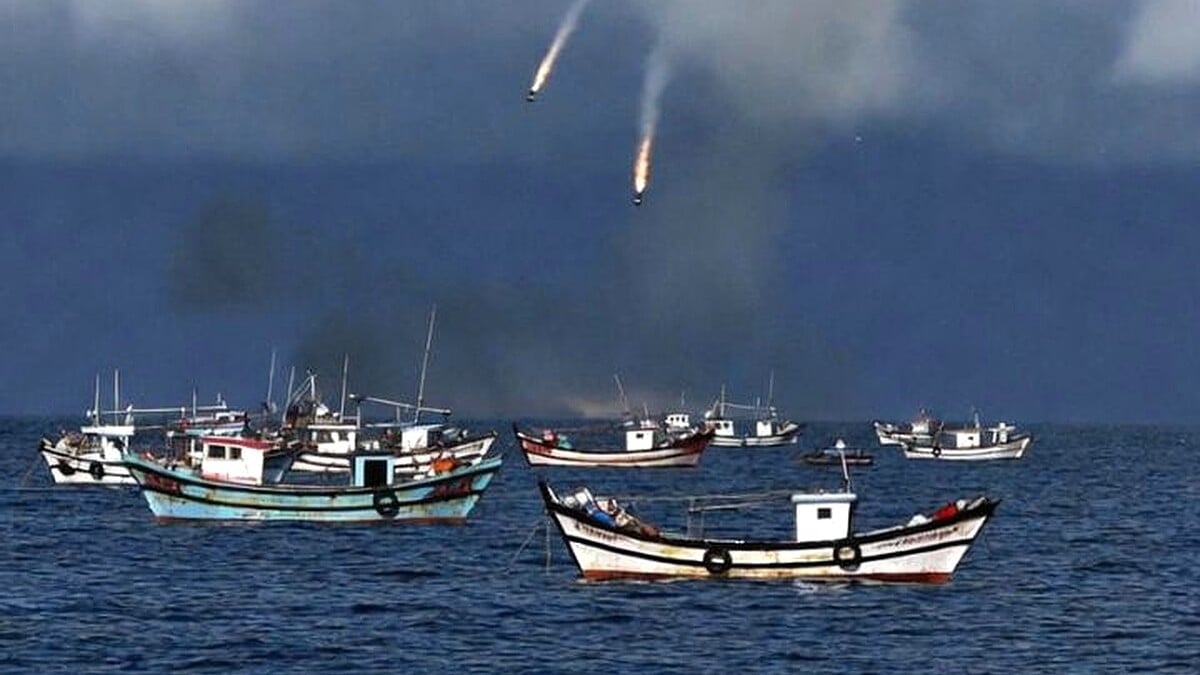




ISLAMABAD: A fisherman from Gwadar lost his life when debris from an Israeli projectile, intercepted by Iranian air defence systems, struck his boat near the Pakistan maritime border.
The incident occurred on Saturday and was confirmed by officials on Sunday. The deceased has been identified as Muhammad Tayyab, a resident of Gannz, a small coastal town in Balochistan’s Gwadar district.
Gwadar Deputy Commissioner Naqibullah Kakar provided details of the tragedy to Dawn. He stated that Tayyab was fishing in Iranian waters close to Pakistani Maritime Border when the mishap took place. According to Kakar, the projectile was likely a drone or missile aimed at targets in Iran’s Sistan-Baluchistan province.
Iranian air defence systems successfully intercepted and destroyed the incoming projectile. However, falling debris from the interception hit Tayyab’s fishing boat, causing fatal injuries that led to his immediate death.
District Police Officer Attaur Rehman also verified the incident. He noted that Tayyab had ventured into Iranian waters for fishing activities, possibly linked to opportunities for Iranian oil-related work or general fishing.
The coastal proximity between Pakistan’s Balochistan and Iran’s Sistan-Baluchistan province often sees shared fishing grounds. Local fishermen frequently cross informal boundaries in search of better catches, exposing them to regional risks.
This event unfolds against the backdrop of heightened military tensions in the Middle East. Since late February 2026, joint US and Israeli strikes have targeted Iranian military and government installations following perceived threats from Iran’s missile and nuclear programs.
Iran has responded with missile and drone attacks on Israeli territory, US bases, and regional allies. The conflict has resulted in significant casualties and damage across multiple countries, with civilian areas occasionally affected by stray munitions or interception fallout.
In recent days, similar debris-related incidents have claimed lives elsewhere in the Gulf region. Reports indicate Pakistani nationals killed in Dubai due to falling debris from aerial interceptions during Iranian retaliatory strikes.
The war has disrupted maritime traffic, energy supplies, and regional stability. Strikes have damaged infrastructure, while retaliatory actions have extended to Gulf states, raising concerns over spillover effects.
Officials in Gwadar emphasized that the fisherman was not involved in any military activity. His death appears to be an unintended consequence of the broader aerial engagements between Israel and Iran.
Kakar suggested that the original target may have been fishing boats or coastal assets in Iran’s Sistan-Baluchistan province. The interception prevented a direct hit but unfortunately scattered debris over nearby waters.
Local authorities recovered Tayyab’s body and informed his family in Gannz. Community members expressed grief over the loss, highlighting the vulnerability of fishermen in contested maritime zones.
The Pakistan government has not issued an official statement on the incident yet. However, such events underscore the need for heightened maritime safety protocols along the Pakistan-Iran border.
Fishermen associations in Balochistan have long called for better coordination with Iranian counterparts to avoid such risks. The porous nature of the sea border complicates enforcement of exclusive economic zones.
Experts point out that ongoing hostilities increase the probability of collateral damage to neutral parties. Intercepted projectiles can produce fragments traveling significant distances, endangering vessels in adjacent waters.
This case adds to a pattern of civilian casualties linked to the conflict. Earlier incidents involved debris striking tankers in Bahrain and vehicles in the UAE, claiming lives including those of foreign workers.
The escalation began with preemptive strikes on February 28, 2026, killing high-profile Iranian figures and prompting widespread retaliation. The cycle of attacks has drawn in multiple actors, complicating de-escalation efforts.
For residents of Gwadar and surrounding areas, the incident serves as a stark reminder of how distant conflicts can directly impact local livelihoods. Fishing remains a primary source of income for many families in the district.
Authorities urged fishermen to exercise caution and adhere to maritime boundaries during periods of regional instability. Enhanced monitoring of air activity could help in issuing timely warnings to seafarers.
The death of Muhammad Tayyab highlights the human cost beyond battlefields. As the Israel-Iran confrontation continues, unintended victims like border fishermen face elevated dangers from modern warfare technologies.
Investigations into the precise origin and trajectory of the projectile remain ongoing. Iranian officials have not commented specifically on this civilian casualty, focusing instead on defending against aggression.
Pakistan’s diplomatic channels may seek clarifications to prevent future recurrences. Ensuring the safety of citizens in shared maritime spaces requires dialogue amid heightened tensions.
The tragedy in Iranian waters near Gwadar adds a poignant chapter to the unfolding regional crisis. It illustrates how interconnected security dynamics affect even the most peripheral communities.