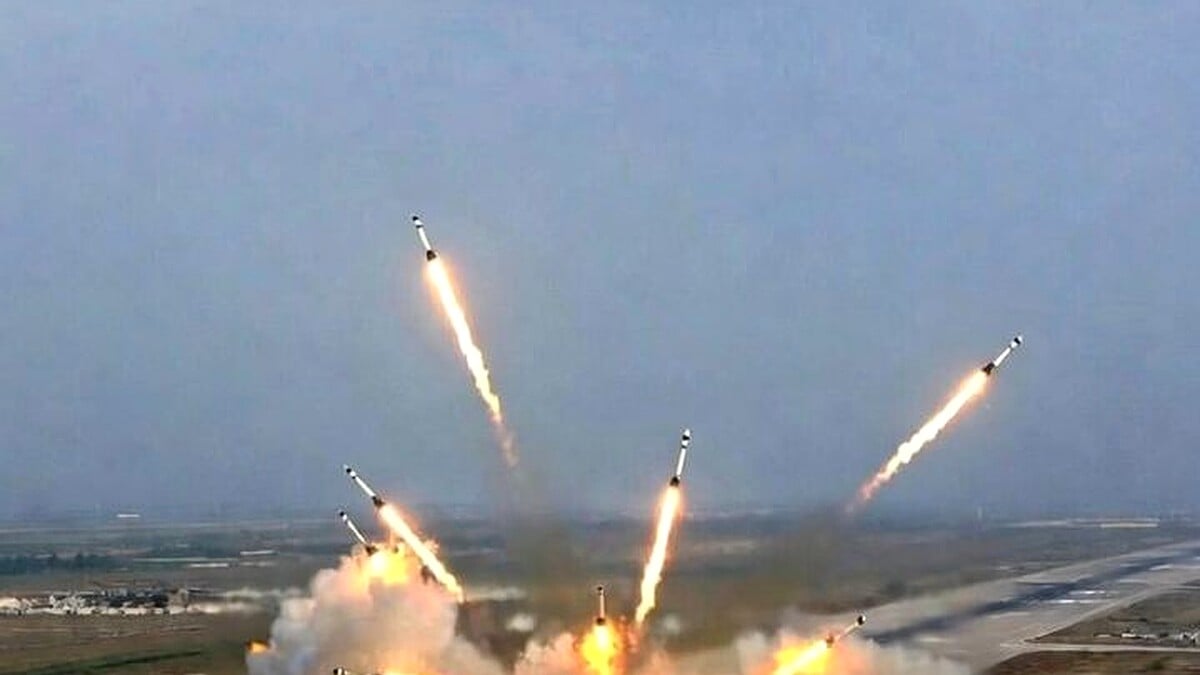




ISLAMABAD: Iran’s Islamic Revolutionary Guard Corps launched a barrage of advanced ballistic missiles targeting Israel’s Ben Gurion International Airport near Tel Aviv in a major escalation of the ongoing conflict between the two nations.
The strike, claimed by the IRGC on Thursday, involved heavy Khorramshahr-4 missiles equipped with one-tonne warheads, aimed at the airport and an adjacent Israeli Air Force base housing the 27th Squadron.
Iranian state-affiliated media described the attack as part of the 19th wave of retaliatory operations, following joint US-Israeli airstrikes on Iranian territory that have intensified over recent weeks.
Israeli sources reported air raid sirens blaring across central regions, including Tel Aviv and surrounding areas, as interceptors from multilayered defense systems engaged incoming projectiles.
Reports from Hebrew media indicated that while some missiles were neutralized, fragments and debris fell near the airport vicinity, with no immediate confirmation of direct structural damage to runways or terminals.
The Ben Gurion facility, Israel’s primary international gateway handling millions of passengers annually, has faced temporary closures and disruptions amid the broader conflict, affecting repatriation flights for stranded citizens.
Military analysts note that the Khorramshahr-4 represents one of Iran’s most capable ballistic systems, with a range exceeding 2,000 kilometers and enhanced accuracy features designed to challenge advanced defenses like Israel’s Iron Dome and Arrow systems.
Previous Iranian salvos in the conflict have included Fattah hypersonic missiles and cluster warhead variants, some of which reportedly penetrated interception layers in populated zones near Tel Aviv.
Casualty figures from the latest barrage remain limited, with Israeli health authorities reporting injuries mostly from shrapnel or panic-related incidents rather than direct hits on civilian infrastructure.
The attack underscores Iran’s strategy of targeting high-value symbolic and logistical assets, aiming to impose economic and psychological pressure amid sustained aerial campaigns against its military and nuclear-related sites.
International observers express concern over the risk of wider regional involvement, as Gulf states host US military assets potentially drawn into defensive roles.
Flight operations at Ben Gurion have been intermittently halted since earlier phases of the escalation, stranding thousands of Israelis abroad and complicating humanitarian corridors.
Iran’s IRGC statement emphasized precision strikes on military-linked facilities at the airport, denying intent to harm civilians while accusing Israel of prior aggression against Iranian leadership and infrastructure.
Israeli officials have maintained a measured response in public statements, focusing on the effectiveness of defensive measures while vowing continued operations to degrade Iran’s missile capabilities.
The conflict’s trajectory has seen missile exchanges accelerate since early 2026, with both sides claiming strategic gains despite mounting costs in resources and international diplomatic isolation.
Experts highlight that repeated attempts to hit Ben Gurion reflect Tehran’s aim to disrupt Israel’s air mobility and global connectivity, a critical vulnerability in prolonged warfare.
No independent verification has fully confirmed the extent of damage at the airport, though satellite imagery and eyewitness accounts suggest scattered impacts in the broader Lod area.
The episode adds to a pattern of tit-for-tat strikes that have reshaped Middle East security dynamics, drawing in proxies and major powers.
Diplomatic channels remain strained, with warnings from regional actors about catastrophic consequences if escalation continues unchecked.
Israel’s multilayered air defense architecture has intercepted the majority of threats in recent waves, though occasional breakthroughs highlight evolving challenges from Iran’s arsenal advancements.
The targeting of Ben Gurion carries significant symbolic weight, given its role as a hub for military resupply and civilian evacuation during crises.
As operations persist, both nations face internal pressures to demonstrate resolve while managing domestic fallout from prolonged hostilities.
The international community continues monitoring closely, urging de-escalation to prevent a broader conflagration.