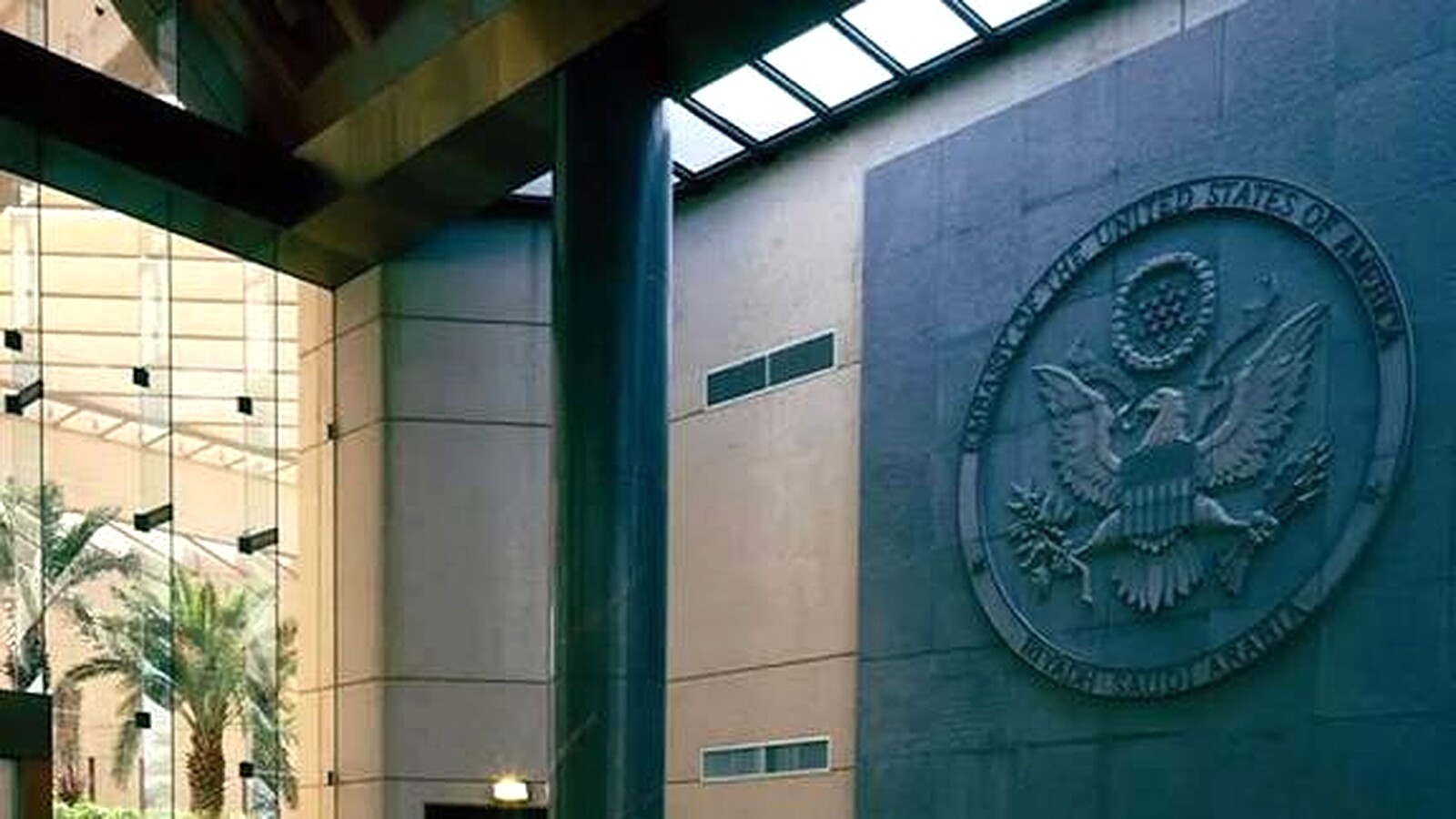




ISLAMABAD: A limited fire broke out at the United States embassy compound in Riyadh early on Tuesday after it was struck by two drones, Saudi officials confirmed, in what appears to be a direct Iranian retaliation amid the intensifying war involving Tehran, Washington and Tel Aviv.
The incident occurred in the Diplomatic Quarter of the Saudi capital, where multiple foreign missions are located. Witnesses reported hearing loud explosions followed by rising smoke and flames visible from the embassy building.
Saudi Arabia’s Ministry of Defense stated that preliminary assessments indicated two drones targeted the facility, resulting in a contained fire and minor material damage to the structure. No injuries were reported among embassy staff or security personnel, according to initial accounts from Saudi and US sources.
The attack unfolded against the backdrop of a broader wave of Iranian missile and drone operations across the Gulf region. These strikes followed coordinated US and Israeli airstrikes on Iranian targets over the weekend, which reportedly resulted in the death of Iran’s Supreme Leader Ayatollah Ali Khamenei and other senior figures.
Iran’s Islamic Revolutionary Guard Corps has claimed responsibility for targeting American interests in response to what Tehran describes as aggressive actions against its sovereignty. The IRGC announced efforts to strike US political and military centres in the region as part of its defensive posture.
Saudi air defence systems intercepted several incoming projectiles in the vicinity of Riyadh, including four drones over the diplomatic area, a military spokesperson noted. One or more evaded interception and impacted near or on the US embassy premises.
The US Mission in Saudi Arabia issued an immediate shelter-in-place advisory for American citizens in Riyadh, Jeddah and Dhahran. It also restricted non-essential travel to military installations across the kingdom, reflecting heightened security concerns.
The State Department has urged US nationals to depart from multiple Middle Eastern countries, citing risks from the expanding conflict. Evacuation notices now cover over a dozen nations, including those not directly involved in hostilities.
This marks one of the first direct hits on a US diplomatic facility in the current escalation. Previous Iranian operations focused primarily on military bases, such as those in Saudi Arabia’s Eastern Province and other Gulf locations.
The embassy in Riyadh, a key hub for US-Saudi diplomatic and security coordination, was reportedly operating with reduced staff at the time due to prior alerts. The compound sustained damage to its roof and perimeter areas, though structural integrity remained intact.
Regional analysts point to Iran’s use of advanced drones capable of long-range strikes, demonstrating Tehran’s ability to project power beyond its borders despite recent losses in missile stockpiles from US-Israeli operations.
Saudi Arabia condemned the attack as a violation of its sovereignty and warned of potential retaliatory measures. Officials emphasised the kingdom’s commitment to defending its territory and allies against external aggression.
The incident has further disrupted regional stability, with airspace closures persisting across the Gulf and energy infrastructure facing intermittent threats. A separate drone strike targeted Saudi Arabia’s Ras Tanura oil refinery, though defences neutralised the threat without major disruption.
Global energy markets reacted sharply to the news, with oil prices climbing amid fears of prolonged supply interruptions. Analysts estimate that sustained conflict could affect up to several million barrels per day in production capacity.
The US administration, under President Donald Trump, has indicated that military operations against Iran are expected to continue for weeks, potentially intensifying. Trump has not ruled out additional measures, including ground involvement if deemed necessary.
Iranian officials have vowed to defend their interests vigorously, while proxies in the region have issued threats against US positions in neighbouring countries.
The fire at the embassy was quickly brought under control by Saudi emergency services, with fire trucks deployed promptly to the scene. Embassy personnel were evacuated as a precaution during the response.
This development underscores the challenges in containing the conflict to specific theatres. What began as targeted strikes has now engulfed diplomatic assets in allied nations, raising alarms about broader international involvement.
Diplomatic efforts to de-escalate remain stalled, with no immediate signs of mediation from major powers. The United Nations Security Council has convened emergency sessions, but divisions among permanent members hinder unified action.
As the situation evolves, security forces in Riyadh maintain high alert, with additional patrols around diplomatic zones. Residents in the capital reported disrupted daily life due to sirens and airspace restrictions.
The episode highlights the fragile balance in the Gulf, where US alliances face direct challenges from Iranian asymmetric capabilities. Future responses from Washington and Riyadh could determine whether the conflict spirals further or finds a containment path.