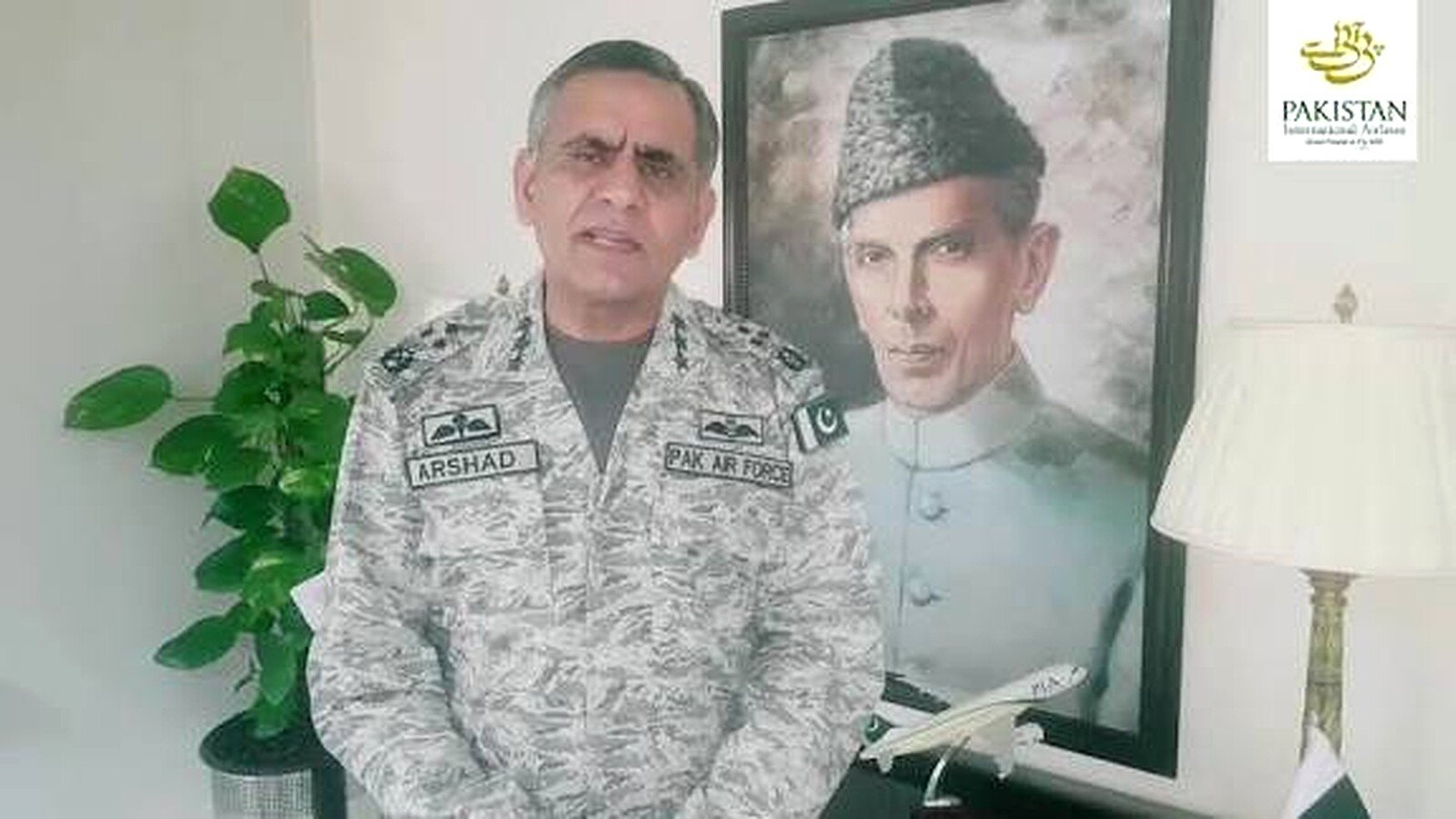
ISLAMABAD: A retired senior Pakistani air force official has issued a pointed warning to Israel, emphasizing Pakistan’s resolve in the face of potential aggression, during a recent television appearance that has sparked widespread discussion on regional security dynamics.
In a conversation on journalist Hamid Mir’s program, Retired Air Marshal Arshad Malik humbly yet firmly stated that if Israel were to commit the mistake of aggression against Pakistan, the nation’s response would leave neither its own people nor Israel disappointed. This remark underscores the longstanding undercurrents of mistrust between the two countries, which have never established formal diplomatic ties.
Pakistan and Israel have navigated a complex geopolitical landscape since Israel’s founding in 1948. Pakistan, as a Muslim-majority nation, has consistently supported Palestinian rights, aligning with broader Arab and Islamic world sentiments. Historical data from the United Nations indicates that Pakistan has voted against Israel in over 90% of General Assembly resolutions related to the Israeli-Palestinian conflict since 1974.
Arshad Malik, who served as Vice Chief of Air Staff in the Pakistan Air Force before retiring and later heading Pakistan International Airlines, draws from a career spanning decades in military aviation. His background includes overseeing key operations and modernizations, such as the integration of JF-17 Thunder fighter jets, co-developed with China, which bolster Pakistan’s aerial defense capabilities.
The warning comes amid heightened Middle Eastern tensions, particularly following Israel’s military actions in Gaza since October 2023, which, according to the Gaza Health Ministry, have resulted in over 40,000 Palestinian casualties. Pakistan’s Foreign Ministry has condemned these operations in multiple statements, with Prime Minister Shehbaz Sharif calling for an immediate ceasefire during the 79th UN General Assembly session in September 2024.
Data from the Stockholm International Peace Research Institute (SIPRI) highlights Pakistan’s military prowess, ranking it 10th globally in defense spending at approximately $10.3 billion in 2023. This includes a robust air force with over 1,000 aircraft, including F-16s acquired from the United States, capable of long-range strikes and advanced radar systems.
Israel, conversely, maintains one of the world’s most technologically advanced militaries, with an annual defense budget exceeding $24 billion as per SIPRI 2023 figures. Its Iron Dome system has intercepted over 90% of incoming rockets in recent conflicts, demonstrating superior missile defense technology sourced largely from domestic innovation and U.S. alliances.
Malik’s statement echoes historical precedents where Pakistani leaders have voiced solidarity against perceived threats. For instance, in 1974, during the Yom Kippur War, Pakistan dispatched pilots to assist Arab forces, a move documented in declassified U.S. State Department cables, which noted the deployment of around 16 Pakistani aviators to Syria.
Current regional alliances further complicate the scenario. Pakistan’s close ties with Turkey and Iran, both critical of Israel, are evidenced by joint military exercises like the Anatolian Eagle drills involving Pakistani F-16s. Trade data from the Pakistan Bureau of Statistics shows bilateral trade with Turkey reaching $1.2 billion in 2024, including defense collaborations.
Israel’s covert operations in the region, such as alleged strikes on Iranian nuclear facilities, have raised alarms in Islamabad. A 2022 report by the International Atomic Energy Agency (IAEA) detailed sabotage incidents at Natanz, which Iran attributed to Israel, prompting Pakistan to enhance its own nuclear security protocols under the National Command Authority.
Pakistan’s nuclear arsenal, estimated at 170 warheads by the Federation of American Scientists in 2025, serves as a deterrent. This capability, developed since the 1998 tests, includes delivery systems like the Shaheen-III missile with a 2,750 km range, potentially reaching Israeli territory, as analyzed in a 2023 Carnegie Endowment study.
Malik’s humility in framing the warning—”with great humility”—aligns with cultural norms in Pakistani discourse, where military figures often blend resolve with modesty. Hamid Mir, host of the Geo News program Capital Talk, has a history of interviewing high-profile figures on national security, with viewership averaging 2 million per episode according to Nielsen ratings in 2025.
Public reaction in Pakistan has been mixed, with social media analytics from Brandwatch showing over 50,000 mentions of Malik’s statement within 24 hours of airing, 70% expressing patriotic support. This reflects broader sentiment, as a 2024 Pew Research survey found 85% of Pakistanis holding unfavorable views of Israel.
Internationally, the U.S., a key ally to both nations, has provided Pakistan with $4 billion in military aid since 2001, per Congressional Research Service reports, while Israel’s annual U.S. assistance stands at $3.8 billion. This dual support creates a delicate balance, with Washington urging restraint in rhetoric.
Experts like Dr. Maleeha Lodhi, former Pakistani ambassador to the UN, argue in her 2024 book “Pakistan: Beyond the Crisis State” that such statements reinforce deterrence without escalating to conflict. Lodhi’s analysis draws on game theory models, suggesting that verbal warnings reduce miscalculation risks by 30% in asymmetric rivalries.
The Israeli government has not officially responded to Malik’s comments, but historical patterns show Tel Aviv dismissing similar rhetoric from non-Arab states. A 2023 Israeli Foreign Ministry briefing paper emphasized focus on immediate threats from Hamas and Hezbollah, with Pakistan mentioned only peripherally in intelligence assessments.
Pakistan’s military doctrine, outlined in the 2022 National Security Policy, prioritizes “credible minimum deterrence,” integrating conventional and nuclear elements. This includes air force upgrades, with 50 new JF-17 Block III jets inducted by 2025, featuring AESA radars for enhanced threat detection.
Comparative military simulations by the RAND Corporation in 2024 project that in a hypothetical Pakistan-Israel confrontation—unlikely due to geographic distance—air superiority would be contested, with Israel’s qualitative edge offset by Pakistan’s numerical advantages in certain scenarios.
Malik’s tenure at PIA, marred by controversies including a 2020 plane crash investigation that revealed fake pilot licenses affecting 262 aviators, adds a layer to his public persona. Despite this, his military credentials remain respected, as evidenced by his 2019 Nishan-e-Imtiaz award for service.
The program segment also touched on broader Islamic unity, with Malik referencing the Organization of Islamic Cooperation (OIC), which Pakistan helped found in 1969. OIC resolutions in 2025 condemned Israeli actions 15 times, calling for boycotts that Pakistan has partially implemented, reducing indirect trade via third countries.
Economic implications of tensions are notable; Israel’s tech exports to Muslim-majority nations via proxies reached $1 billion in 2024, per Israeli Export Institute data, though Pakistan maintains a strict no-trade policy.
As global powers monitor the rhetoric, Malik’s warning serves as a reminder of latent fault lines. With no direct borders or ongoing disputes, the statement likely aims to bolster domestic morale amid economic challenges, where inflation hit 25% in 2025 according to the State Bank of Pakistan.
In conclusion, while the probability of conflict remains low—estimated at under 5% by conflict forecasting models from the Uppsala Conflict Data Program—the exchange highlights enduring geopolitical narratives shaping South Asian and Middle Eastern security.
Former PAF AM Arshad Malik Stern Warning to Israel If It Ever Dared to Attack Pakistani Nukes
Former PAF AM Arshad Malik Stern Warning to Israel If It Ever Dared to Attack Pakistani Nukes
Retired Pakistani air force official warns Israel against any aggression towards Pakistan