



ISLAMABAD: The United States Embassy in Islamabad has issued a formal security alert to American citizens residing in or visiting Pakistan, urging heightened vigilance amid widespread demonstrations triggered by the killing of Iran’s Supreme Leader Ayatollah Ali Khamenei.
The alert follows violent protests across Pakistan, particularly in major cities, where crowds expressed outrage over the joint US-Israeli military operation that resulted in Khamenei’s death on February 28, 2026.
Khamenei, aged 86, had ruled Iran as Supreme Leader since 1989, succeeding Ayatollah Ruhollah Khomeini and shaping the Islamic Republic’s hardline policies for nearly four decades.
Iranian state media confirmed his martyrdom in strikes targeting his compound in Tehran, describing the attack as a criminal act by the United States and Israel.
The incident has escalated regional tensions, with Iran announcing 40 days of national mourning and vows of retaliation from its officials.
In Pakistan, where a significant Shia population holds reverence for Iran’s leadership, news of Khamenei’s death sparked immediate public reaction.
Protests began Saturday evening and intensified on Sunday, with demonstrators condemning US involvement and chanting anti-American and anti-Israel slogans.
The most severe violence occurred in Karachi, where hundreds attempted to storm the US Consulate General.
Clashes with police and security forces left at least nine protesters dead and dozens wounded, according to local authorities and hospital officials.
Witnesses reported barricades breached, windows smashed, and parts of the compound set ablaze before forces regained control.
Similar unrest unfolded in Lahore, with repeated rallies near the US Consulate leading to police intervention using tear gas.
In Islamabad, hundreds of Shia protesters marched toward the Diplomatic Enclave housing the US Embassy, prompting baton charges and tear gas deployment by police.
Additional demonstrations were reported or planned in Peshawar and northern areas such as Gilgit-Baltistan.
Pakistan’s Interior Minister appealed for calm, acknowledging shared grief among citizens over Khamenei’s martyrdom while urging restraint to prevent further escalation.
The government has reinforced security around US diplomatic missions nationwide to avert additional breaches.
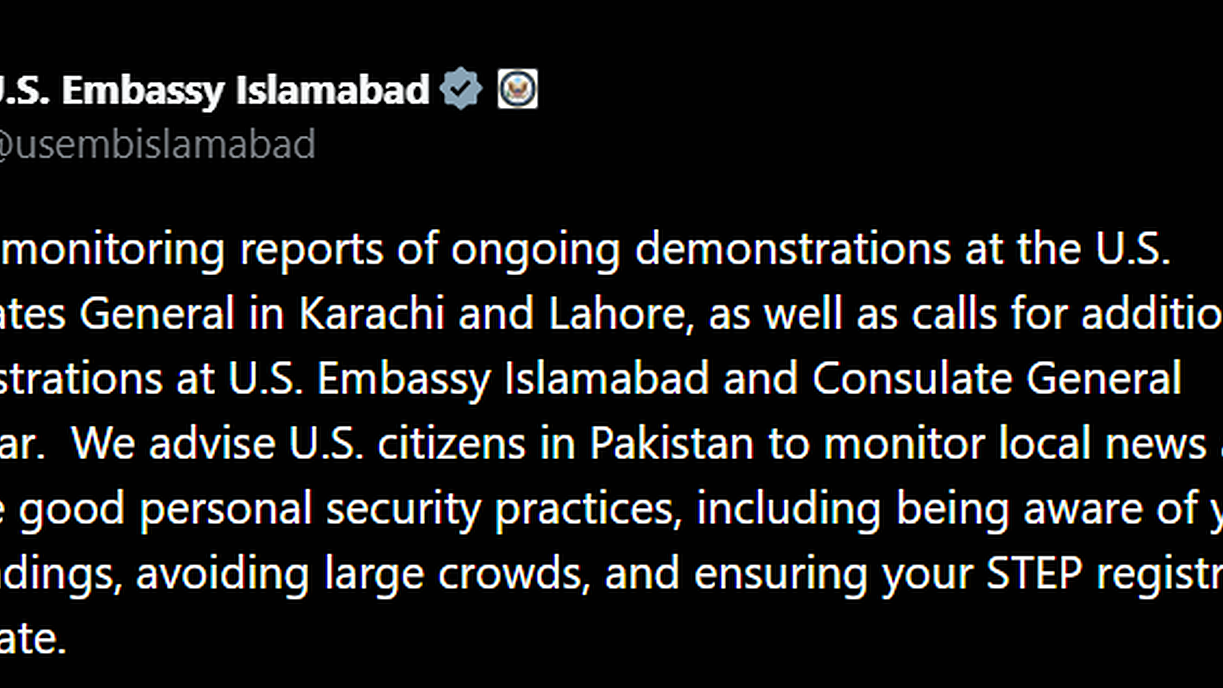
The US Embassy’s alert, posted on its official channels, stated it was closely monitoring demonstrations at consulates in Karachi and Lahore, as well as potential gatherings near the Islamabad embassy and Peshawar consulate.
It advised American citizens to stay informed through local media, remain aware of surroundings, avoid large crowds and demonstrations, and update their registrations with the Smart Traveler Enrollment Program.
US government personnel faced movement restrictions until further notice.
All visa and American Citizen Services appointments at the embassy were cancelled for March 2 due to the security environment.
Analysts note that Pakistan’s response reflects its delicate balancing act in foreign policy.
The country maintains close ties with both the United States, a key economic and security partner, and Iran, a neighbor with deep cultural and religious links for its Shia minority.
Previous episodes of unrest over Middle East events have occasionally strained these relations.
The killing of Khamenei represents a pivotal shift in the Middle East’s power dynamics.
Having led Iran through conflicts including proxy engagements in Syria, Yemen, and Lebanon, he oversaw nuclear advancements and resisted Western sanctions.
His death in a direct military strike has raised questions about Iran’s succession process and potential for internal instability.
An interim leadership arrangement has been reported, but the long-term implications remain uncertain amid ongoing hostilities.
In Pakistan, the protests highlight the transnational impact of the Iran crisis.
Shia communities, comprising around 15-20 percent of the population, have historically observed Iranian events with solidarity.
Authorities fear prolonged demonstrations could evolve into broader civil disturbances if regional conflict intensifies.
The US Embassy’s caution underscores concerns for expatriate safety in an already volatile period.
Citizens have been reminded that large public gatherings pose risks of sudden violence or security crackdowns.
The situation continues to develop, with calls for protests potentially spreading further.
Pakistan’s law enforcement remains on high alert to maintain order while diplomatic channels address the fallout.
The episode serves as a stark reminder of how distant geopolitical actions can rapidly reverberate in allied nations.