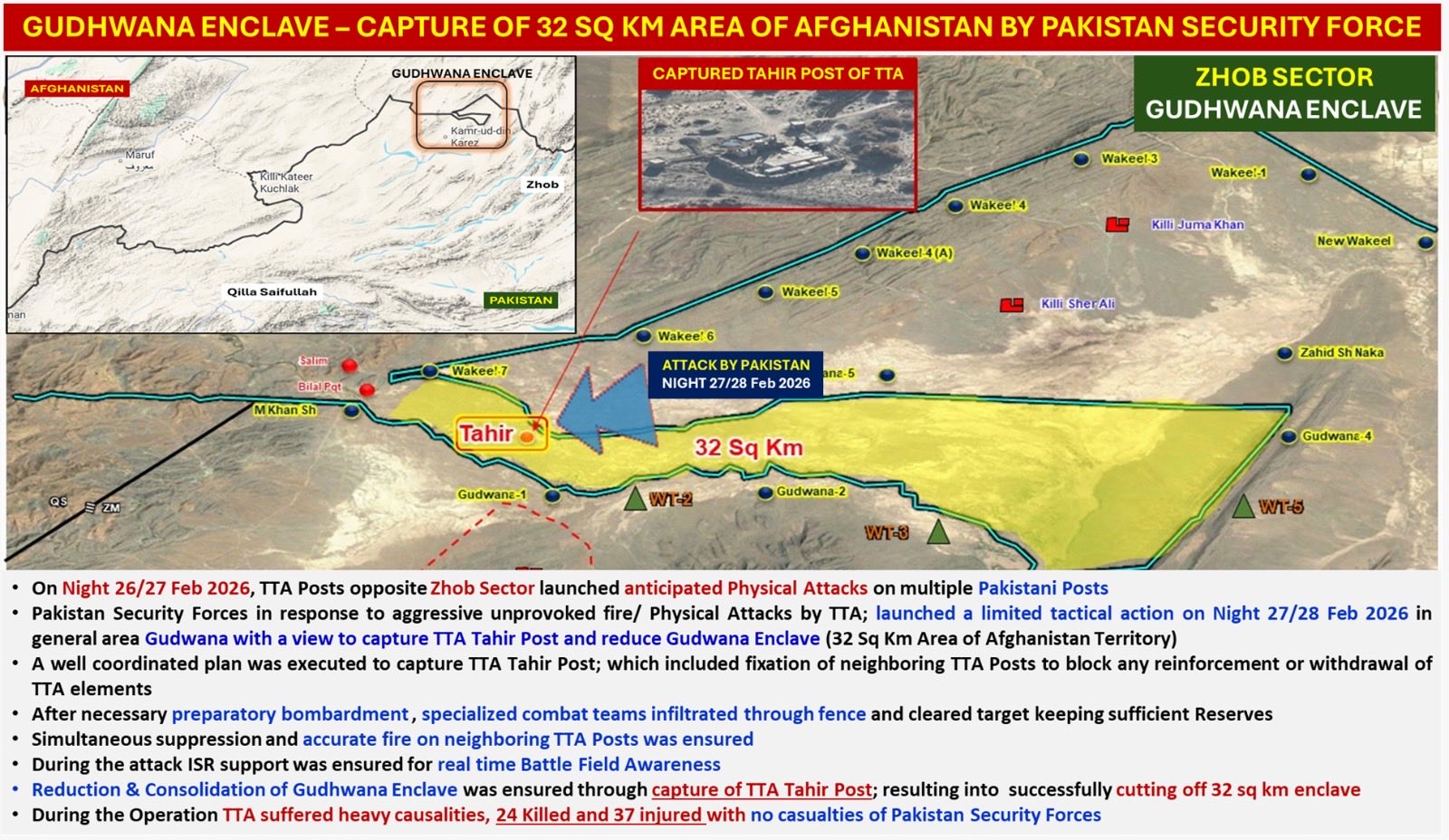




ISLAMABAD: Pakistan has reportedly captured approximately 32 square kilometers of Afghan territory near the Chaman border crossing amid escalating cross-border clashes with Taliban forces.
The development marks a significant escalation in the long-standing tensions along the Durand Line, the disputed 2,640-kilometer frontier between the two nations. Pakistani security sources indicate the move came as part of defensive operations following repeated Afghan incursions and militant attacks originating from across the border.
The Chaman-Spin Boldak crossing, a vital trade route linking Balochistan province in Pakistan to southern Afghanistan, has been at the epicenter of recent violence. Overnight exchanges of fire, artillery barrages, and airstrikes have intensified since late February 2026, with both sides accusing each other of initiating hostilities.
Pakistan’s military actions reportedly targeted Taliban military installations, training camps, and outposts believed to harbor Tehrik-i-Taliban Pakistan (TTP) militants. Officials in Islamabad claim these operations neutralized threats responsible for attacks inside Pakistani territory, including bombings in urban centers and assaults on border posts.
In response, Afghan Taliban spokespersons have denied territorial losses on such a scale and countered with claims of capturing multiple Pakistani outposts along various sectors of the border. They reported inflicting heavy casualties on Pakistani forces, including dozens of soldiers killed or taken captive during ground engagements.
The reported 32 square kilometers capture near Chaman appears linked to operations securing strategic high ground or forward positions previously used for cross-border firing. Satellite imagery and local reports suggest shifts in control around disputed areas where the incomplete border fence has left vulnerabilities.
Pakistan has long accused the Afghan Taliban government of providing safe havens to TTP fighters, who have escalated attacks since the Taliban’s return to power in Kabul in 2021. Islamabad points to a surge in militant incidents in Khyber Pakhtunkhwa and Balochistan as justification for preemptive strikes.
The Durand Line, drawn in 1893 by British colonial authorities, remains unrecognized by Afghanistan, which views it as an artificial division separating Pashtun communities. This historical dispute has fueled periodic skirmishes, but the current intensity surpasses many previous incidents.
Recent clashes have disrupted cross-border trade, with the Friendship Gate at Chaman remaining closed for extended periods. Thousands of Afghan refugees and traders have been stranded, exacerbating humanitarian concerns in the region.
Pakistan’s Defence Minister has described the situation as an “open war,” emphasizing the need to defend national sovereignty against what Islamabad terms unprovoked aggression. Military spokespersons released footage showing Pakistani forces at forward positions, including one instance of raising the national flag at a captured Taliban outpost.
Afghan officials, meanwhile, have condemned the incursions as violations of sovereignty and reported civilian casualties from Pakistani airstrikes in provinces such as Kandahar, Paktia, and even the capital Kabul. The United Nations has expressed concern over the impact on civilians caught in the crossfire.
International reactions have included calls for restraint from regional powers and mediation efforts through channels like Qatar and Turkey. Russia has reportedly warned both sides against further escalation, citing risks to regional stability.
The border fencing project, initiated by Pakistan years ago to curb militant movement and smuggling, has been a flashpoint. Taliban forces have opposed it, viewing the barrier as an attempt to legitimize the Durand Line unilaterally.
Analysts note that the latest developments could prolong instability, with potential for broader involvement if militant groups exploit the chaos. The TTP’s continued operations from Afghan soil remain a core grievance for Pakistan, driving the cycle of retaliation.
Local residents in Chaman report heightened fears, with markets deserted and families fleeing potential violence. Overnight flashes of artillery and the roar of jets have become commonplace, disrupting daily life in border communities.
Both governments have issued competing casualty figures, with Pakistan claiming hundreds of Afghan militant losses and Afghanistan asserting significant damage to Pakistani positions. Independent verification remains challenging due to restricted access.
The incident underscores the fragile state of Pak-Afghan relations, once marked by cooperation during the anti-Soviet jihad but now strained by mutual accusations of harboring insurgents.
As clashes persist, diplomatic channels appear limited, with no immediate ceasefire in sight. The international community watches closely, wary of spillover effects in an already volatile region.