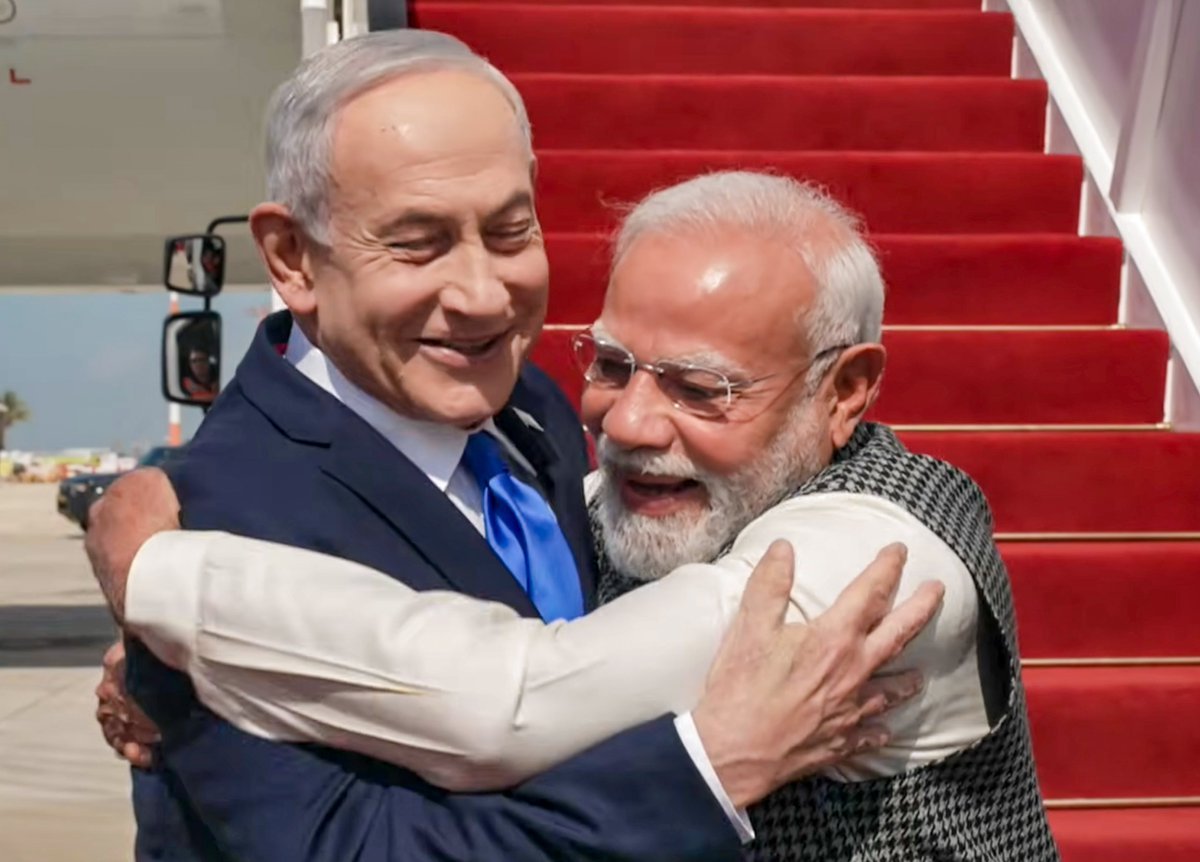




ISLAMABAD: Prime Minister Narendra Modi received an unprecedented personal welcome from Israeli Prime Minister Benjamin Netanyahu at Ben Gurion Airport during his recent two-day state visit to Israel, breaking established diplomatic protocols as Netanyahu and his wife Sara greeted Modi directly on the tarmac with warm embraces and a ceremonial red-carpet reception.
This rare gesture underscored the exceptional warmth in India-Israel relations, which have evolved from tactical cooperation to a robust strategic partnership under Modi’s leadership.
The visit, Modi’s second to Israel, included high-level talks on defence, security, trade, technology including artificial intelligence, and quantum computing, alongside Modi’s address to the Knesset where he affirmed India’s firm support for Israel following the October 7, 2023 attacks.
Netanyahu hailed the “tremendous alliance” between the two nations, emphasizing shared views on regional challenges and mutual friendship.
Pakistan reacted swiftly and sharply to these developments, viewing the deepening convergence as a direct security concern for Islamabad.
The Pakistani Senate unanimously passed a resolution condemning Israeli Prime Minister Netanyahu’s remarks on forming a “hexagon of alliances,” a proposed geopolitical framework centered on Israel with India, Greece, Cyprus, and unnamed Arab, African, and Asian states as key pillars.
The resolution, moved by Pakistan Peoples Party leader Palwasha Mohammad Zai Khan, described the initiative as provocative and a threat to regional and international peace, stability, and the unity of the Muslim Ummah.
Senate members deplored what they termed an emerging “anti-Muslim bloc,” linking it to broader Israeli efforts that could undermine sovereignty and territorial integrity of Islamic countries.
While the hexagon remains conceptual and not yet formalized, its proposed inclusion of India alongside Mediterranean nations like Greece and Cyprus highlights overlapping security interests in countering perceived radical axes in the Middle East.
Analysts note that such a grouping could foster coordinated intelligence sharing, defence collaboration, and economic connectivity, potentially reshaping West Asian dynamics.
Pakistan’s concerns extend beyond diplomatic symbolism to tangible defence cooperation between India and Israel.
Reports indicate discussions during the visit on advanced technologies, including potential sharing of Israel’s Iron Dome air defence system for joint production or technology transfer to India.
Indian defence circles have speculated that Israel may offer phased missile-related advancements to counter evolving threats, particularly Pakistan’s Ababeel missile.
The Ababeel, a medium-range ballistic missile with claimed multiple independently targetable reentry vehicle (MIRV) capability, has a reported range of 2,200 to 2,500 kilometres, enabling coverage of significant regional targets from southern Pakistan launch sites.
Some analysts suggest this system poses challenges to existing deterrence balances, with its MIRV features designed to overwhelm missile defences through multiple warheads.
Pakistan has positioned the Ababeel as a response to perceived threats from India’s ballistic missile defence developments.
In this context, enhanced India-Israel defence ties, including possible long-range missile systems or related technologies, could alter South Asian strategic equations.
Turkey, with its historical tensions involving Greece and Cyprus, is anticipated to oppose any bloc strengthening those nations, adding complexity to the regional landscape.
Though the hexagon proposal lacks concrete details and institutional structure, the high-profile nature of Modi’s reception and the visible bilateral advancements have amplified Islamabad’s unease.
Pakistani strategic commentary frames the India-Israel partnership as increasingly structural rather than merely transactional, with implications for deterrence, regional alliances, and broader Muslim world cohesion.
The visit thus highlights a shifting geopolitical reality where India’s alignment with Israel intersects with Pakistan’s security priorities.
As bilateral ties deepen through defence deals and technology sharing, Islamabad perceives a need to recalibrate its diplomatic and military posture amid these evolving configurations.
The episode underscores how personal diplomatic gestures and strategic proposals can trigger immediate regional ripple effects, particularly in a volatile neighbourhood marked by longstanding rivalries.