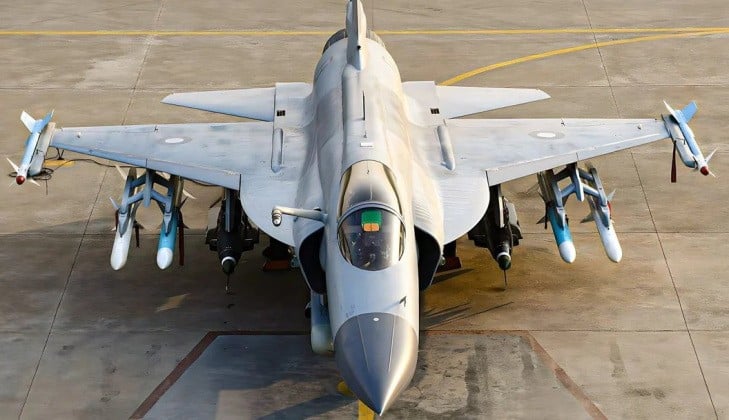




ISLAMABAD: Recent media reports suggesting that Pakistan has delivered six JF-17 Thunder fighter jets to Somalia are entirely fabricated and lack any credible foundation.
These unsubstantiated claims have circulated on social media and certain online platforms, often accompanied by misleading images or unverified assertions.
No official statement from the Government of Pakistan, the Pakistan Air Force, or the Ministry of Defence has confirmed any such delivery.
Defence analysts and reliable sources have dismissed the reports as misinformation, highlighting a pattern of exaggerated or premature claims regarding JF-17 exports.
The JF-17 Thunder, a multirole combat aircraft jointly developed by Pakistan Aeronautical Complex and China’s Chengdu Aircraft Corporation, remains a flagship product of Pakistan’s defence industry.
It has seen successful exports to countries like Myanmar and Nigeria in previous years, with ongoing interest from several nations.
Pakistan has actively marketed the Block III variant, featuring advanced avionics, AESA radar, and enhanced weapon systems, as a cost-effective option for developing air forces.
Recent discussions have focused on Somalia’s interest in acquiring up to 24 JF-17 Thunder Block III jets in a potential deal valued at around $900 million.
Reports from defence publications indicate that talks gained momentum following a February 2026 visit to Islamabad by the Somali Air Force Commander.
The proposed package would include aircraft, pilot training, weapons integration, and logistical support.
Such a transaction, if finalized, would represent Somalia’s most significant defence investment since the collapse of its central government in 1991.
Somalia seeks to rebuild its air combat capabilities amid ongoing security challenges, including insurgent threats and the need for sovereign airspace control.
The JF-17’s unit cost, estimated at $30-40 million, positions it as an affordable alternative to Western platforms that can exceed three times that price.
No evidence suggests any jets have been delivered yet, as negotiations remain in preliminary or advanced discussion stages without a signed contract.
Premature reports of deliveries often stem from speculation or unverified leaks in defence circles.
Pakistan’s defence export policy emphasizes transparency and government-to-government agreements.
Official channels, including the Directorate General of Inter-Services Public Relations, have not corroborated any transfer to Somalia.
The spread of fake news on military matters can undermine trust and fuel unnecessary regional speculation.
In the Horn of Africa context, such acquisitions could influence security dynamics, particularly regarding airspace sovereignty and counter-insurgency operations.
However, until an official announcement, claims of actual deliveries remain baseless.
Experts urge caution against unverified social media narratives that amplify rumours without substantiation.
Pakistan continues to pursue defence exports strategically, building on the JF-17’s operational success with the Pakistan Air Force.
The aircraft has proven reliable in various roles, from air defence to ground attack.
Interest from African nations reflects growing confidence in Sino-Pakistani technology.
For Somalia, modernizing its air force would mark a step toward greater self-reliance after decades of reliance on foreign partners.
Discussions reportedly include comprehensive support to ensure operational readiness.
No delivery of six jets or any number has occurred, as per available information.
The fabrication of such reports underscores the need for rigorous fact-checking in defence journalism.
Pakistan’s commitment to responsible arms exports prioritizes verified agreements over sensational claims.
Observers anticipate further developments only through official channels.
Misinformation on this scale can distort perceptions of bilateral ties between Pakistan and Somalia.
Both nations maintain diplomatic relations focused on mutual interests.
Any future deal would likely involve phased implementation and international financing considerations.
Somalia’s economic constraints make external support probable for such a large procurement.
Until then, reports of deliveries are confirmed as fake.
This clarification aims to counter disinformation and provide a fact-based perspective on the matter.