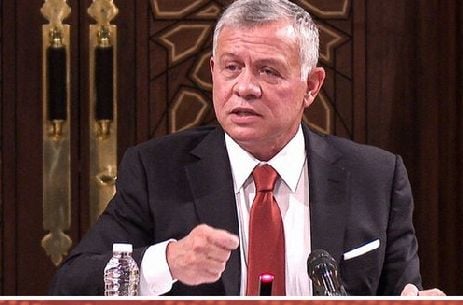




ISLAMABAD: Jordan’s King Abdullah II has firmly reiterated that his country’s territory and airspace will not be used as a launchpad for any military action against Iran by Israel or the United States, amid escalating regional tensions and reports of increased American military presence in the kingdom.
The statement comes at a critical juncture when fears of direct confrontation between Israel and Iran have intensified, with satellite imagery revealing a significant buildup of US fighter jets, electronic warfare aircraft, and cargo planes at Jordan’s Muwaffaq Salti Air Base.
Jordanian government sources emphasized that while a defence agreement exists with the United States, allowing the presence of American forces, this does not extend to permitting offensive operations against Iran.
The kingdom has consistently maintained that it will not serve as a staging ground for attacks, underscoring its commitment to neutrality in the volatile Middle East landscape.
King Abdullah II, in recent remarks during a meeting with the Jordanian Journalists Syndicate, stressed that Jordan will not allow breaches of its airspace by any party and will not become a battlefield in regional conflicts.
He highlighted that the security of the kingdom and the safety of its citizens remain paramount, above all other considerations.
This position echoes earlier declarations by the king and senior officials, including Foreign Minister Ayman Safadi, who affirmed that Jordan would not be a launching point for military action against Iran nor a battlefield for any regional dispute.
The reaffirmation arrives against the backdrop of heightened US-Iran tensions, with Washington deploying additional assets in the region as part of broader deterrence efforts.
Satellite observations from Planet Labs have documented more than 60 US strike aircraft stationed at the key Jordanian base, raising questions about potential roles in any future escalation.
Jordanian authorities have clarified that such deployments fall under existing bilateral defence pacts and are governed strictly by those agreements.
Despite close security ties with the US, Amman has sought to distance itself from offensive actions, prioritising diplomatic solutions and de-escalation.
The king’s message serves as a clear signal to both Iran and Western allies, asserting Jordan’s sovereignty while navigating complex alliances.
Analysts note that Jordan’s geographic position places it in a precarious spot, sandwiched between Israel to the west and Iran-backed proxies to the east.
The kingdom has historically balanced its peace treaty with Israel, strong US partnership, and the need to maintain stability amid domestic sensitivities over regional conflicts.
In previous instances, such as Iran’s direct attack on Israel in April 2024, Jordan intercepted projectiles violating its airspace to protect national security, framing the action as defensive rather than supportive of any belligerent.
Jordanian officials portrayed those interceptions as safeguarding sovereignty, not aiding Israel.
The current stance reinforces a policy of non-involvement in offensive operations, even as US military assets increase in the country.
Government spokespersons have reiterated that Jordan will respond decisively to any violation of its airspace or threats to its citizens.
This approach aims to preserve neutrality and prevent the kingdom from being drawn into a wider war.
Observers point out that Jordan’s declaration aligns with similar positions from other regional states wary of entanglement in a potential US or Israeli strike on Iranian targets.
The emphasis on dialogue and political solutions, as articulated by King Abdullah II, reflects a broader call for restraint to avert further escalation.
Jordan’s economy and social fabric remain vulnerable to regional instability, with past conflicts contributing to refugee inflows and security challenges.
By publicly ruling out its territory’s use for attacks, Amman seeks to mitigate risks to its stability and citizens.
The statement has drawn attention amid reports suggesting that Israeli assessments view a strike on Iran as increasingly likely.
Jordan’s calibrated response underscores its determination to stay outside the fray.
King Abdullah II’s insistence on sovereignty highlights the delicate balancing act the Hashemite kingdom performs in a polarised region.
As tensions persist, Jordan’s firm position may influence diplomatic efforts to contain the crisis and promote de-escalation through negotiation rather than military confrontation.
The kingdom’s leadership continues to advocate for peaceful resolutions, warning that escalation could have unpredictable consequences for the entire Middle East.