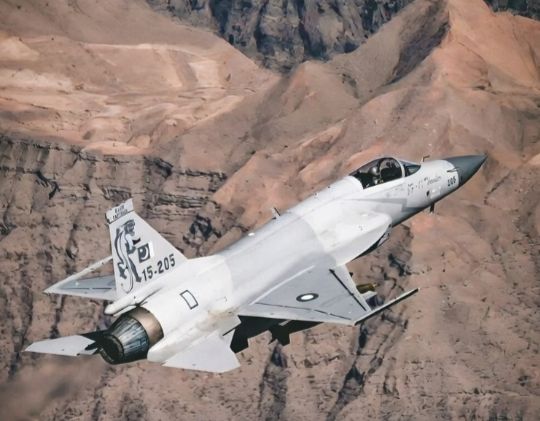




ISLAMABAD: The Pakistan Air Force has achieved a significant milestone in its indigenous defense capabilities with the integration of advanced electronic warfare systems on the JF-17 Thunder multirole fighter, enabling the aircraft to function effectively as a dedicated electronic warfare platform.
Recent developments allow the JF-17 Block III variant to carry specialized pods, including the locally manufactured Panjnad and the Chinese-origin KJ-600 series, to conduct suppression of enemy air defenses operations.
This configuration strengthens the fighter’s ability to degrade or neutralize hostile radar and missile guidance systems in contested environments.
The Panjnad pod represents a highly upgraded, indigenously produced derivative of the Chinese KJ-600 electronic warfare pod.
Defense exhibitions, such as IDEAS-2024 in Karachi, prominently displayed JF-17 Block III aircraft equipped with the Panjnad pod on the centerline hardpoint alongside other munitions.
Analysts describe the Panjnad as a self-protection jammer offering broad-spectrum coverage against radar threats, enhancing survivability during high-risk missions.
Integration of such pods complements the aircraft’s internal electronic warfare suite, which includes a radar warning receiver and tail-fin-mounted jamming elements.
The JF-17 Block III features the KLJ-7A active electronically scanned array radar, which provides superior detection range, target tracking, and resistance to electronic interference.
This radar, combined with external jamming capabilities, allows the platform to detect threats at extended distances while disrupting enemy sensors.
The aircraft’s electronic warfare enhancements support suppression of enemy air defenses roles by pairing jamming with anti-radiation missiles such as the LD-10.
Such weapons enable the JF-17 to target and destroy ground-based radar installations that guide surface-to-air missiles.
The Pakistan Air Force has emphasized the JF-17’s excellent suppression of enemy air defenses and destruction of enemy air defenses capabilities in official statements and operational planning.
External pods like the Panjnad expand these roles beyond internal systems, permitting dedicated escort or standoff jamming configurations.
In networked operations, the JF-17 coordinates with airborne early warning platforms and other fighters, including the J-10C, through secure data links.
This integration creates layered electromagnetic dominance, where jamming pods blind adversaries while precision strikes follow.
The development aligns with broader modernization efforts by the Pakistan Air Force to achieve self-reliance in critical technologies.
The Panjnad pod exemplifies local innovation, reducing dependence on foreign suppliers for electronic warfare assets.
Production at facilities like the Pakistan Aeronautical Complex in Kamra incorporates lessons from operational experience and joint Sino-Pakistani collaboration.
The JF-17 program, jointly developed by Pakistan and China, has evolved from its initial lightweight multirole design to a 4.5-generation platform in the Block III configuration.
Over 150 JF-17 aircraft serve in the Pakistan Air Force inventory, forming the backbone alongside F-16 and J-10C squadrons.
Recent international displays, including at the World Defence Show 2026, have highlighted the Block III’s electronic warfare upgrades to potential export customers.
Interest from countries in Africa, the Middle East, and Asia underscores the platform’s cost-effectiveness and combat-proven attributes.
The fighter’s ability to undertake suppression of enemy air defenses missions with advanced pods positions it competitively against more expensive Western counterparts.
Electronic warfare remains a decisive factor in contemporary conflicts, where control of the electromagnetic spectrum determines mission success.
By equipping the JF-17 with the Panjnad and KJ-600-derived systems, the Pakistan Air Force enhances its capacity to operate in high-threat scenarios.
This capability supports deterrence strategies and contributes to regional airpower balance.
Ongoing upgrades, including potential further refinements to the electronic warfare suite, indicate continued evolution of the Thunder platform.
The integration marks a step toward greater operational flexibility and technological sovereignty for Pakistan’s defense forces.