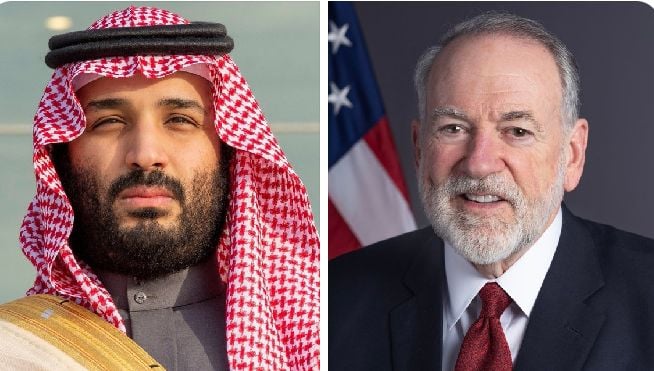




ISLAMABAD: Saudi Arabia has issued a sharp diplomatic rebuke to the United States after its ambassador to Israel suggested that Israeli expansion across much of the Middle East would be acceptable.
The Kingdom’s Ministry of Foreign Affairs released a strongly worded statement on February 21, 2026, categorically rejecting comments made by Ambassador Mike Huckabee in a recent interview.
Huckabee, a former Arkansas governor and evangelical Christian, appeared on a program hosted by commentator Tucker Carlson.
During the exchange, Carlson referenced biblical passages from Genesis describing land promised to Abraham’s descendants from the river of Egypt to the Euphrates.
This territory, in modern terms, would include Israel along with Jordan, Lebanon, Syria, and significant portions of Iraq and Saudi Arabia.
When pressed on whether Israel held a right to such an expanse, Huckabee responded that it would be fine if they took it all.
He described the assertion as rooted in scriptural promises to the Jewish people.
The ambassador later described his phrasing as somewhat hyperbolic, clarifying that Israel was not actively pursuing such territorial gains.
The remarks ignited widespread outrage across Arab and Muslim-majority nations.
Saudi Arabia’s foreign ministry described the statements as irresponsible, reckless, and in direct violation of international law.
It accused them of contravening the United Nations Charter and established diplomatic norms.
The Kingdom emphasized that such rhetoric from a senior US official set a dangerous precedent.
It showed disregard for longstanding relations between the United States and countries in the region.
The statement warned that extremist views of this nature threatened international peace and security.
They risked provoking states and peoples while undermining the foundations of the post-World War II international order.
That order prioritizes respect for sovereign borders and peaceful resolution of disputes.
Jordan’s Ministry of Foreign Affairs swiftly followed with its own condemnation.
It labeled the comments absurd and provocative.
They constituted an infringement on regional sovereignty and a breach of international law.
Egypt’s foreign ministry echoed the sentiment, calling the remarks a blatant violation of principles governing state relations.
It rejected any notion of sovereignty based on religious narratives over occupied or neighboring territories.
The Arab League, representing 22 member states, denounced the ambassador’s words as extremist and lacking sound basis.
The Organization of Islamic Cooperation issued a parallel statement.
It described the comments as dangerous and irresponsible, framing them as support for expansionism and annexation.
The Palestinian Ministry of Foreign Affairs condemned the statements as provocative.
They contradicted international consensus on ending occupation and establishing a viable Palestinian state.
Multiple reports highlighted the timing amid heightened regional tensions.
Ongoing conflicts and diplomatic efforts for stability made the remarks particularly inflammatory.
Huckabee’s appointment as ambassador reflected strong pro-Israel leanings within the current US administration.
His background as a staunch defender of Israeli policies aligned with Christian Zionist perspectives.
Those views often interpret biblical texts as granting divine entitlement to expanded territories.
The interview occurred against a backdrop of debates over US foreign policy in the Middle East.
Carlson, known for critical stances on certain aspects of US support for Israel, pressed Huckabee on the implications.
The exchange drew attention to tensions between religious interpretations and modern geopolitical realities.
Saudi Arabia’s response underscored its commitment to sovereignty.
As a key US ally with deep economic and security ties, the Kingdom’s criticism carried significant weight.
It called implicitly for clarification from the US State Department on the official position.
Observers noted that similar condemnations from multiple capitals amplified the diplomatic fallout.
The episode risked straining relations at a time when cooperation on issues like energy and counterterrorism remained vital.
Regional analysts suggested the statements could fuel perceptions of bias in US diplomacy.
They might complicate efforts toward broader normalization or de-escalation.
The controversy revived discussions on the concept of Greater Israel.
This idea, drawn from certain interpretations of biblical borders, has long been contentious.
It features in debates over settlements and territorial claims.
Huckabee’s words, even if qualified later, resonated as endorsement of maximalist views.
Saudi Arabia’s firm stance reinforced its role as a defender of Arab consensus.
The ministry’s language avoided direct personal attacks but focused on principles.
It stressed that peace depended on mutual respect for boundaries and international norms.
The development highlighted fragile balances in US-Arab relations.
Despite alliances, core issues of sovereignty triggered unified pushback.
As reactions continued, attention turned to any potential response from Washington.
The incident served as a reminder of how religious rhetoric in official channels could inflame regional sensitivities.
It underscored the need for careful calibration in diplomatic language.