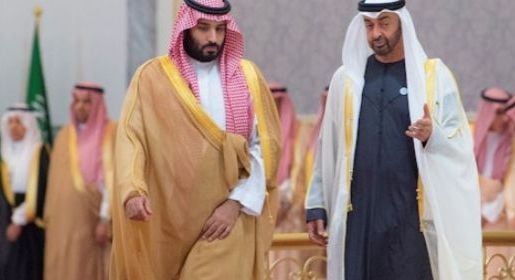




The relationship between Saudi Arabia and the United Arab Emirates has deteriorated markedly in recent months, marked by direct military confrontations in Yemen, proxy support in Sudan’s civil war, and escalating economic competition. This rift, once concealed behind diplomatic unity, has surfaced through airstrikes on UAE-backed forces and public accusations of undermining national security, raising concerns over Gulf stability and broader Middle East dynamics. Analysts highlight diverging ambitions under Crown Prince Mohammed bin Salman and UAE President Mohammed bin Zayed, with potential exacerbation from transactional U.S. foreign policy approaches.
ISLAMABAD: The once-unbreakable alliance between Saudi Arabia and the United Arab Emirates has fractured into open rivalry, driven by clashing visions for regional dominance and influence.
What began as tactical differences in shared interventions has evolved into a strategic divide with far-reaching implications.
In late December 2025, Saudi-led forces conducted airstrikes on positions linked to the UAE-backed Southern Transitional Council in Yemen’s southern port city of Mukalla, resulting in casualties among separatist fighters and accusations from Riyadh that Abu Dhabi was threatening Saudi national security.
The strikes targeted shipments allegedly carrying weapons to the STC, a group the UAE has supported to secure maritime access and influence along the Red Sea coast.
The UAE denied arming separatists for offensive purposes, claiming the vessels transported legitimate supplies, yet subsequently withdrew remaining troops from Yemen while maintaining proxy backing.
This incident marked one of the sharpest public escalations, exposing years of accumulated tensions.
The Yemen conflict, initiated in 2015 as a joint Saudi-UAE operation against Iran-backed Houthis, saw early coordination give way to divergence by 2019 when the UAE redeployed forces from frontline battles to focus on southern alliances and port control.
A fragile truce with the Houthis since 2022 froze major fighting, but the STC’s advances in late 2025 reignited friction, with Saudi Arabia viewing them as a direct challenge to its preferred unified Yemeni government.
Beyond Yemen, the rift extends to Sudan, where Saudi Arabia supports the Sudanese Armed Forces under General Abdel Fattah al-Burhan, while the UAE has faced accusations from UN experts and U.S. lawmakers of arming the paramilitary Rapid Support Forces despite denials.
The RSF’s battlefield gains, bolstered by alleged drone supplies and other aid, have prolonged Sudan’s devastating civil war, displacing millions and drawing international condemnation for atrocities.
Saudi Arabia prioritizes backing recognized governments to ensure Red Sea stability, whereas the UAE favors militias and non-state actors for economic access, including ports and resources.
This pattern repeats in other arenas, from Libya to the Horn of Africa, where competing patronage networks fragment local conflicts.
Economic dimensions further strain ties, with both nations pursuing aggressive diversification beyond oil through Vision 2030 in Saudi Arabia and similar initiatives in the UAE.
Competition for foreign investment, technology hubs, and regional headquarters has intensified, as companies weigh Riyadh’s mandates against Abu Dhabi’s established business environment.
Trade tensions echo past Gulf crises, with reports of boycotts and withdrawals from joint events signaling spillover into commercial spheres.
Personal leadership dynamics add complexity, as Mohammed bin Salman and Mohammed bin Zayed, once seen as aligned, now compete for influence, with reports of severed direct communication channels.
Saudi narratives occasionally portray the UAE as overly aligned with Israel following the Abraham Accords, while Emirati voices express resentment toward perceived Saudi dominance.
The return of Donald Trump’s administration introduces additional variables, given his transactional foreign policy style and close ties to both leaderships.
Trump’s approach may encourage competitive bidding for U.S. favor through investments or deals, potentially deepening the divide rather than mediating reconciliation.
Analysts warn that without restraint, the rivalry could erode Gulf Cooperation Council unity, embolden Iran, and prolong proxy wars, undermining regional security.
U.S. officials and senators have expressed alarm, urging de-escalation to prevent broader instability.
Yet prospects for immediate resolution appear limited, as structural divergences in strategy and ambition persist.
The deterioration underscores a shift from cooperative partnership to cautious competition between two pivotal Gulf powers.
As the rift unfolds, its consequences ripple across Yemen’s stalled peace efforts, Sudan’s humanitarian catastrophe, and the broader quest for Middle East stability.
Observers note that while direct conflict remains unlikely, the ongoing proxy confrontations and narrative battles risk entrenching a new era of intra-Gulf tension.
Saudi Arabia and the United Arab Emirates, key architects of post-Arab Spring order, now embody its fragmentation.
The path forward hinges on whether mutual interests in economic prosperity and external threat management can override current rivalries.
For now, the once-close allies navigate an increasingly adversarial landscape, with implications that extend well beyond their borders.