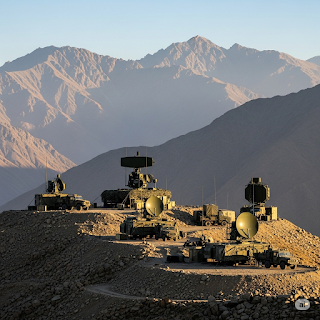




The Pakistan Air Force has achieved a significant advancement in its air defense capabilities by transforming the Czech-origin VERA-E and VERA-NG passive surveillance systems into a networked, AI-enhanced backbone for silent detection and engagement operations.
ISLAMABAD: In a strategic evolution over the past five years, the Pakistan Air Force (PAF) has elevated the VERA-E and VERA-NG passive electronic support measures (ESM) systems from standalone sensors to an integrated, artificial intelligence-driven component of its air defense architecture. This transformation enables radar-silent engagements, preserving the element of surprise while countering advanced aerial threats, including stealth platforms and low-observable unmanned aerial vehicles.
The VERA systems, developed by the Czech company ERA a.s., operate on the multilateration Time Difference of Arrival (TDOA) principle. They detect and locate electromagnetic emissions from aircraft radars, communications, and other sources without emitting signals themselves. This passive nature renders the sensors undetectable by adversary radar warning receivers, providing a critical advantage in contested electromagnetic environments.
Under the Centre for Artificial Intelligence and Computing (CENTAIC), established by the PAF in August 2020, major software upgrades and sensor fusion enhancements have been implemented. CENTAIC focuses on AI applications such as machine learning, big data analytics, and predictive processing to support military operations. These developments have allowed real-time passive data from VERA-NG to feed directly into the command-and-control networks of surface-to-air missile (SAM) batteries, including the Chinese-origin HQ-9P and LY-80 systems.
The HQ-9P, inducted into the Pakistan Army’s air defense in 2021, offers long-range coverage up to 125 kilometers against aircraft and shorter ranges against cruise missiles. The LY-80, formally inducted in 2017, provides medium-range defense with engagement distances of 40 to 70 kilometers depending on the variant. By integrating VERA-derived targeting cues, these active SAM systems can now execute engagements without activating their own radars, reducing vulnerability to anti-radiation missiles and electronic countermeasures.
The upgrade to the VERA-NG standard has substantially expanded technical performance. The system now tracks up to 500 simultaneous targets, a marked increase over earlier configurations. Its frequency coverage extends down to 50 MHz, improving detection of low-probability-of-intercept signals and low radar cross-section threats, such as stealth UAVs and modern fighter aircraft employing reduced-signature emissions.
Operational mobility has been enhanced through the adoption of the Deployable Passive ESM Tracker (DPET) configuration. This truck-mounted variant, featuring deployable masts, allows rapid relocation and setup in diverse terrains, supporting flexible deployment along Pakistan’s borders and strategic zones.
A key element of the enhancement is the continuous refinement of a national Emitter Database. This database enables precise electronic fingerprinting, identifying specific aircraft types, units, or even individual platforms based on unique signal characteristics. Such identification supports faster classification and prioritization in high-threat scenarios.
These advancements align with broader PAF efforts to build a network-centric force. CENTAIC’s role in fusing passive ESM data with other sensors creates a layered, resilient air defense grid. Passive detection complements active radars, reducing the risk of detection while maintaining comprehensive situational awareness.
The integration reflects Pakistan’s response to evolving regional aerial threats, including advanced fighters, drones, and standoff munitions. By leveraging passive systems for initial detection and cueing active interceptors only when necessary, the PAF minimizes electromagnetic emissions, complicating adversary suppression efforts.
Observers note that this silent air defense approach draws from global trends in electronic warfare, where passive sensors provide foundational intelligence in contested domains. The VERA-NG’s proven export success to several nations underscores its reliability and effectiveness.
Pakistan’s progress in this domain, driven by indigenous AI development at CENTAIC and strategic acquisitions, positions its air defense as more adaptive and survivable. The transition underscores a doctrinal shift toward data-driven, low-signature operations in modern air warfare.