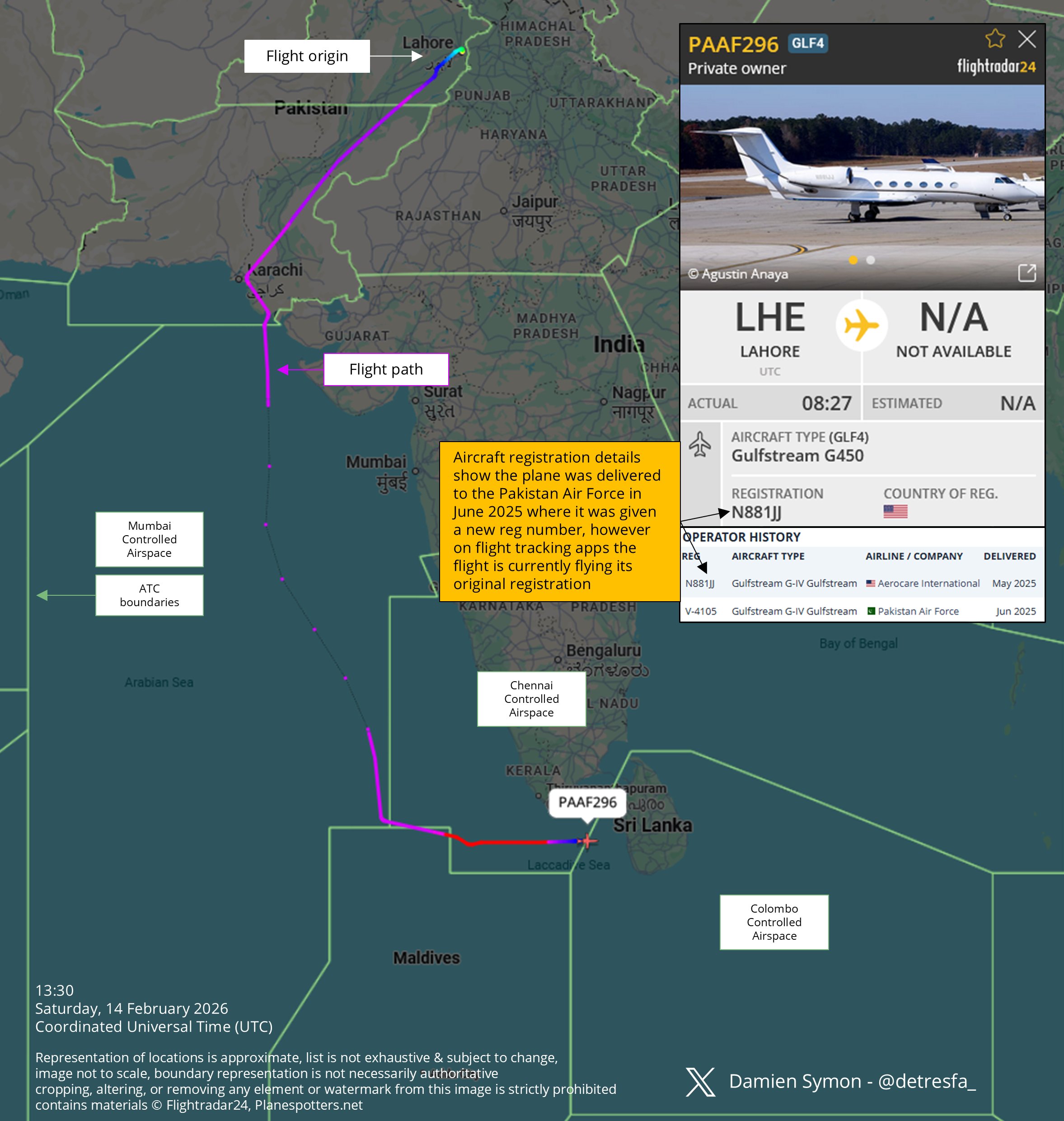




ISLAMABAD: A Pakistan Air Force special-mission aircraft reportedly transited through airspace managed by Indian air traffic control on February 14, 2026, triggering widespread speculation and media reports of an alleged violation of the longstanding mutual airspace ban between India and Pakistan. However, detailed analysis of flight-tracking data and international aviation regulations confirms the aircraft remained strictly within international airspace throughout its journey from Lahore to Colombo, Sri Lanka, and never entered India’s sovereign territorial airspace.
The aircraft in question was a Gulfstream G450 business jet bearing United States civil registration N881JJ and operating under the military callsign PAAF296. Flight paths reconstructed from open-source ADS-B broadcasts showed the jet departing Allama Iqbal International Airport in Lahore shortly after midday and following a south-westerly trajectory over the Arabian Sea before turning south-east towards Sri Lanka. The route passed through the Mumbai Flight Information Region, an area where Indian authorities provide air traffic services over international waters under ICAO agreements.
Under international law codified in the 1982 United Nations Convention on the Law of the Sea and the 1944 Chicago Convention on International Civil Aviation, a coastal state’s sovereign airspace extends only twelve nautical miles from its baseline. Beyond this limit lies international airspace where freedom of overflight applies to all aircraft, including military platforms, subject to compliance with flight information region rules. The PAF aircraft maintained a track well outside India’s twelve-mile territorial limit, even as it crossed sectors delegated to Indian controllers.
The mutual airspace closure between India and Pakistan dates back to the sharp escalation of tensions in early 2025 following cross-border incidents. New Delhi imposed a complete ban on aircraft registered in, operated by, or leased to Pakistani entities from entering or overflying Indian sovereign territory. Islamabad reciprocated with identical restrictions on Indian-registered or operated aircraft. Both countries have periodically extended these prohibitions through NOTAMs, with Pakistan’s latest extension valid until February 24, 2026. The restrictions, however, apply exclusively to each nation’s territorial airspace and do not automatically prohibit passage through international airspace or foreign FIRs.
Social media accounts specialising in open-source intelligence initially highlighted the transit, with visuals from platforms such as Flightradar24 showing the aircraft icon positioned over the Indian Ocean within the Mumbai FIR. Several Indian defence commentators and news aggregators interpreted the presence in the FIR as evidence of airspace penetration, prompting headlines suggesting a deliberate breach or an extraordinary diplomatic exception. One prominent post claimed the flight represented “a rare transit amid ongoing hostilities,” fuelling online debate about possible back-channel permissions.
Clarification emerged swiftly from aviation enthusiasts and former air traffic controllers who emphasised the distinction between FIR management and sovereign airspace. The Mumbai FIR covers vast oceanic expanses extending hundreds of nautical miles from India’s western coastline, including corridors routinely used by international commercial, military and state aircraft travelling between the Middle East, South Asia and South-East Asia. Pakistan Air Force aircraft have historically utilised these routes when heading towards friendly destinations such as Sri Lanka, Maldives or Gulf states, provided they remain beyond territorial limits.
No official statement has been issued by either the Indian Ministry of Defence, the Directorate General of Civil Aviation, the Pakistan Air Force or the Civil Aviation Authority of Pakistan regarding today’s transit. In the absence of intercept activity, radio warnings, diplomatic protests or NOTAM amendments, aviation safety observers conclude the flight proceeded under standard international protocols. Previous instances during 2025, including humanitarian relief missions to cyclone-affected Sri Lanka, saw Pakistan request and receive case-by-case overflight permissions even amid heightened tensions, though those clearances applied to sovereign segments rather than purely international routes.
The episode underscores persistent sensitivities surrounding India-Pakistan aerial interactions more than a year after the airspace bans took effect. Flight-tracking enthusiasts continue to monitor military movements closely, often leading to rapid dissemination of information that requires careful contextualisation. Today’s transit, while visually striking on radar plots due to its proximity to Indian-managed airspace, ultimately adhered to established rules of international aviation and did not contravene the existing bilateral restrictions.
Experts note that such transits remain routine for several air forces operating in the region whenever sovereign corridors are closed but oceanic routes stay open. The Pakistan Air Force maintains a small fleet of Gulfstream jets for VIP, command-and-control and special-mission roles, frequently deploying them on long-range flights that traverse international waters. The callsign PAAF296 is consistent with previous PAF executive-transport operations observed in the same geographical area.
As bilateral relations show no immediate signs of thaw, airspace management will likely remain a tightly controlled domain. Today’s event, rather than signalling a relaxation of rules, appears to illustrate the continuing functionality of international aviation frameworks even between adversarial neighbours. The incident also highlights the importance of distinguishing between technical FIR jurisdiction and legally sovereign airspace when interpreting military flight activity in contested regions.