



ISLAMABAD: Newly unsealed records from the United States Department of Justice have brought renewed attention to the associations of Jeffrey Epstein, the late financier and convicted sex offender, with prominent international figures, including Emirati diplomat Hind Al-Owais. The documents, part of the broader Epstein files released in recent months, reveal approximately 469 email exchanges between Al-Owais and Epstein spanning 2011 and 2012, a period following his 2008 conviction for soliciting prostitution from a minor. These communications, which include arrangements for meetings and personal references, have prompted questions about the nature of their relationship, though authorities have stated that the files contain no accusations of criminal involvement against Al-Owais.
Hind Al-Owais, a notable figure in UAE diplomacy, has held key positions focused on human rights and gender equality. She previously served as a senior adviser at the United Nations headquarters in New York, marking her as one of the first Emirati women in such a role, and currently directs the UAE Permanent Committee for Human Rights. Her public profile emphasizes advocacy for women’s empowerment, participation in global forums on sustainable development, and contributions to UAE initiatives at international events like Expo 2020. The emergence of these emails contrasts sharply with her established image as a champion of women’s rights, fueling online debates and calls for greater transparency in diplomatic accountability.
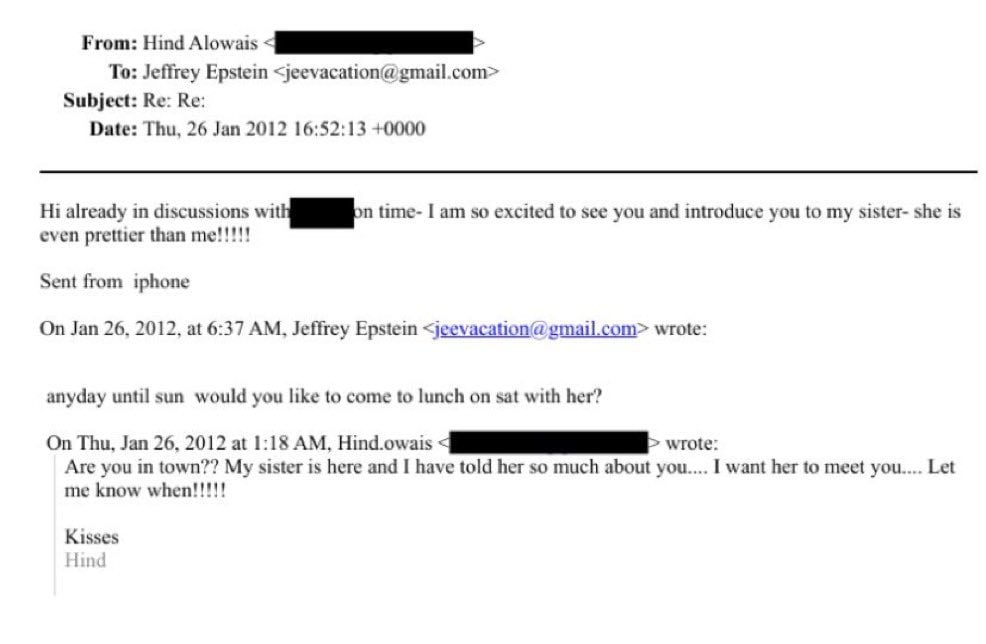
The specific conversation highlighted in public discussions involves messages exchanged in January 2012. In one instance, Al-Owais reportedly informed Epstein that she was engaged in a discussion with a girl described as even more beautiful than herself. Epstein responded by expressing anticipation for a meeting and suggesting lunch, indicating interest in meeting Al-Owais along with her sister. Al-Owais then inquired about Epstein’s availability in town, noting that her sister was present and that she had spoken highly of him, expressing eagerness for an introduction. The exchange concluded with a friendly sign-off including kisses, underscoring a casual and familiar tone in their correspondence.
Additional context from the documents shows repeated coordination for social encounters during this timeframe. Epstein’s responses often conveyed enthusiasm for personal meetings, while Al-Owais appeared to facilitate introductions and logistics. Some reports reference other messages discussing the preparation of individuals described as girls, with one email noting the challenge of readying one or two at a time. These details have drawn particular scrutiny given Epstein’s documented history of exploiting minors and his associations with influential networks, though the released materials do not establish any direct criminal link or wrongdoing by Al-Owais in relation to these interactions.
The timing of the emails is significant, occurring years before Al-Owais assumed prominent UN-related roles in 2015. While some speculation has arisen regarding potential influences on her career trajectory, no evidence in the public documents substantiates claims of Epstein’s involvement in her professional advancements. The correspondence appears to reflect personal and social networking common in elite circles, yet the context of Epstein’s convictions has amplified concerns about judgment and associations among public figures.
Public reaction to the revelations has been mixed, with some Emirati commentators defending Al-Owais by emphasizing the absence of criminal charges and framing the contacts as non-implicating. Others have expressed outrage, highlighting the apparent contradiction between her human rights advocacy and these past communications. The episode contributes to ongoing global discourse on the Epstein case, which continues to uncover connections involving politicians, business leaders, and diplomats from various countries, underscoring the financier’s extensive reach even after his legal troubles.
The release of these records forms part of broader efforts to increase transparency in the Epstein investigations, following judicial orders for unsealing related materials. While much of the content involves logistical or innocuous exchanges, certain phrases and contexts have resonated strongly due to Epstein’s criminal background. Al-Owais has not issued a public response to the specific allegations stemming from these emails, and UAE official channels have remained silent on the matter.
This development highlights the enduring impact of Epstein’s network on international perceptions of accountability. As more details emerge from the files, they serve as a reminder of the complexities surrounding associations with controversial figures and the importance of ethical boundaries in diplomatic and public life. The case continues to provoke discussions on power dynamics, gender advocacy, and the scrutiny faced by those in influential positions when past correspondences surface.