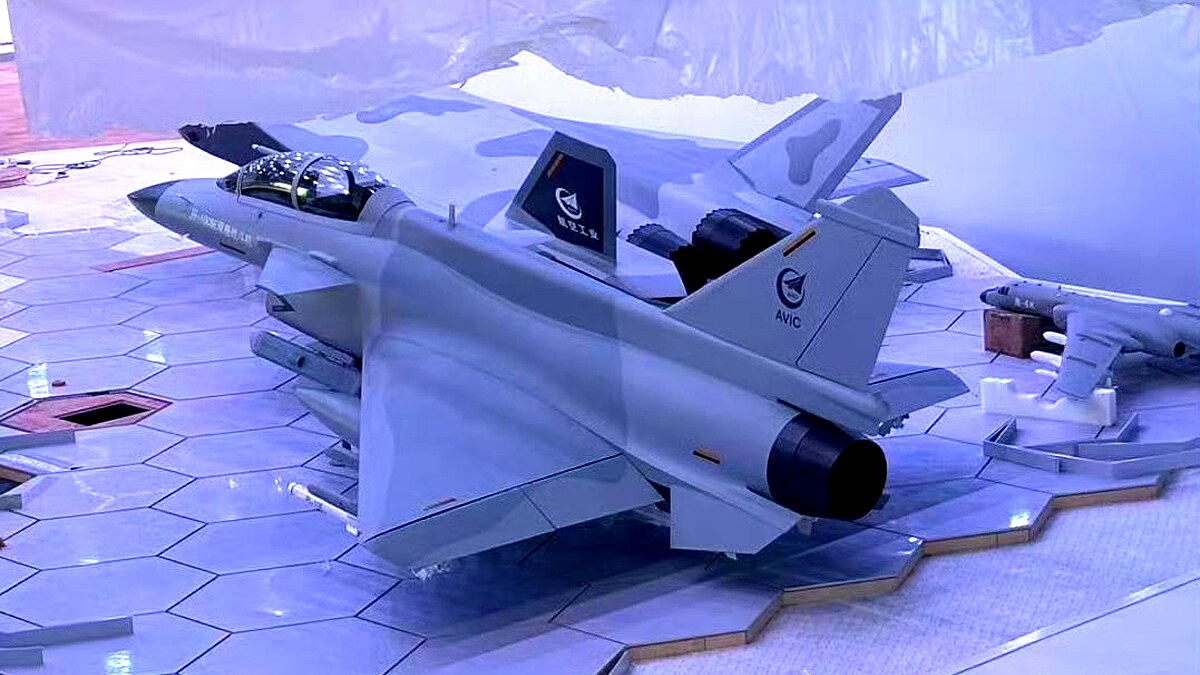


In a development that has drawn intense interest from defense analysts and regional observers, imagery and reports circulating in late 2026 point to an advanced evolution of the Chengdu J-10C multirole fighter.
Designated J-10CSE in some discussions (and frequently referred to in enthusiast and analytical circles as a “J-10D” or specialized electronic-warfare/strike derivative), the new configuration incorporates conformal fuel tanks, a substantially upgraded electronic warfare suite, increased payload flexibility, and a two-seat cockpit optimized for clear division of labor between pilot and systems operator.
While official Chinese nomenclature remains characteristically opaque and some details remain unconfirmed by state media, the visible design changes represent a logical maturation of the J-10 family for contested electromagnetic and long-range environments.
The baseline J-10C, which entered PLAAF service in 2018, already marked a significant leap over earlier J-10A/B models. It introduced an indigenous AESA radar, the WS-10B Taihang afterburning turbofan in later batches, compatibility with the long-range PL-15 and infrared-imaging PL-10 air-to-air missiles, and improved avionics integration.
The aircraft’s canard-delta layout, diverterless supersonic inlet, and eleven hardpoints have made it a capable medium-weight multirole platform for air superiority, interception, and precision strike.
The J-10CSE builds directly on this foundation while addressing limitations in range, electronic attack capacity, and crew workload that become critical in high-intensity conflict.
### Conformal Fuel Tanks: Extending Reach Without Sacrificing Agility
One of the most visible upgrades is the addition of conformal fuel tanks (CFTs). Unlike conventional drop tanks that increase drag and occupy hardpoints, CFTs are blended into the airframe contours—typically along the upper fuselage or wing roots—preserving more of the aircraft’s aerodynamic cleanliness and radar cross-section characteristics.
On the J-10CSE, these tanks appear to provide a meaningful increase in internal fuel volume while leaving underwing and centerline stations free for weapons or additional sensors.
More on this topic: Pakistan Defence & Security · All topics
The operational payoff is substantial. The standard J-10C’s combat radius is often cited in the 550–1,240 km range depending on load and profile; ferry range with external tanks approaches 4,600 km.
Conformal tanks allow the CSE variant to sustain longer patrols, deeper strike profiles, or extended electronic attack missions without the performance penalty of multiple drop tanks.
In a Taiwan Strait or South China Sea scenario, this extra endurance supports persistent combat air patrols, escort of strike packages, or loitering electronic warfare support while remaining closer to optimal energy states for dogfighting or high-g maneuvers.
The design also reduces the logistical burden of recovering and servicing external tanks after every mission.
### Improved Electronic Warfare Suite
Electronic warfare forms the second major pillar of the upgrade. Earlier J-10C airframes already carried integrated ECM and radar warning receivers. The CSE variant appears to expand this capability significantly, with reports of an enlarged dorsal spine or conformal fairings housing additional transmitters, receivers, cooling systems, and signal-processing hardware.
This architecture is reminiscent of specialized EW derivatives seen on other fourth-generation platforms and aligns with broader PLA efforts to field dedicated electronic attack assets that can operate alongside, rather than separately from, kinetic fighters.
Enhanced EW capabilities would include more powerful broadband jamming, improved direction-finding and geolocation of enemy emitters, sophisticated deception techniques, and better self-protection against modern surface-to-air and air-to-air threats.
In networked operations the aircraft could act as a “mini-AWACS” or SEAD/DEAD node, suppressing enemy air defenses, protecting strike packages, or creating corridors for follow-on forces.
The two-seat configuration (discussed below) is particularly well suited to this role, allowing a dedicated electronic warfare officer to manage complex spectrum operations while the pilot focuses on aircraft handling and tactical positioning.
### Payload Flexibility and Weapons Growth
Payload improvements complement the range and EW upgrades. By freeing hardpoints previously consumed by external fuel tanks and integrating more advanced pylons or dual-carriage options, the J-10CSE can carry heavier or more diverse loads.
Typical J-10C configurations already support combinations of PL-15s, PL-10s, precision-guided bombs, anti-radiation missiles such as the YJ-91, and anti-ship weapons. The advanced variant is expected to expand this further—potentially accommodating additional long-range air-to-air missiles, larger air-to-surface munitions, or specialized EW pods without compromising internal fuel or aerodynamic performance.
Greater payload capacity also supports mixed mission loads: for example, a pair of long-range air-to-air missiles for self-defense, a full suite of air-to-ground weapons for strike, and dedicated jamming pods.
This flexibility turns the aircraft into a true “swing-role” platform capable of transitioning rapidly between air superiority, interdiction, and electronic attack within a single sortie.
### Two-Seat Cockpit and Division of Labor
Perhaps the most doctrinally significant change is the adoption of a two-seat cockpit optimized for role specialization. Earlier two-seat J-10S trainers retained combat capability but were primarily instructional platforms. The J-10CSE’s dual-crew arrangement appears purpose-built for operational division of labor.
The front-seat pilot retains primary responsibility for aircraft control, energy management, and visual/tactical flying. The rear-seat systems operator (or weapon systems officer) manages the complex sensor fusion, electronic warfare suite, data-link coordination, and weapons employment.
This arrangement mirrors successful Western and Russian two-seat multirole designs in which cognitive load is distributed. In a dense electromagnetic environment saturated with simultaneous air, surface, and cyber threats, a single pilot can quickly become saturated.
A dedicated second crewmember can monitor multiple threat axes, execute complex jamming waveforms, coordinate with other platforms via secure data links, and prosecute ground or maritime targets while the pilot maintains situational awareness and aircraft energy.
The result is higher mission effectiveness and lower pilot workload, particularly during extended or high-intensity sorties.
The two-seat layout also facilitates training and tactics development. Instructors can more effectively mentor junior pilots in real combat profiles, and operational crews can refine cooperative tactics between pilot and systems operator that are difficult to perfect in single-seat aircraft.
### Strategic and Operational Implications
Taken together, the conformal tanks, improved EW, expanded payload, and two-seat specialization position the J-10CSE as a more survivable and versatile asset within the PLA’s layered airpower structure. It bridges the gap between pure air-superiority fighters and dedicated electronic attack or strike platforms.
In regional contingencies it could provide persistent presence, protect high-value assets, suppress enemy sensors and communications, and deliver precision effects at greater range—all while operating from the same bases and logistical footprint as existing J-10C units.
Export interest, particularly from operators already flying the J-10CE such as Pakistan, is likely. An upgraded variant offering greater range, electronic attack capacity, and dual-crew efficiency would represent a compelling mid-life or follow-on option without requiring an entirely new airframe family.
While full technical specifications, production timelines, and official designations remain subject to confirmation, the visible design choices of the J-10CSE reflect a clear evolutionary path.
Chengdu and the broader Chinese aerospace industry continue to extract additional capability from the mature J-10 airframe through careful integration of conformal structures, advanced electronics, and human-systems optimization.
The result is a fighter better adapted to the demands of modern, sensor-rich, and electronically contested battlefields—one that extends the relevance of China’s most numerous fourth-generation multirole platform well into the coming decades.
More on this topic: Defence & Security →