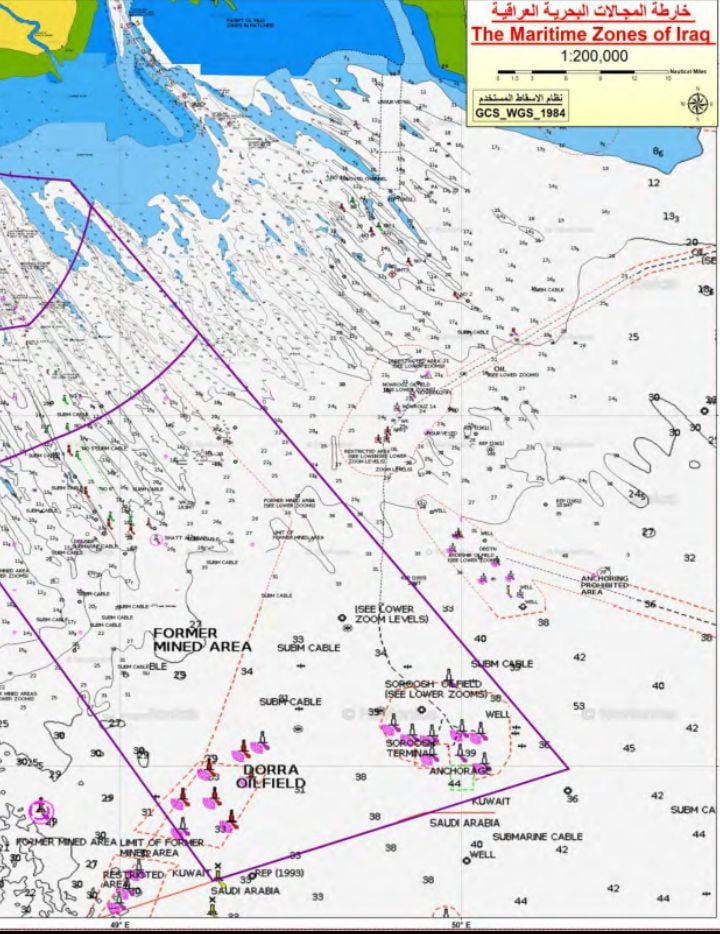
ISLAMABAD: Saudi Arabia and Kuwait have lodged strong protests against Iraq’s recent submission of updated maritime boundary coordinates and a map to the United Nations, asserting that the move infringes upon Kuwaiti sovereignty and encroaches on the jointly managed Saudi-Kuwaiti divided submerged zone.
The dispute escalated rapidly following Iraq’s deposit of geographic coordinates with the UN on January 19 and February 9, 2026. Iraq’s Foreign Ministry described the action as a legitimate delineation of its maritime zones in compliance with the 1982 United Nations Convention on the Law of the Sea (UNCLOS).
Kuwait responded swiftly by summoning Iraq’s chargé d’affaires, Zaid Abbas Shanshal, to deliver a formal protest memorandum. Kuwaiti officials emphasized that the submitted coordinates and map include claims over maritime areas and fixed elevations, notably Fasht Al-Qaid and Fasht Al-Aij, which have never been subject to sovereignty disputes with Iraq.
Saudi Arabia expressed profound concern in an official statement, highlighting that Iraq’s filing extends into parts of the submerged divided zone adjacent to the onshore Saudi-Kuwaiti Neutral Zone. This area features shared natural resources governed by longstanding bilateral agreements between Riyadh and Kuwait City.
The Saudi Ministry of Foreign Affairs categorically rejected any third-party claims to rights in the divided submerged zone beyond the established boundaries. It invoked UN Security Council Resolution 833 of 1993, which demarcated the land and maritime borders between Iraq and Kuwait following the 1990-1991 Gulf crisis.
Broader regional support for Kuwait emerged promptly. Qatar, Bahrain, Oman, the United Arab Emirates, and other Gulf Cooperation Council members issued statements affirming full solidarity with Kuwait’s sovereign rights over its maritime territories.
The Gulf Cooperation Council Secretary-General, Jasem Al-Budaiwi, called for Iraq to withdraw the deposited coordinates and map, describing them as a direct infringement on Kuwaiti maritime zones and elevations.
Jordan and additional Arab states echoed this position, underscoring adherence to international law and existing bilateral accords. The unified Gulf response reflects heightened sensitivity to maritime sovereignty in the northern Persian Gulf, where overlapping claims can impact resource exploration and navigation.
Historical context underscores the tensions. The Iraq-Kuwait maritime boundary remains partially unresolved despite progress on land borders. Negotiations through the Joint Technical and Legal Committee continued as recently as July 2025, focusing on areas beyond buoy 162 in the Khor Abdullah waterway.
Iraq has maintained that its submission does not alter internationally recognized boundaries but refreshes its legal position based on the lowest low-water line. Iraqi Foreign Minister Fuad Hussein noted that Kuwait deposited its own maps with the UN in 2014 without prior consultation with Baghdad.
Kuwait insists the features in question fall unequivocally under its jurisdiction, consistent with prior UN demarcations and bilateral understandings. The inclusion of shoals like Fasht Al-Qaid in Iraq’s map has been deemed particularly provocative.
The Saudi-Kuwaiti Divided Zone, both onshore and submerged, holds significant economic importance due to shared oil and gas fields, including the Al-Durra field. Any perceived encroachment risks complicating joint resource management and potentially inviting further complications involving other regional actors.
Analysts observe that the swift regional backing for Kuwait signals a collective Gulf stance against unilateral actions that could destabilize established agreements. This solidarity revives memories of past disputes, including Iraq’s 1990 invasion of Kuwait, which led to international intervention and boundary reaffirmation.
Diplomatic channels remain open, with calls for dialogue prevailing in statements from Saudi Arabia and others. Riyadh urged responsible engagement based on principles of good neighborliness and international law to prevent escalation.
The incident highlights ongoing challenges in finalizing maritime delimitations in the Persian Gulf. UNCLOS provides a framework for such submissions, yet objections arise when claims intersect with neighboring states’ established rights.
As the UN processes the Iraqi submission, further diplomatic exchanges are anticipated. The outcome could influence future negotiations on resource sharing and boundary stability in this strategically vital waterway.
The controversy underscores the delicate balance required in Gulf maritime affairs, where sovereignty assertions intersect with economic interests and regional security considerations.