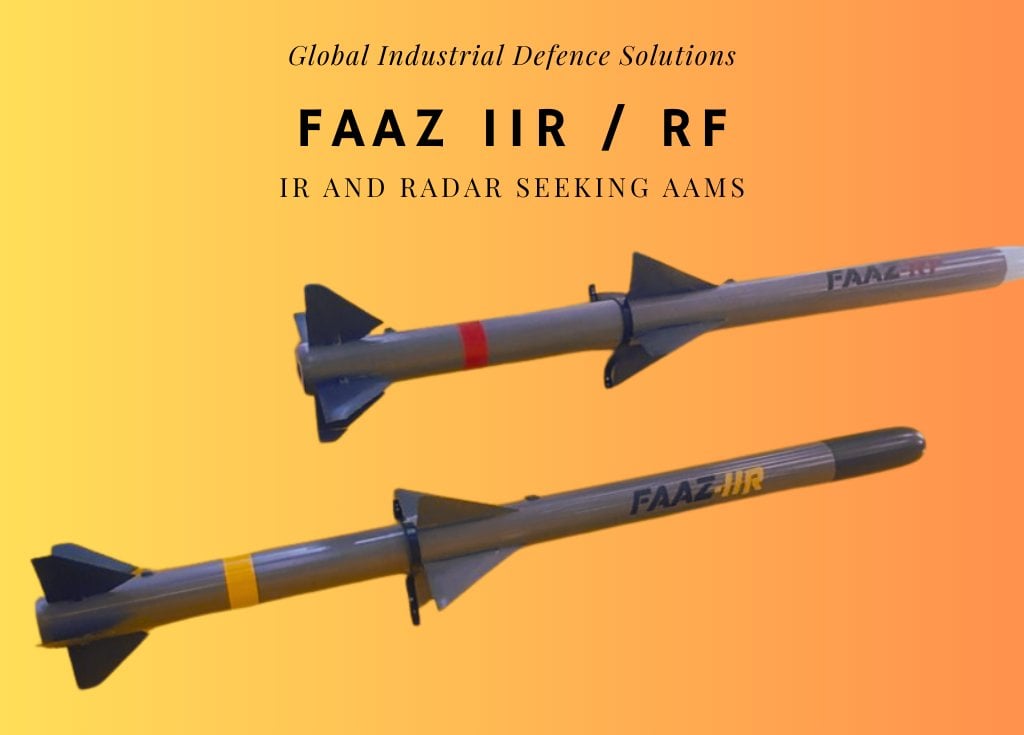
The Pakistan Air Force is set to unveil the advanced FAAZ-II beyond-visual-range air-to-air missile, featuring a maximum range approaching 200 km that positions it competitively with leading systems like China’s PL-15.
ISLAMABAD: The Pakistan Air Force (PAF) is preparing to unveil the FAAZ-II, an advanced variant of its indigenous beyond-visual-range (BVR) air-to-air missile family, with a projected maximum range close to 200 kilometres, marking a major stride in domestic defence manufacturing and aerial combat capability.
This development comes as the PAF intensifies efforts toward self-reliance in precision-guided munitions amid evolving regional air threats.
The FAAZ family, developed by Global Industrial and Defence Solutions (GIDS), represents Pakistan’s push for indigenous high-tech weaponry.
The baseline FAAZ-1 series offers a range of 100 km, equipped with active radar homing (ARH) or imaging infrared (IIR) seekers and capable of Mach 3.5 speeds.
The FAAZ-II builds on this foundation with significant enhancements, primarily in propulsion and guidance to achieve extended reach.
Official specifications from GIDS roadmaps and exhibitions, including displays at IDEF 2023 and the company’s “Road to Future” portfolio, list the FAAZ-2 with a maximum range of 180 km.
Defence analysts and recent reports indicate ongoing refinements that could push effective performance closer to 200 km under optimal launch conditions, such as high-altitude releases from modern fighters.
This range would surpass the PAF’s current imported PL-15E variant, which is limited to around 145 km in export configuration.
The domestic PL-15 (non-export) has been reported with ranges up to 200-300 km in some assessments, though operational figures vary based on platform and environment.
By developing FAAZ-II indigenously, the PAF aims to reduce dependency on foreign suppliers while achieving comparable or superior engagement envelopes.
The missile incorporates likely dual-pulse solid rocket motors for sustained energy in the terminal phase, enabling better no-escape zone performance against manoeuvring targets.
It supports both ARH and IIR seeker options, providing flexibility against jamming and low-observable threats.
Targets include fighter aircraft, unmanned aerial vehicles, helicopters, and potentially cruise missiles in defensive roles.
Integration is planned for platforms like the JF-17 Block-III, J-10CE, and future acquisitions, enhancing networked air combat through data links.
This aligns with broader PAF modernisation, including AESA radar upgrades and stand-off weapons like the Taimoor cruise missile.
The FAAZ-II project reflects collaboration influences, including reported technical exchanges with Turkey on BVR systems, blending expertise from projects like Gökdoğan.
Such partnerships accelerate maturation while preserving core indigenous design.
Development timelines show prototypes displayed since 2023, with testing phases advancing steadily.
Unveiling is expected soon, potentially at a defence exhibition or official PAF event, showcasing flight tests or integration milestones.
Experts note that while stated ranges represent maximum kinematic potential, real-world no-escape zones depend on factors like launch altitude, speed, target aspect, and electronic warfare environment.
Even so, a near-200 km capability would significantly extend PAF’s first-shot advantage in contested airspace.
This milestone underscores Pakistan’s growing defence industrial base, from short-range systems to long-range precision munitions.
It complements recent advancements, such as the Taimoor air-launched cruise missile tested successfully in early 2026 with 600 km range.
The FAAZ-II positions Pakistan among a select group of nations producing advanced BVR missiles domestically.
As regional air forces upgrade fleets, indigenous long-range weapons ensure credible deterrence and operational flexibility.
The unveiling will likely highlight Pakistan’s commitment to technological sovereignty in aerial defence.