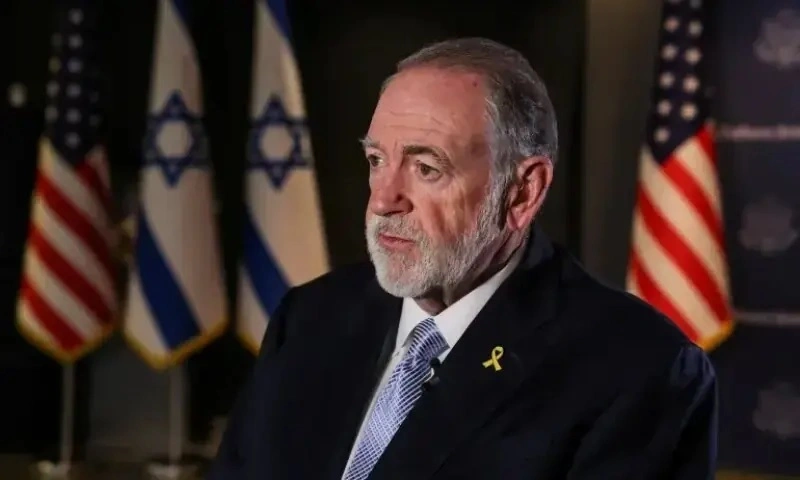
ISLAMABAD: Pakistan and 13 other nations have strongly condemned recent remarks by US Ambassador to Israel Mike Huckabee suggesting it would be acceptable for Israel to control vast territories across the Middle East.
The controversy erupted following Huckabee’s interview with conservative commentator Tucker Carlson, released on Friday. In the discussion, Huckabee, a former Baptist minister and long-time proponent of Israel, defended the country’s borders by referencing biblical promises.
Carlson referenced Genesis 15:18, which describes land promised to Abraham’s descendants stretching from the Nile River in Egypt to the Euphrates River in Iraq. This biblical expanse would encompass modern-day Israel, Jordan, Lebanon, Syria, and significant portions of Iraq and Saudi Arabia.
When pressed on whether Israel held a right to this territory, Huckabee responded that it would be fine if Israel took it all. He quickly qualified the statement by noting that Israel was not actively seeking such expansion and focused instead on security within its current legitimate holdings.
The remarks ignited immediate backlash across the region. Huckabee, confirmed as ambassador in April 2025 following Senate approval, has been a vocal supporter of Israel since his appointment under President Donald Trump.
On Sunday, a joint statement issued by the foreign ministries of Pakistan, Egypt, Jordan, the United Arab Emirates, Qatar, Indonesia, Kuwait, Oman, Turkiye, Saudi Arabia, Bahrain, Lebanon, Syria, and Palestine expressed profound concern and strong condemnation.
The Organisation of Islamic Cooperation, the League of Arab States, and the Gulf Cooperation Council also endorsed the statement. Signatories described Huckabee’s comments as dangerous and inflammatory.
The statement highlighted that such assertions contradict ongoing US-led efforts to contain escalation in the region. It specifically referenced President Trump’s vision and a comprehensive plan aimed at ending the Gaza conflict through tolerance and peaceful coexistence.
Officials stressed that remarks legitimizing control over territories belonging to other states undermine these objectives. They fuel tensions and amount to incitement rather than promoting peace.
The joint declaration reaffirmed that Israel holds no sovereignty over occupied Palestinian territories or other Arab lands. It called for adherence to international law and respect for established borders.
Huckabee’s comments have drawn widespread criticism from Arab and Muslim-majority countries. Governments viewed the biblical justification as a threat to regional stability amid fragile diplomatic balances.
The interview occurred against a backdrop of strained relations in the Middle East. Ongoing conflicts and negotiations make any suggestion of territorial expansion highly sensitive.
Analysts note that Huckabee’s evangelical background informs his strong pro-Israel stance. His appointment reflected priorities of the current US administration in strengthening ties with Israel.
The swift regional response underscores unified opposition to perceived threats against sovereign territories. Countries involved represent a broad coalition spanning the Arab world, Asia, and key Islamic organizations.
Pakistan’s Foreign Office highlighted the statement on Sunday, emphasizing collective concern over implications for peace efforts. The response aligns with Islamabad’s consistent position on Palestinian rights and regional sovereignty.
Egypt, Jordan, and Gulf states echoed similar sentiments, prioritizing de-escalation over provocative rhetoric. Indonesia and Turkiye added weight from beyond the immediate region.
The condemnation arrives as diplomatic channels seek to advance stability. It serves as a reminder of sensitivities surrounding historical and religious claims in territorial disputes.
Observers anticipate further scrutiny of US diplomatic language in the region. Huckabee’s role as ambassador places him at the center of bilateral relations between Washington and Tel Aviv.
The episode highlights tensions between religious interpretations and modern geopolitics. Biblical references to land promises continue to influence certain political narratives.
Regional leaders urged restraint in public statements to avoid exacerbating divisions. The joint statement called for focus on dialogue and mutual respect.
This development may influence future US engagements in the Middle East. It underscores the importance of calibrated diplomacy in a volatile landscape.