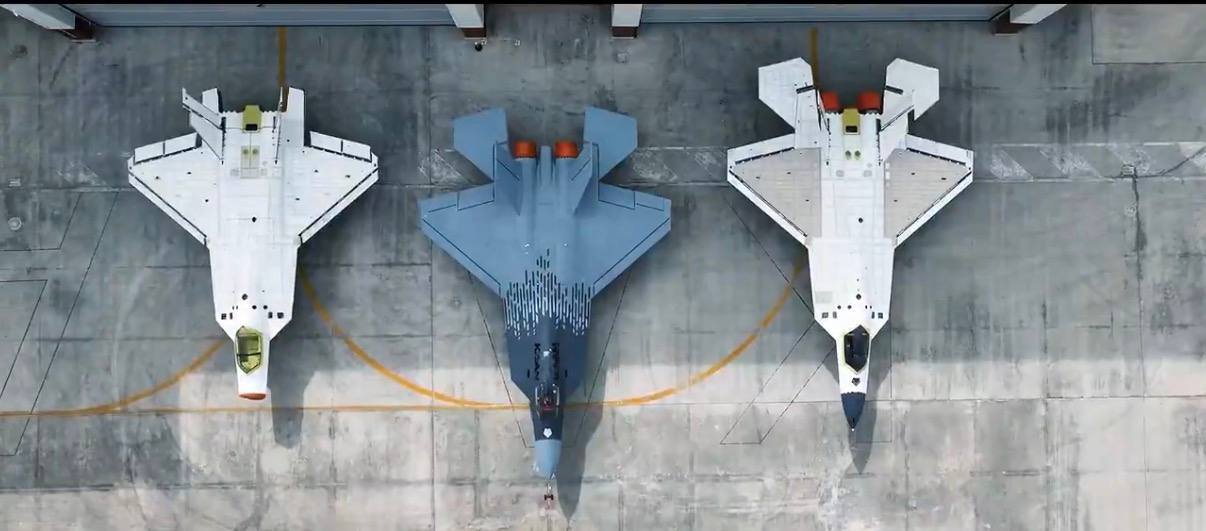
ISLAMABAD: Turkish Aerospace Industries has unveiled evolved prototypes of the KAAN fifth-generation fighter jet featuring refined design elements and advanced sensor integration, marking a significant milestone in Türkiye’s push for sovereign air combat capabilities.
The release of new footage on February 21, 2026, exactly two years after the aircraft’s maiden flight, showcases three distinct prototypes: P0, the initial flying demonstrator from 2024, alongside P1 and P2 in more advanced configurations.
These prototypes represent a shift from basic flight validation to comprehensive systems testing, with structural modifications aimed at optimizing internal volume, enhancing stealth features, and accommodating sophisticated onboard electronics.
The KAAN program, valued at billions, positions Türkiye among a select group of nations independently developing fifth-generation combat aircraft, comparable to the American F-35, Chinese J-20, and Russian Su-57.
Key design refinements include repositioned and enlarged air intakes for improved engine performance, faceted apertures for infrared search and track systems, and provisions for electro-optical targeting under the nose.
At the heart of the aircraft lies ASELSAN’s MURAD active electronically scanned array radar, utilizing gallium nitride technology for superior detection and tracking in contested environments.
This radar integrates with a broader suite encompassing infrared search and track, distributed aperture systems, and electro-optical sensors, all fused through a central processing unit to deliver enhanced situational awareness and network-centric warfare potential.
The platform incorporates low-observable shaping, radar-absorbent materials, internal weapons bays, and edge alignment to minimize radar cross-section against modern threats.
Powered initially by General Electric F110 engines, the twin-engine design supports supersonic performance, with long-term plans for an indigenous powerplant to achieve full operational independence.
Türkiye’s Defense Industries Presidency has emphasized parallel development of multiple prototypes to accelerate testing phases, with additional airframes like P3 planned for 2026 integration trials.
The program targets initial deliveries to the Turkish Air Force around 2028-2030, evolving from interim configurations toward mature fifth-generation standards once domestic engines mature.
Beyond national requirements, the KAAN attracts international interest as an alternative to Western systems often restricted by political conditions.
Pakistan has emerged as a key prospective partner, with longstanding defense ties between Islamabad and Ankara driving deeper collaboration on the project.
Reports indicate that hundreds of Pakistani engineers have contributed to KAAN development since earlier phases, building expertise in advanced aerospace systems.
Agreements discussed in recent years point toward establishing a joint production facility in Pakistan, enabling localized manufacturing of subsystems and potentially customized variants for the Pakistan Air Force.
Such cooperation would share development costs, facilitate technology transfer, and train Pakistani personnel in cutting-edge fighter jet production.
The Pakistan Air Force has expressed keen interest in inducting the KAAN, viewing it as a strategic asset to modernize its fleet amid regional security dynamics.
Projections suggest possible induction into PAF service by around 2030, aligning with Türkiye’s broader delivery timeline for operational blocks.
This partnership extends beyond acquisition to foster industrial growth, with potential for co-production enhancing both nations’ defense self-reliance.
The unveiling underscores Türkiye’s rapid progress in maturing the KAAN from conceptual design to a multi-prototype fleet, reinforcing its ambition for airpower sovereignty.
As flight testing intensifies throughout 2026, the program advances toward validating stealth credentials, sensor fusion reliability, and multirole flexibility in air superiority and ground attack missions.
Observers note that sustained momentum could position KAAN as a viable export contender, particularly in regions seeking diversified fifth-generation options without stringent end-user agreements.
The developments highlight a broader trend in global defense where emerging powers invest in indigenous platforms to reduce foreign dependency and bolster strategic autonomy.