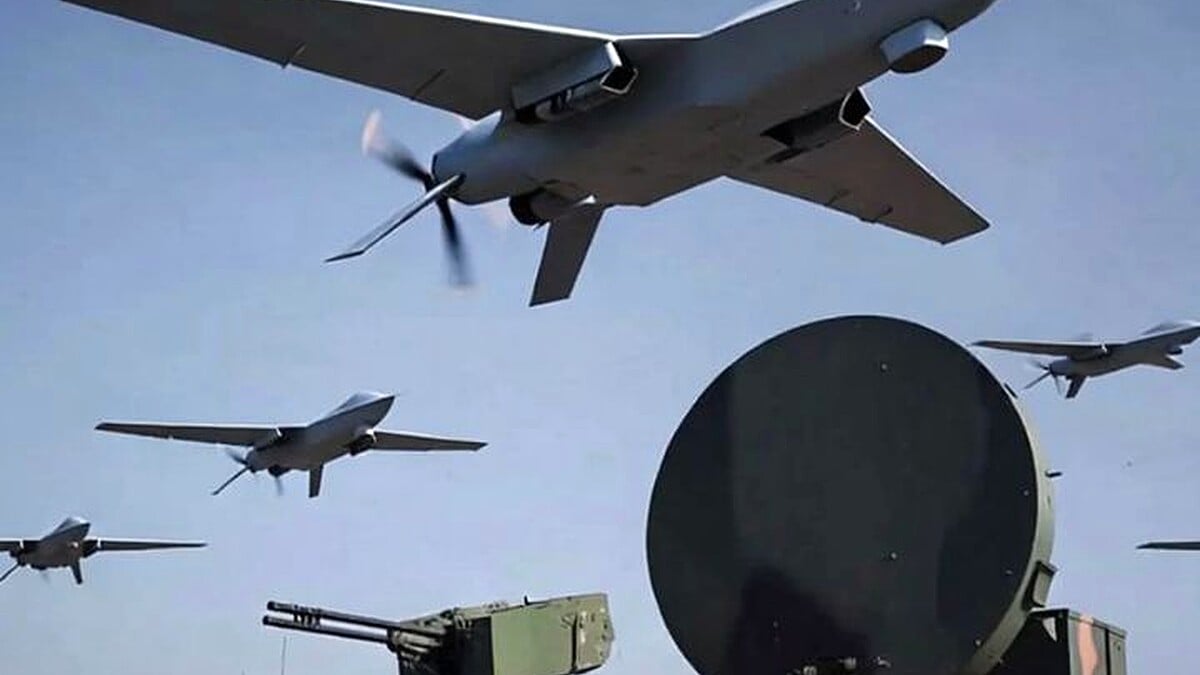
ISLAMABAD: India has rapidly developed a sophisticated layered counter-drone kill chain, integrating indigenous technologies with tri-service coordination to counter the growing threat of unmanned aerial vehicles (UAVs) along its borders.
This multi-layered approach combines detection, tracking, jamming, and kinetic neutralization, aiming to create an impenetrable shield against drone incursions.
At the core of India’s defenses stands the D4 system, developed by the Defence Research and Development Organisation (DRDO) and produced by Bharat Electronics Limited (BEL).
The D4 provides 360-degree coverage for detecting and neutralizing micro and small UAVs within a 1-1.25 km range, available in static and vehicle-mounted configurations.
It integrates radar, electro-optical sensors, radio frequency detection, jamming, and directed energy options for soft and hard kills.
Complementing this is Bhargavastra, a low-cost, AI-enabled hard-kill system from Solar Defence and Aerospace Limited.
Designed specifically to tackle drone swarms, it features radar detection up to 6 km and a strike range of 2.5 km, capable of launching up to 64 micro-missiles simultaneously.
The system employs unguided micro-rockets for area saturation against groups and guided variants for precise targeting of evasive threats.
Zen Technologies contributes with its multi-layer Counter-Unmanned Aerial System (C-UAS), incorporating radar, camera tracking, GPS jamming, and kinetic interception methods.
Recent contracts worth billions of rupees have upgraded these platforms, enhancing multi-sensor fusion for rapid response.
Indrajaal, an AI-powered autonomous system from Grene Robotics, offers wide-area protection covering up to 4,000 square kilometers.
It enables real-time detection, identification, and neutralization across critical infrastructure, including mobile units for dynamic deployment.
Dronaam provides a compact, tactical solution with directional and omnidirectional coverage, deployable as rifle-style or backpack units for frontline forces.
These systems form a comprehensive ecosystem, blending soft-kill electronic warfare with hard-kill munitions to address threats from micro-drones to larger armed UAVs.
Pakistan maintains a diverse and advancing drone arsenal, drawing from indigenous developments alongside Chinese and Turkish platforms.
Indigenous assets include the Burraq, an armed reconnaissance UAV capable of precision strikes, and the Shahpar series, with Shahpar-II and emerging Shahpar-III variants offering extended endurance and payload options.
Pakistan has integrated Chinese Wing Loong II drones, produced jointly in significant numbers, equipped with synthetic aperture radar and multiple hardpoints for guided munitions.
Turkish contributions feature Bayraktar TB2, proven in various conflicts for reconnaissance and strike roles, alongside Akinci models with higher altitude and payload capacities.
These platforms incorporate advanced features such as low-observable designs in some cases, electronic countermeasures, and autonomous navigation to potentially challenge detection systems.
Analysts note that while India’s layered defenses have demonstrated some effectiveness in neutralizing incursions, including reported swarm attacks, however, Pakistan advanced drones with jamming resistance, low-altitude flight profiles, and swarm tactics could exploit gaps.
The cost asymmetry remains a factor: inexpensive offensive drones force expensive defensive responses, potentially straining resources in prolonged scenarios.
Pakistan’s emphasis on redundancy, mobility, and dispersed operations contrasts with India’s capital-intensive integration of high-end sensors and networks.
Recent border incidents highlight this dynamic, with India’s systems intercepting numerous attempts, yet raising questions about long-term penetration capabilities against evolving threats from Pakistan drones fleet.
Experts suggest that neither side holds absolute dominance, however, Pakistan rapid indigenous drone technology coupled with Turkish transfer of technology will pose big threat to Indian Air Defence System in any future conflict.
India’s focus on indigenous innovation under Make in India continues to expand its counter-drone portfolio, while Pakistan leverages partnerships to enhance offensive UAV resilience.
The aerial domain along the Line of Control thus represents a critical arena where technological adaptation and operational tactics will determine future outcomes.