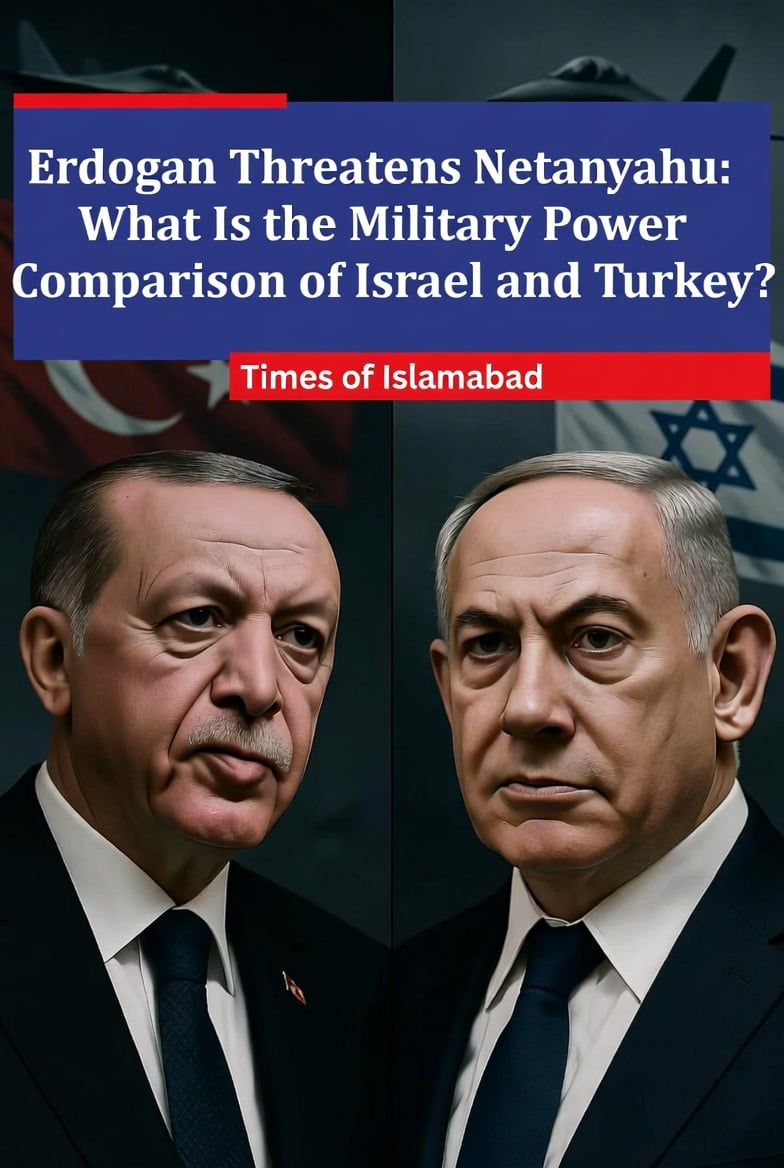




ISLAMABAD: Turkish President Recep Tayyip Erdogan’s warning of possible military action against Israel over its continued strikes in Iran and Lebanon has sharply escalated regional tensions, bringing into focus not only political confrontation but also a complex and high-stakes military comparison between two technologically advanced and battle-hardened forces.
The statement has triggered widespread debate among defence analysts regarding whether Turkey, a major NATO military power, could challenge Israel’s highly advanced and combat-proven military, especially in a scenario where the United States either remains neutral or actively supports Israel.
Turkey fields one of the largest armed forces in the region with approximately 355,000 active personnel and a reserve strength nearing 400,000, offering significant manpower depth and operational endurance, while Israel relies on a smaller standing force of around 170,000 but maintains a highly efficient mobilisation system that can rapidly expand its ranks to over 600,000 during wartime.
On land, Turkey holds a numerical advantage with more than 2,200 tanks, supported by thousands of armoured vehicles and modern artillery systems, while Israel’s smaller tank fleet, dominated by the Merkava series, is widely considered technologically superior with advanced protection systems, integrated battlefield networking, and high survivability in combat environments.
Air power remains a decisive domain where Israel maintains a qualitative edge through its fleet of F-35 stealth fighters, advanced F-15 and F-16 aircraft, and a robust integrated air defence network that includes multi-layered missile shields such as Iron Dome, David’s Sling, and Arrow systems.
Turkey operates a large fleet of F-16 aircraft but has faced limitations following its exclusion from the F-35 programme, prompting Ankara to accelerate indigenous defence projects including the KAAN fifth-generation fighter and upgrades to its existing fleet with advanced avionics and electronic warfare systems.
A critical area where Turkey has demonstrated significant global impact is in unmanned aerial systems, with platforms such as the Bayraktar TB2, Akinci, and Anka drones transforming modern warfare dynamics through precision strikes, surveillance, and cost-effective force projection, as seen in conflicts across Libya, Syria, and the Caucasus.
These drones provide Turkey with a strong asymmetric advantage, allowing it to conduct sustained operations, gather real-time intelligence, and target enemy assets with high precision, potentially offsetting Israel’s air superiority in certain operational scenarios.
In the missile domain, Israel maintains a formidable arsenal of precision-guided munitions and long-range strike capabilities, including air-launched cruise missiles and ballistic missile defence systems, while Turkey has rapidly expanded its indigenous missile programme with systems such as the Bora short-range ballistic missile, capable of striking targets at distances exceeding 280 kilometres.
Turkey is also developing longer-range missile capabilities under programmes such as Tayfun, which signals Ankara’s ambition to extend its strategic reach and enhance deterrence against regional adversaries, complementing its growing inventory of guided rockets and cruise missiles.
Electronic warfare and airborne early warning capabilities are critical in modern conflicts, where Turkey operates Boeing 737 AEW&C Peace Eagle aircraft, providing advanced radar coverage, command and control, and real-time battlefield coordination across large operational areas.
Israel, however, maintains a highly sophisticated electronic warfare ecosystem, integrating airborne platforms, cyber capabilities, and space-based intelligence to achieve situational dominance, often giving it an early warning and targeting advantage in high-intensity conflicts.
Satellite and space-based capabilities further tilt the technological balance, with Israel possessing advanced reconnaissance satellites capable of high-resolution imaging and real-time intelligence gathering, while Turkey has made significant progress with indigenous satellite programmes such as Göktürk, enhancing its surveillance and communication capabilities.
Naval power presents a more balanced comparison, with Turkey operating over 150 vessels including frigates, corvettes, submarines, and the amphibious assault ship TCG Anadolu, which significantly enhances its ability to project power across maritime regions.
Israel’s navy, though smaller, focuses on high-end capabilities including missile-equipped corvettes and advanced submarines believed to provide second-strike capabilities, ensuring strategic deterrence despite limited fleet size.
Geography remains a critical factor, as Turkey’s vast landmass provides strategic depth and logistical resilience, while Israel’s compact geography makes it more vulnerable to sustained missile and drone attacks but also enables rapid mobilisation and concentrated defence.
In a scenario where the United States does not intervene, military analysts suggest that Turkey’s advantages in manpower, industrial capacity, drone warfare, and missile development could allow it to sustain a prolonged conflict, gradually applying pressure through attrition and multi-domain operations.
However, Israel’s technological superiority, integrated defence systems, and ability to deliver rapid, high-precision strikes could enable it to achieve early operational gains, potentially neutralising key Turkish assets before Ankara can fully leverage its numerical strengths.
If the United States enters the conflict in support of Israel, the balance shifts overwhelmingly, as American air and naval power, combined with advanced missile defence and global logistics, would significantly constrain Turkey’s operational capabilities and likely deter prolonged engagement.
Such a development would also create unprecedented strain within NATO, given Turkey’s membership in the alliance, potentially leading to a broader geopolitical crisis with implications extending far beyond the immediate conflict zone.
Economic sustainability and defence production capacity would play a decisive role in any extended conflict, where Turkey’s expanding defence industry, including domestic drone, missile, and naval production, offers long-term resilience, while Israel’s high-tech defence sector ensures continuous innovation and rapid adaptation.
Regional dynamics would further complicate the situation, as Turkey could garner political and strategic support from segments of the Muslim world, while Israel maintains strong ties with Western powers and growing cooperation with several Middle Eastern states.
Analysts warn that any direct confrontation between Turkey and Israel would likely escalate into a multi-domain conflict involving cyber warfare, missile exchanges, drone swarms, and proxy engagements across multiple theatres, increasing the risk of a wider regional war.
Erdogan’s warning, whether viewed as strategic signalling or a genuine escalation pathway, underscores the fragile nature of current Middle Eastern geopolitics, where overlapping conflicts and competing alliances can rapidly converge into a larger crisis.
As tensions continue to rise, the comparison of Turkish and Israeli military capabilities highlights not only the strengths of both nations but also the immense risks associated with any direct confrontation, the consequences of which would extend far beyond the battlefield and reshape regional power structures for years to come.