ISLAMABAD: The United States Navy, widely regarded as the most formidable naval force in history, has declined near-daily requests from the global oil and shipping industries to provide military escorts for commercial vessels through the Strait of Hormuz.
This decision comes despite massive US naval deployments in the region and President Donald Trump’s public statements offering such protection if necessary.
Reuters reported on March 10 that the US Navy has consistently refused these requests since the onset of Operation Epic Fury, the US-led military campaign against Iran that began on February 28.
Sources familiar with briefings between the Navy and industry representatives confirmed that the risk of Iranian attacks remains too high for safe escort operations at present.
The Strait of Hormuz, a narrow 33-kilometre-wide waterway at its narrowest point, connects the Persian Gulf to the Gulf of Oman and carries approximately one-fifth of the world’s daily oil consumption.
Disruptions here have already caused significant volatility in global energy markets, with oil prices surging amid halted or reduced transits.
Operation Epic Fury targets Iranian military infrastructure, including naval assets, missile sites, and command centres, to degrade Tehran’s ability to threaten regional shipping.
US Central Command has reported striking over thousands of targets, including the destruction of multiple Iranian naval vessels, mine-laying craft, and capabilities near the strait.
Despite these efforts to neutralise threats, the Navy assesses that residual Iranian asymmetric warfare options persist.
These include fast attack boats, drones, mines, and anti-ship missiles from the Islamic Revolutionary Guard Corps Navy, which specialises in operations in confined waters like the strait.
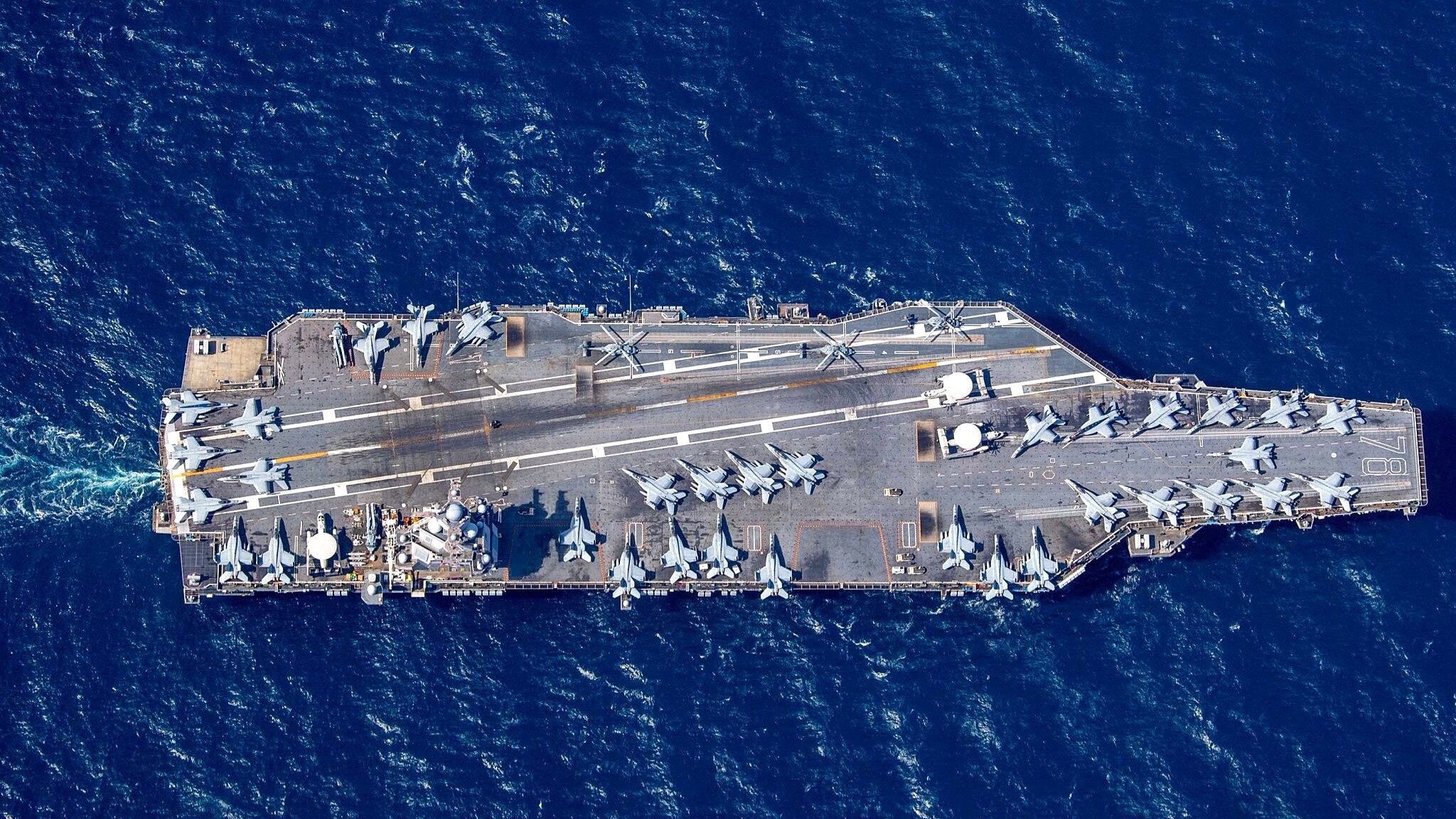
The US maintains substantial carrier strike groups in theatre to support ongoing operations.
The USS Abraham Lincoln carrier strike group operates in the Arabian Sea, providing airpower for strikes and regional deterrence.
The USS Gerald R. Ford, the Navy’s newest supercarrier, transited the Suez Canal and now patrols the Red Sea, extending its deployment to bolster presence.
Reports indicate the USS George H.W. Bush has completed pre-deployment exercises and may soon join, potentially marking three nuclear-powered supercarriers concentrated near the conflict zone.
Each carrier displaces around 100,000 tons, embarks up to 75 aircraft including advanced fighters like F-35C Lightning II and F/A-18E/F Super Hornets, and is protected by Aegis-equipped cruisers and destroyers with sophisticated radar and missile defence systems.
Allied contributions include France’s Charles de Gaulle carrier group in the Eastern Mediterranean and Red Sea, alongside Britain’s HMS Dragon Type 45 destroyer supporting air defence in the region.
This combined firepower represents overwhelming conventional superiority over most national militaries worldwide.
Yet the Navy’s refusal highlights the challenges of escorting individual tankers in a high-threat environment.
Industry sources noted regular briefings where the Navy explained that escorts are under review but not feasible until risks decrease further.
President Trump has repeatedly stated readiness to escort tankers and provide war risk insurance through mechanisms like the US Development Finance Corporation.
However, military officials emphasise that options remain under assessment, with no escorts implemented to date.
The White House clarified this position after a deleted social media post by Energy Secretary Chris Wright erroneously claimed a successful escort.
Press Secretary Karoline Leavitt confirmed no such operations have occurred, though they could if conditions allow.
Iran’s Revolutionary Guards have challenged US intentions, with spokespersons welcoming potential escorts as opportunities for confrontation.
Threats to close the strait or attack vessels have already reduced traffic sharply, with some ships hit in recent incidents.
Shipping analysis indicates shadow fleet vessels continue limited transits, but mainstream commercial traffic has plummeted.
This standoff underscores the strategic vulnerability of global energy flows despite US dominance at sea.
The Navy’s cautious stance reflects a calculation that direct escorts could expose assets to unnecessary risks before Iranian capabilities are fully suppressed.
Ongoing strikes aim to create safer conditions, but the strait remains a contested domain where asymmetric tactics complicate traditional naval protection.
As Operation Epic Fury enters its second week, the focus stays on degrading Iranian threats to enable secure navigation.
Until then, the refusal to escort single tankers illustrates the gap between overwhelming power projection and the practical demands of safeguarding commerce in contested chokepoints.
Global markets watch closely, as prolonged disruptions could sustain elevated oil prices and strain energy security.