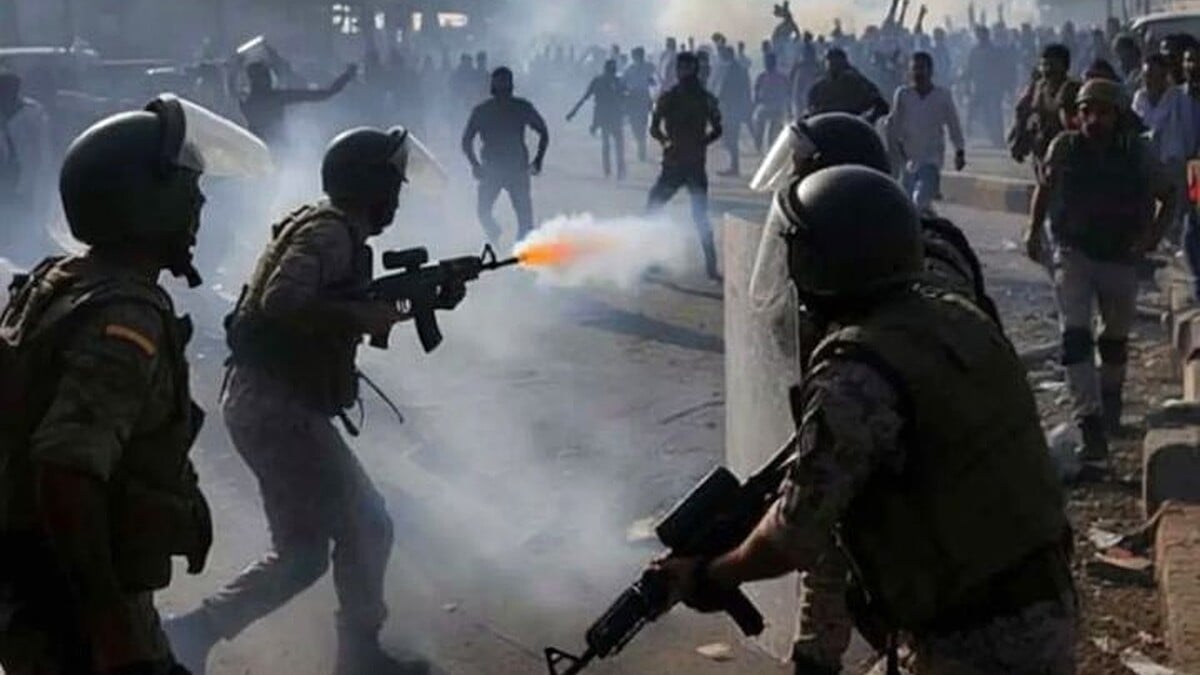
ISLAMABAD: Bahrain has deployed specialized Jordanian anti-riot troops to reinforce local security forces in suppressing protests sparked by the kingdom’s support for the United States in its ongoing military confrontation with Iran, according to multiple regional reports and US diplomatic sources.
The move represents the first foreign military assistance for internal crowd control in Bahrain since the 2011 Arab Spring uprising, when Saudi-led Peninsula Shield Force units intervened to aid the monarchy against mass demonstrations.
Protests have surged in Manama and surrounding areas, driven by public outrage over Bahrain’s hosting of the US Navy’s Fifth Fleet headquarters, which has become a primary target in Iran’s retaliatory strikes following joint US-Israeli operations against Iranian facilities starting late February 2026.
Demonstrators, largely from the Shia-majority community, have demanded the immediate withdrawal of US forces, viewing the military presence as a direct invitation for conflict that endangers civilian lives and national sovereignty.
Clashes have escalated with reports of protesters using Molotov cocktails against police lines, while security forces responded with tear gas, batons, and mass arrests, including individuals sharing footage of Iranian missile impacts on social media.
The Bahraini government has imposed strict restrictions on filming or disseminating videos of strikes, citing national security concerns, with warnings of legal consequences for violations.
Iranian attacks on Bahrain have included missile and drone barrages targeting the Fifth Fleet base in Juffair and nearby infrastructure, such as refineries, causing fires, structural damage estimated in hundreds of millions of dollars, and civilian casualties including dozens wounded.
Bahrain’s defenses intercepted numerous projectiles, but some penetrated, leading to residential area impacts and at least three confirmed deaths from related incidents in early March.
The US State Department ordered the departure of non-emergency personnel and family members from Bahrain, alongside Jordan and Iraq, amid heightened risks from Iranian retaliation targeting US-allied sites.
This evacuation reflects the vulnerability of over 9,000 US personnel stationed at the Fifth Fleet facility, the second-largest American military presence in the Middle East by troop count.
Jordan’s involvement stems from its own strategic alignment with the US and shared concerns over regional instability, as the kingdom has intercepted Iranian projectiles and hosts American assets.
Jordanian units, trained in anti-riot and crowd management, have been positioned to support Bahraini police in high-tension zones, aiming to prevent the unrest from spiraling into broader disorder.
Analysts highlight how the conflict has reignited longstanding sectarian grievances in Bahrain, where the Sunni ruling Al Khalifa family faces persistent allegations of marginalizing the Shia population.
Protests echo elements of the 2011 uprising, though current demonstrations tie directly to geopolitical alignments rather than purely domestic reforms.
The monarchy perceives the unrest as a potential security threat amplified by external actors, prompting reliance on regional partners beyond traditional GCC frameworks.
The UN Security Council recently adopted a Bahrain-co-sponsored resolution condemning Iranian attacks on Gulf states and Jordan, backed by 135 countries with abstentions from China and Russia, affirming rights to self-defense while demanding cessation of hostilities.
Bahrain’s foreign ministry has described Iranian actions as violations of international law, emphasizing coordinated Gulf responses to external aggression.
Observers warn that foreign troop deployment could deepen public alienation, prolong demonstrations, and complicate efforts to de-escalate domestic tensions amid the wider war.
As air raid sirens continue intermittently and strikes persist, Bahrain maintains heavy security deployments in protest-prone neighborhoods like Sitra Island.
The fluid situation raises concerns over potential escalation if protests intensify or additional Iranian operations target Bahraini territory.
The kingdom’s strategic Gulf position underscores its critical role in US naval operations, yet this alignment now fuels significant internal dissent as the conflict disrupts regional stability and civilian security.