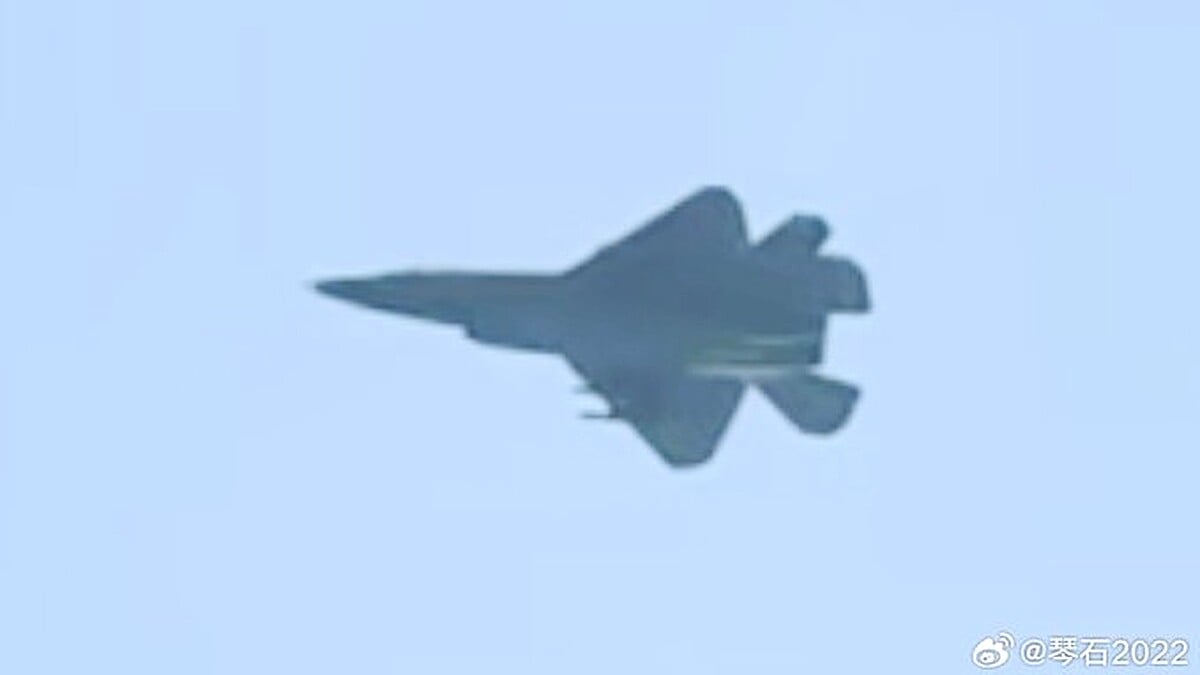
ISLAMABAD: In a significant development for China’s fifth-generation aviation programme, the Shenyang J-35 stealth fighter has been observed for the first time carrying an external weapons loadout, including what defence analysts identify as four beyond-visual-range air-to-air missiles, likely the PL-15 or the ultra-long-range PL-17.
This sighting represents a key milestone in the aircraft’s operational evolution, transitioning from primarily internal carriage configurations optimised for stealth to configurations that prioritise payload flexibility, even at the cost of reduced low-observability.
The J-35, derived from the earlier FC-31 Gyrfalcon prototype, has rapidly progressed since its public debut. State media reports indicate that the carrier-based variant completed electromagnetic catapult-assisted takeoffs and arrested landings on the Fujian carrier in 2025, while the land-based J-35A entered People’s Liberation Army Air Force service around the same period.
Production has accelerated, with Shenyang Aircraft Corporation announcing first flights of the year in early 2026 and revealing new units in serial production testing. Estimates suggest China could field hundreds of the type by the end of the decade.
The recent appearance with external pylons underscores ongoing efforts to enhance the fighter’s versatility. Internal weapons bays of the J-35 are designed to accommodate up to six shorter-range missiles, such as the PL-15, which offers ranges exceeding 200 kilometres and active electronically scanned array guidance.
However, the larger PL-17, measuring approximately six metres in length and capable of reaches up to 400 kilometres, cannot fit internally on most stealth platforms, including the J-35 or even the larger J-20. External carriage of such missiles, while compromising radar cross-section, allows integration of very-long-range capabilities for air denial missions.
Analysts note that this configuration mirrors practices seen on non-stealth platforms like the J-16, where the PL-17 has been operational since at least 2022-2023. The debut on the J-35 suggests testing of mixed loadouts to balance stealth with firepower in contested environments.
Pakistan has shown strong interest in an advanced export-oriented version of the J-35, often referred to interchangeably as FC-31 in earlier reports. Senior Pakistan Air Force officials confirmed intentions to acquire the type as early as 2024, with preparations for pilot training in China.
By mid-2025, Pakistani government sources disclosed an offer from Beijing for up to 40 J-35 stealth aircraft, potentially bundled with systems like the KJ-500 airborne early warning platform and HQ-19 air defence missiles. Deliveries were projected to commence within months, positioning Pakistan as the first foreign operator of this fifth-generation platform.
The attraction lies in the J-35’s multirole capabilities, including air superiority, precision strikes, and potential maritime roles. Its reported radar cross-section, described by Chinese sources as comparable to a sparrow or smaller than a human palm, incorporates advanced metamaterials and design refinements.
Paired with long-range missiles like the PL-15 or PL-17 in external configurations, the aircraft could extend engagement envelopes significantly, offering a qualitative edge in regional airpower dynamics.
Defence observers highlight that Pakistan’s pursuit aligns with broader modernisation goals following acquisitions of J-10C fighters and ongoing JF-17 upgrades. The J-35 would complement existing fleets by introducing true stealth and sensor fusion technologies.
Reports from 2025 indicate negotiations for 30-40 units, with possible induction timelines stretching into 2026-2027. While some uncertainties emerged in mid-2025 regarding finalisation, the strategic intent remains clear amid evolving security requirements.
This milestone for the J-35 not only demonstrates China’s maturing fifth-generation ecosystem but also underscores deepening Sino-Pakistani defence ties. As production ramps up and export variants mature, the platform’s integration of advanced weaponry like external BVR missiles could redefine operational doctrines in South Asia and beyond.
The development signals a shift toward greater payload options for stealth fighters, ensuring they remain effective across diverse threat scenarios while maintaining core low-observable advantages in primary configurations.