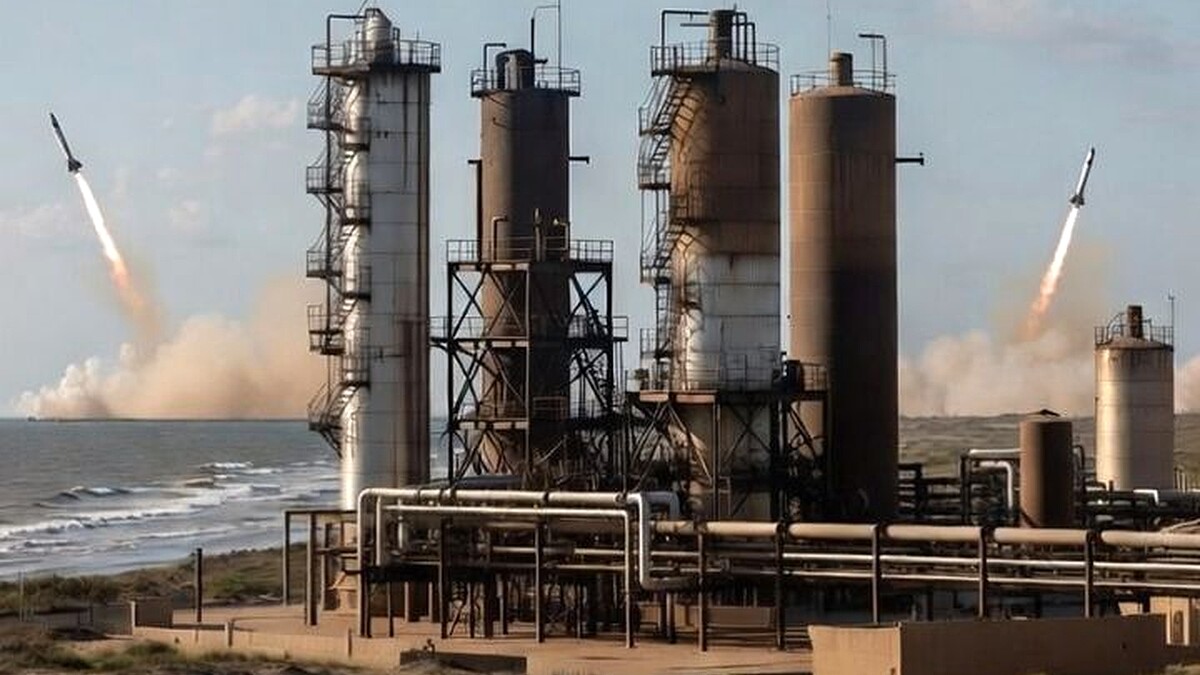




ISLAMABAD: Iran’s Islamic Revolutionary Guard Corps announced on Saturday that it targeted Israel’s Haifa refinery with Kheibar Shekan ballistic missiles in direct response to strikes on oil infrastructure in southern Tehran.
The IRGC statement described the action as immediate retaliation for what it termed an unprovoked assault by US and Israeli forces on energy reserves near the Iranian capital. Reports from Iranian state-affiliated media indicated that air raids hit oil storage tanks and related facilities in southern Tehran minutes earlier, triggering fires and prompting swift countermeasures.
This exchange marks a significant escalation in the ongoing conflict that began in late February 2026 with joint US-Israeli operations against Iranian military and nuclear sites. The targeting of energy infrastructure introduces a new dimension to the hostilities, raising concerns over potential disruptions to global oil supplies.
The Kheibar Shekan missile, a solid-fuel medium-range ballistic weapon developed by Iran, features maneuverable re-entry capabilities designed for precision strikes. Unveiled in recent years, it forms part of Iran’s advanced arsenal aimed at overcoming regional air defenses. Iranian officials have repeatedly highlighted its use in multiple waves of Operation True Promise 4, which has involved dozens of missile barrages since the conflict intensified.
Israeli military sources have not yet confirmed damage to the Haifa refinery, one of Israel’s key energy processing facilities located in the northern port city. Past incidents in the region have seen similar claims met with partial interceptions or limited impacts due to multilayered defense systems including Arrow and David’s Sling.
The Tehran strike reportedly focused on southern oil depots, with plumes of smoke observed by local witnesses. Fars News Agency, quoting IRGC channels, stated that the Haifa response occurred “right now” following the Tehran incident, underscoring the rapid tit-for-tat nature of the exchanges.
Broader context reveals a pattern of infrastructure targeting. US and Israeli forces have conducted thousands of strikes across Iran since late February, degrading ballistic missile launchers, production facilities, and command nodes. Pentagon assessments indicate a sharp decline in Iranian retaliatory missile volume, down by approximately 90 percent in recent days, attributed to successful suppression of launch capabilities.
Iran, however, maintains active operations through proxies and direct launches. Recent waves have targeted not only Israel but also US bases in Gulf states, with missiles like Khorramshahr-4 and Fattah employed alongside Kheibar Shekan variants.
The Haifa refinery holds strategic importance for Israel’s energy security, processing crude oil imports and supplying domestic needs. Any sustained damage could compound pressures on fuel availability amid heightened regional tensions.
Analysts note that energy sector attacks carry high risks of wider economic fallout. Oil prices have shown volatility in response to earlier exchanges, with fears of Strait of Hormuz disruptions adding to market uncertainty.
Iranian President Masoud Pezeshkian has reiterated defiance, stating that Tehran will not capitulate despite demands from US President Donald Trump for unconditional surrender. Pezeshkian also extended apologies to neighboring countries affected by spillover strikes, while vowing continued resistance.
The IRGC’s focus on Haifa aligns with prior declarations targeting military and security centers in the city during earlier barrages. Statements from early March referenced strikes on Haifa alongside Tel Aviv and other sites using similar missile systems.
Independent verification remains challenging in real-time due to information controls on both sides. Israeli restrictions on media footage from potential impact zones have limited visual confirmation of the latest claims.
The conflict has already resulted in significant casualties and infrastructure losses across multiple fronts, including Lebanon where Hezbollah has engaged in parallel actions. US forces report minimal personnel losses but acknowledge the sustained intensity of operations.
As exchanges continue, international observers express alarm over the potential for further escalation involving critical energy assets. The targeting of refineries signals a shift toward economic warfare elements within the broader military campaign.
Regional powers monitor developments closely, with implications for stability in the Persian Gulf and beyond. The IRGC’s latest statement reinforces Iran’s doctrine of proportionate retaliation against perceived aggressions on its territory.
This incident underscores the fragile balance in the Middle East theater, where rapid responses to strikes on strategic facilities could dictate the trajectory of the ongoing confrontation.