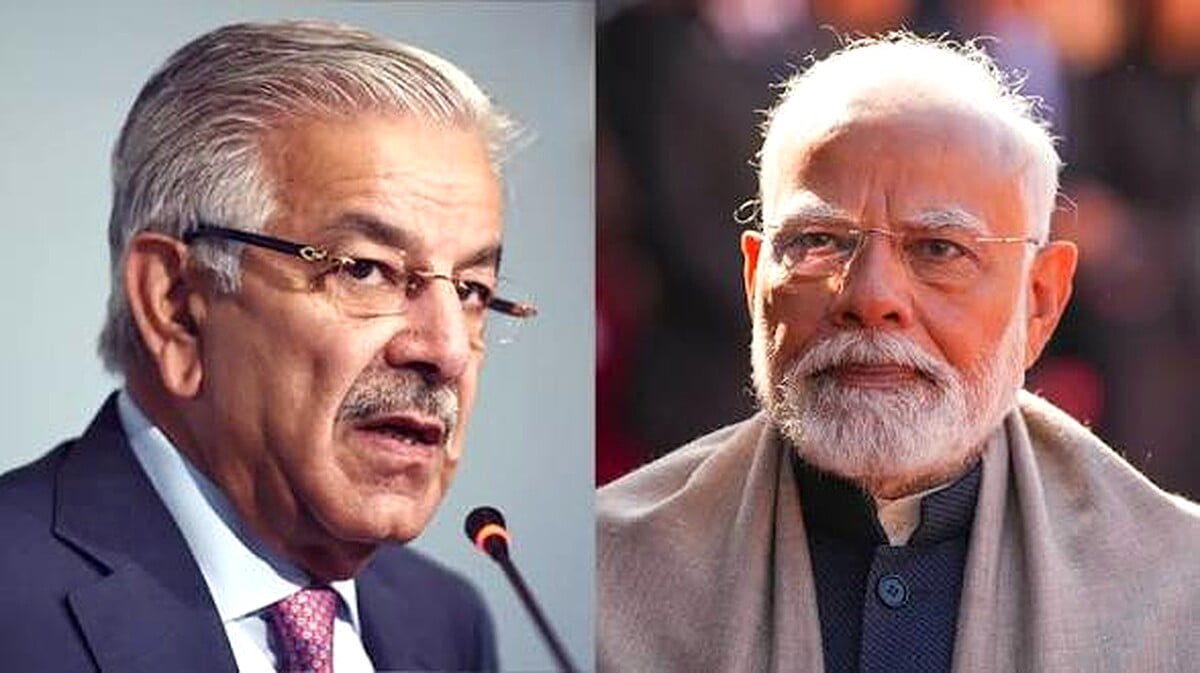




ISLAMABAD: Pakistan’s Defence Minister Khawaja Asif has delivered a blunt warning to India over any repeat of what he termed false flag operations or provocative steps.
He stated that previous responses stayed within 200 to 250 kilometres inside Indian territory but future action would extend far deeper.
Asif declared Pakistani forces would push all the way to Kolkata, roughly 2000 kilometres from Islamabad, leaving no room for doubt.
The message was aimed at both Indian leadership and its ally Israel, according to viral regional television clips and official statements.
Such penetration would cross multiple Indian states and reach West Bengal’s economic heartland.
Regional media including SAMAA TV and The Express Tribune reported the minister’s exact phrasing of striking “inside their homes” during live interviews this week.
International outlets such as The Hindu and NDTV covered the broader exchange with Indian Defence Minister Rajnath Singh but noted the calibrated tone without the full Kolkata reference.
Asif’s remarks came days before the first anniversary of the 2025 Pahalgam incident which Pakistan has consistently labelled a staged false flag that collapsed under international scrutiny.
In the 2019 Balakot crisis Indian airstrikes targeted sites approximately 60 to 80 kilometres inside Pakistan while Pakistan’s retaliation remained confined near the Line of Control.
Asif reminded audiences that nuclear-armed neighbours cannot afford illusions of limited war given the drastic consequences.
Pakistan maintains an estimated 170 nuclear warheads while India holds around 172 according to the latest Stockholm International Peace Research Institute assessments.
Pakistan’s active military strength exceeds 650000 personnel compared with India’s 1.4 million yet Islamabad relies on asymmetric capabilities and long-range systems.
The Shaheen-III missile in Pakistan’s arsenal boasts a verified range of 2750 kilometres easily covering the 2000-kilometre threshold mentioned.
India’s Agni-V missile offers similar intercontinental reach underscoring the mutual deterrence framework that has held since 1998.
Analysts tracking South Asian security note that defence budgets reflect the asymmetry with India spending over 80 billion dollars annually against Pakistan’s roughly 10 billion dollars.
Yet geography and rapid mobilisation times give Pakistan credible depth options in any escalation scenario.
Asif stressed Islamabad’s commitment to regional peace while insisting its resolve to defend sovereignty remains absolute and its preparedness complete.
The statement has triggered widespread debate across Pakistani social platforms with millions viewing clips of the fiery address.
Security experts caution that such public rhetoric though deterrent in intent carries risks of miscalculation in a region with multiple flashpoints.
Historical patterns after 2019 Pulwama and Balakot show both sides ultimately stepped back from full confrontation through back-channel diplomacy.
Nevertheless Asif’s latest intervention signals a doctrinal shift toward deeper retaliatory strikes if any manufactured crisis emerges.
Pakistani military sources privately affirm that modern precision munitions and real-time intelligence now enable operations well beyond the 250-kilometre limit of past engagements.
Global risk indices currently place India-Pakistan tensions in the high category with any false flag triggering rapid response chains.
Asif concluded by urging New Delhi to abandon threat-mongering that externalises internal political fragility.
The remarks arrive amid ongoing diplomatic efforts to stabilise the relationship yet underscore persistent trust deficits.
Observers believe the explicit Kolkata reference serves as symbolic messaging to underscore unlimited strategic depth rather than literal operational targeting.
Still the data-driven distance figures lend measurable weight to the deterrent posture articulated by Pakistan’s top defence official.