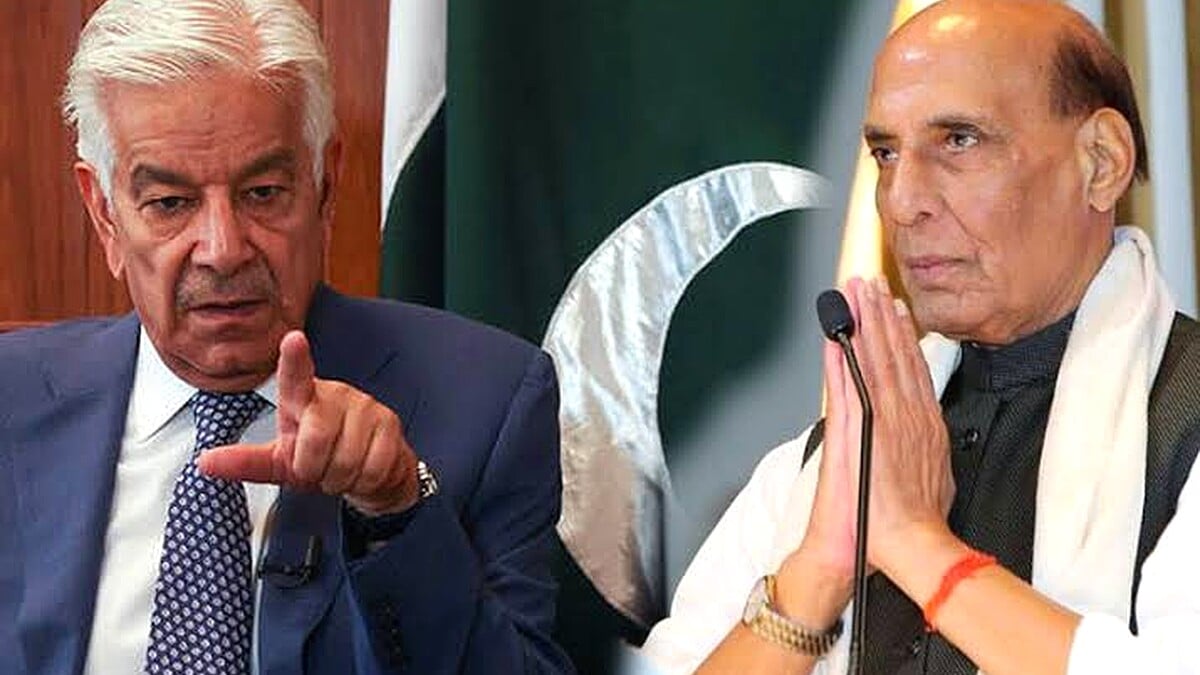




ISLAMABAD: Defence Minister Khawaja Asif has delivered a strong rebuttal to recent threat rhetoric from his Indian counterpart Rajnath Singh stating that any illusion of war between the two nuclear-armed neighbours would prove disastrous.
The Pakistani minister responded sharply through a public statement criticising India’s recurring pattern of hostile assertions amid ongoing regional tensions. He cautioned New Delhi against misadventure while highlighting Pakistan’s enhanced international standing as a trusted peace facilitator.
Rajnath Singh had earlier warned that any misstep by Pakistan in the current volatile climate particularly amid the West Asia conflict would invite an unprecedented and decisive response from India. He referenced past operations including Operation Sindoor to underscore India’s resolve in protecting its interests.
Asif countered by describing such statements as part of a familiar threat-mongering tactic. He stressed that Pakistan remains fully prepared to respond to any aggression while simultaneously playing a pivotal role in global de-escalation efforts.
Pakistan has emerged as a key intermediary in efforts to ease tensions between the United States and Iran. Foreign Minister Ishaq Dar confirmed that both sides have placed confidence in Islamabad to relay messages and host talks aimed at achieving a comprehensive settlement.
In late March 2026 Islamabad convened a high-level meeting of foreign ministers from Saudi Arabia Turkey and Egypt. The discussions focused on immediate ceasefire in West Asia protection of vital shipping routes through the Strait of Hormuz and strict adherence to international law.
The Strait of Hormuz accounts for nearly 20 per cent of global oil trade. Recent disruptions have already driven oil prices up by more than 15 per cent creating volatility in energy markets worldwide according to industry data.
Pakistan and China jointly advanced a five-point peace proposal calling for swift ceasefire structured negotiations and safeguards for critical maritime passages. This initiative followed detailed consultations in Beijing involving senior diplomats from both nations.
Defence Minister Asif pointed out that Pakistan’s diplomatic leverage has grown significantly. He noted unprecedented coordination with the United States on de-escalation matters and deepening trust within the broader Muslim world.
Regional media reports quote Asif asserting that India never anticipated Pakistan attaining such a position where its mediation becomes indispensable in major international conflicts. He contrasted this with what he termed India’s growing isolation on the global stage.
Pakistani officials have relayed a detailed 15-point ceasefire framework between Washington and Tehran. The proposal reportedly includes a 30-day initial truce measures on nuclear facilities limits on missile capabilities and phased lifting of sanctions tied to compliance.
These efforts coincide with Pakistan’s consistent advocacy for dialogue in the Russia-Ukraine conflict now entering its fifth year. At the United Nations Security Council Pakistani envoys have repeatedly called for immediate ceasefire and negotiations that respect legitimate security concerns of all parties.
Analysts observe that Pakistan’s unique relationships across divided parties enable rare backchannel communications. This capability has positioned Islamabad as a responsible actor capable of bridging divides where others face credibility challenges.
Asif emphasised that Pakistan’s defenders stand ready while the country prioritises peaceful resolution through diplomacy. He warned that any attempt to test Pakistan’s resolve would meet a firm and calibrated response.
The minister’s remarks come against the backdrop of the brief but intense India-Pakistan military engagement in May 2025. Both sides eventually agreed to ceasefire following direct military hotline contacts and international diplomatic interventions.
Pakistan maintains that its current diplomatic activism reflects a principled foreign policy favouring dialogue over confrontation. Officials highlight appreciation from multiple stakeholders seeking to prevent wider regional instability.
Defence Minister Asif’s latest statement underscores confidence in Pakistan’s trajectory. He indicated that the trust reposed in Islamabad by diverse international actors marks a notable shift and serves as a cornerstone of its strengthened global profile.
As tensions persist across West Asia and Eastern Europe observers continue to monitor Pakistan’s dual track of robust defence preparedness and active peace diplomacy.