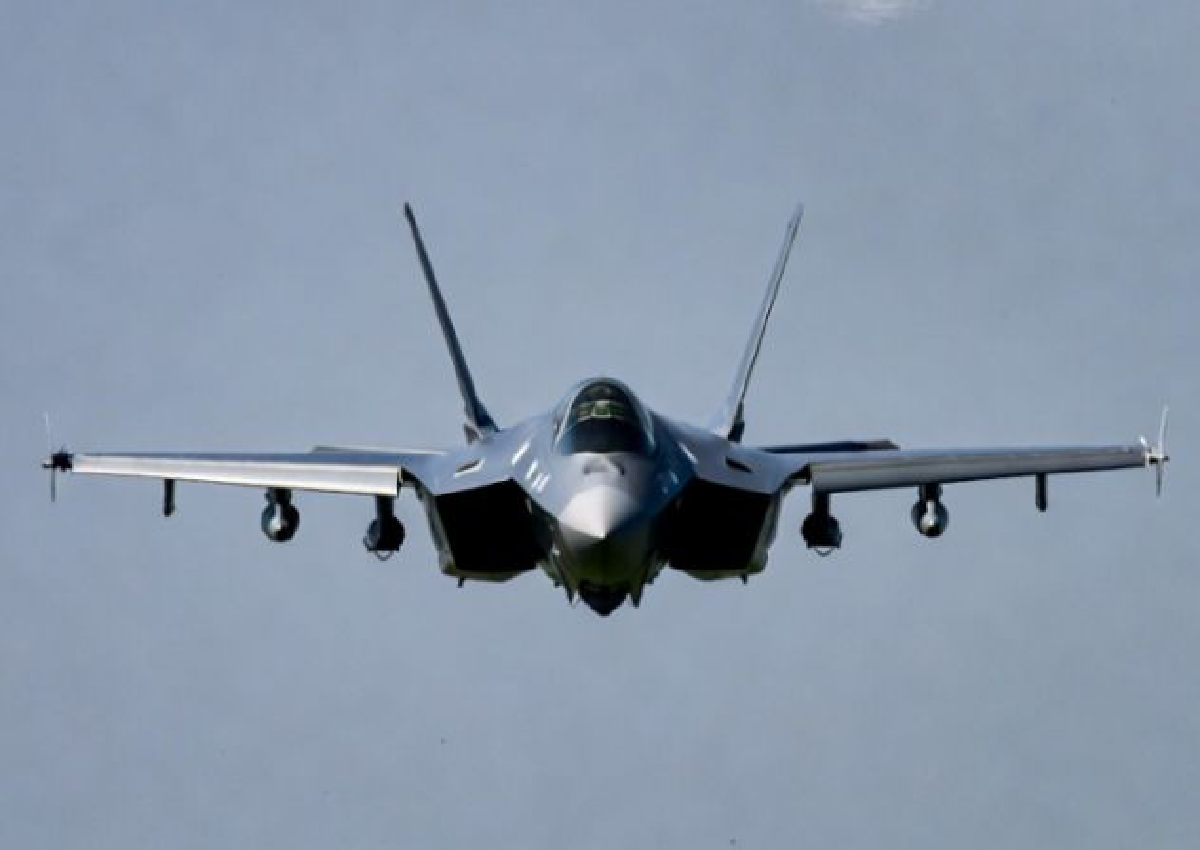




ISLAMABAD: The Pakistan Air Force (PAF) is poised to achieve a landmark in regional air power dynamics with the impending induction of China’s Shenyang J-35A fifth-generation stealth fighter, often referred to as the Grey Falcon, expected to commence in 2026. This development follows years of strategic discussions and preparations, positioning Pakistan as the first export customer and potentially the first Muslim-majority nation to operate a true fifth-generation combat platform. Reports indicate initial deliveries of a limited batch could materialize early in the year, marking a shift toward enhanced survivability and deep-strike potential amid evolving security challenges.
The J-35A emerges as a twin-engine multirole stealth aircraft engineered for superior low-observability. Chinese sources highlight its radar cross-section (RCS) as exceptionally small, described as palm-sized or roughly equivalent to 0.001 square meters in some estimates, achieved through advanced fuselage shaping, diverterless supersonic inlets (DSI), and metamaterial coatings. This design renders the aircraft largely invisible to many existing regional air defense radars, allowing it to penetrate contested airspace with minimal detection risk while maintaining high operational effectiveness.
Central to the J-35A’s prowess is its active electronically scanned array (AESA) radar, reportedly incorporating gallium nitride (GaN) technology for extended detection ranges exceeding 200 kilometers. The system enables simultaneous tracking of multiple targets, including stealthy adversaries, and supports network-centric warfare through sensor fusion with infrared search and track (IRST), distributed aperture systems, and electronic warfare suites. Such capabilities provide the PAF with a formidable tool for air superiority, precision strikes, and suppression of enemy air defenses in high-threat environments.
The induction timeline reflects deliberate strategic refinement rather than delay. While the carrier-based J-35 variant progressed rapidly to align with naval requirements, the land-based J-35A underwent targeted enhancements for Pakistan’s operational needs. Engineers optimized the DSI for superior airflow at supersonic speeds and refined the WS-19 engine’s serrated nozzle geometry to minimize infrared signatures, thereby improving overall stealth and persistence during extended missions. These upgrades ensure the aircraft arrives as a mature, combat-ready system rather than an experimental prototype.
Armament integration forms a critical aspect of the J-35A’s configuration for the PAF. The fighter features internal weapons bays to preserve its low RCS, accommodating folding-fin missiles such as the PL-16 for medium-range engagements and the ultra-long-range PL-17, capable of reaching targets beyond 300 kilometers. This allows standoff strikes against high-value assets like airborne early warning systems or command centers, significantly expanding the PAF’s engagement envelope and deterrence posture in South Asia.
Pakistan’s pursuit of the J-35A aligns with broader modernization efforts to address squadron shortfalls and counterbalance neighboring advancements. Official statements from PAF leadership have emphasized the need for next-generation platforms to maintain credible deterrence. Reports suggest an initial tranche of four to twelve aircraft, with potential expansion to 40 units over phased deliveries through 2027, possibly replacing aging fleets while complementing existing assets like the J-10CE.
The acquisition underscores deepening Sino-Pakistani defense cooperation, with pilot training already underway in China to facilitate seamless integration. Infrastructure preparations at key bases are progressing to support the J-35A’s advanced avionics, maintenance requirements, and sensor suites. This collaboration extends to complementary systems, including airborne early warning platforms and air defense enhancements, creating a layered network-centric force structure.
Analysts view the J-35A’s arrival as transformative for regional air power equilibrium. Its combination of stealth, extended sensor reach, and long-range weaponry could enable the PAF to conduct operations with greater survivability against sophisticated defenses. While exact performance metrics remain classified, open-source assessments place the aircraft’s maximum speed around Mach 1.8, with a combat radius supporting deep interdiction tasks.
The strategic patience exhibited in the acquisition process highlights a calculated approach to capability development. By prioritizing refinements in propulsion, stealth features, and avionics maturity, the PAF ensures the Grey Falcon enters service as a fully optimized predator capable of dominating contested electromagnetic spectra from day one. This induction is anticipated to bolster national security amid ongoing geopolitical tensions.