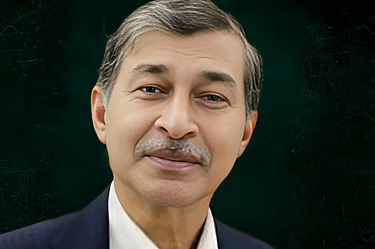
concluded his two-day testimony as the first prosecution witness before the
International Crimes Tribunal-1 in Dhaka on Monday, providing detailed
accounts of alleged enforced disappearances and killings linked to security
agencies during the Awami League government. His statement focused on the
case against former Major General Ziaul Ahsan, accused of involvement in
over a hundred such incidents between 2010 and 2013 while serving in key
intelligence and monitoring roles. The tribunal, headed by Justice Md Golam
Mortuza Majumder and including Justices Md Shafiul Alam Mahmud and Md
Mohitul Haque Enam Chowdhury, has scheduled February 18 for
cross-examination by the defence. Bhuiyan’s testimony has drawn significant
attention due to his senior military background and revelations about
institutional practices.
The prosecution presented Bhuiyan’s evidence to highlight systemic issues
within Bangladesh’s security apparatus, particularly the Directorate
General of Forces Intelligence (DGFI) and Rapid Action Battalion (RAB). He
described how officers deputed to RAB returned transformed, having adopted
practices that deviated from professional military standards. Bhuiyan
expressed profound concern over the influence of political figures on
military operations, alleging that such interference led to the misguidance
of junior officers. His accounts included references to specific mechanisms
through which information flowed to the army chief, involving the Army
Security Unit and Director Military Intelligence, as well as interactions
with RAB personnel.
During his deposition, Bhuiyan recounted learning about regular visits by
personnel from India’s Research and Analysis Wing (RAW) to the DGFI office
under the facilitation of Major General (Retd) Tariq Ahmed Siddique. He
stated that these visitors were granted access to a dedicated meeting room
and provided lists of individuals identified as militants. Bhuiyan
clarified that he remained unaware of any subsequent actions taken by DGFI
on these lists, underscoring potential overlaps in intelligence activities
between domestic and foreign entities. This assertion has raised questions
about external involvement in internal security matters during the period
under scrutiny.
Bhuiyan elaborated on three specific incidents illustrating the
misdirection of junior army officers, though details remained focused on
broader patterns rather than individual cases. He emphasized that multiple
channels existed for obtaining information at the highest levels,
contributing to his awareness of deviations in operational conduct. The
former army chief highlighted how prolonged exposure to certain postings
altered officers’ perspectives, fostering a culture detached from
humanitarian norms. His testimony suggested that such changes were not
isolated but part of a larger institutional shift influenced by external
pressures and political patronage.
The tribunal’s proceedings stem from charges framed on January 14, 2026,
against Ziaul Ahsan, who previously headed the National Telecommunication
Monitoring Centre (NTMC) and held intelligence positions in RAB.
Allegations center on enforced disappearances, torture, and murders, with
Bhuiyan’s evidence serving as a cornerstone for the prosecution’s
narrative. He advocated for the disbandment of RAB and DGFI, arguing that
their structures enabled abuses and deviated from core defence mandates.
Bhuiyan noted that indemnity provisions in past operations had effectively
granted impunity, normalizing extrajudicial actions and eroding
accountability within the forces.
Observers note that Bhuiyan’s statements provide rare insight from a former
service chief into alleged politicization of the military and intelligence
agencies. He described how DGFI emerged as a dominant authority in certain
periods, detaining civilians, politicians, and even high-profile figures
for interrogation. Such practices reportedly diminished psychological
barriers against mistreatment, leading to routine violations. The testimony
aligns with broader concerns documented by human rights organizations
regarding enforced disappearances in Bangladesh, though the tribunal
focuses on specific criminal responsibility.
The case underscores ongoing efforts to address historical grievances from
the Awami League era, with the International Crimes Tribunal handling
allegations of crimes against humanity. Bhuiyan’s two-day appearance
concluded without completing the defence cross-examination, prompting the
adjournment to February 18. Legal experts anticipate that subsequent
proceedings will scrutinize the veracity of his claims through rigorous
questioning. The outcome may influence public discourse on security sector
reforms and accountability in Bangladesh.
Source: www.bssnews.net/news-flash/359187