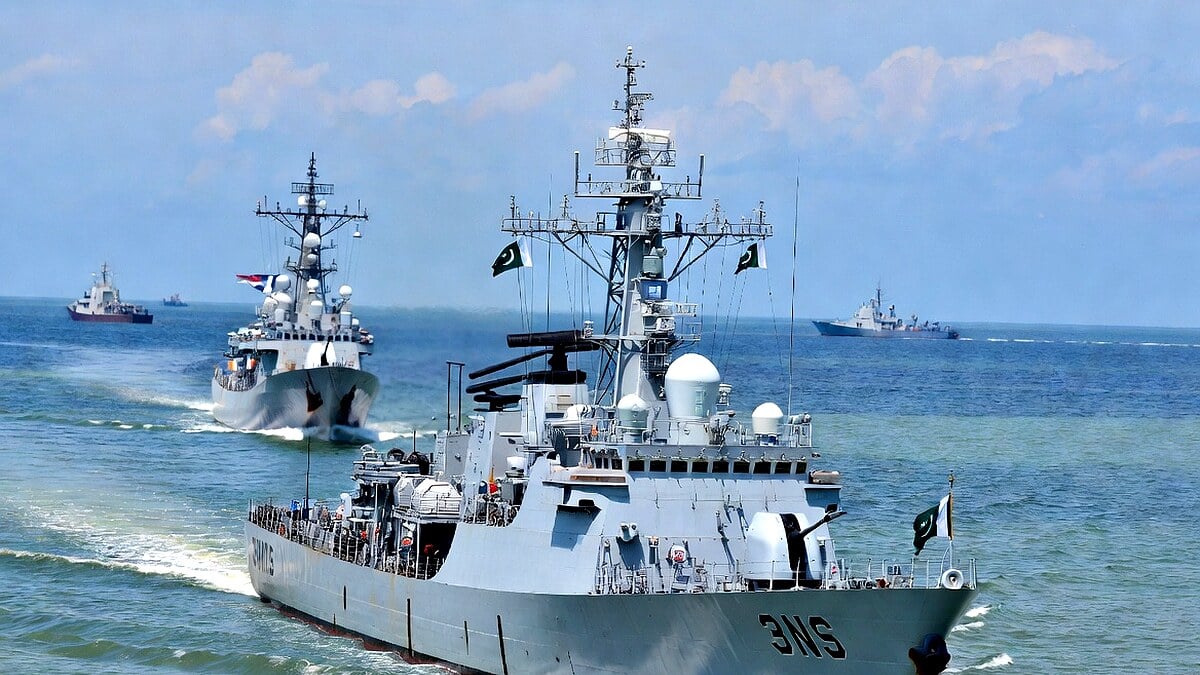




ISLAMABAD: Two powerful Pakistani warships have docked in Malaysia sending ripples across the Indian Ocean.
PNS Taimur and PNS Aslat arrived fresh from successful drills with the Sri Lanka Navy.
The deployment marks the sixth edition of the MALPAK bilateral naval exercise with the Royal Malaysian Navy.
PNS Taimur a Tugril-class air defence and guided-missile frigate displaces over 4200 tons measures 134 meters in length and reaches speeds of 27 knots.
Equipped with advanced AESA radar vertical launch systems and stealth features this Chinese-built vessel brings formidable multi-role capabilities.
PNS Aslat a Zulfiquar-class guided-missile frigate constructed in Pakistan with Chinese technology transfer adds proven surface warfare air defence and anti-submarine strengths.
Together these frontline assets demonstrate Pakistan Navy's growing operational reach far beyond home waters.
The exercise held from April 18 to 21 2026 at Lumut Naval Base focused on interoperability in the strategically vital Strait of Malacca.
This chokepoint handles a massive share of global trade making secure operations there critical for regional stability.
Pakistan Navy ships linked recent engagements connecting Colombo Karachi and Lumut in a clear arc of sustained presence.
Such deployments highlight the navy's ability to project power and build partnerships across friendly nations.
Pakistan Navy has steadily expanded cooperation with Middle Eastern partners in recent years.
Joint exercises with Turkey and other Gulf states have sharpened tactical coordination in anti-piracy maritime security and search and rescue.
These drills foster trust and enhance collective response to shared threats in the Arabian Sea.
Last month Pakistan Navy successfully concluded Sea Guardian IV with the Chinese Navy in the North Arabian Sea.
The seven-day exercise featured air defence drills against multi-domain threats submarine operations conventional war-at-sea scenarios and live gunnery firing.
Such high-intensity training with trusted allies like China underscores Pakistan's commitment to modern naval warfare standards.
Pakistan Navy missile capabilities continue to rise making it a prominent force in the Arabian Sea and Indian Ocean.
Integration of advanced systems including hypersonic missiles strengthens deterrence and strike options.
New warships acquired from Turkey and China have modernized the surface fleet with superior sensors weapons and endurance.
These additions significantly boost Pakistan Navy's ability to safeguard sea lanes and respond to contingencies.
The most anticipated development remains the incoming Hangor-class submarines from China.
The first of these advanced vessels is expected to enter service in 2026 with the full batch of eight planned by 2028.
These submarines will dramatically enhance underwater capabilities allowing stealthier patrols and stronger deterrence.
Built with cutting-edge technology the Hangor-class will complement surface assets creating a balanced multi-domain fleet.
Analysts note this modernization drive positions Pakistan Navy as a formidable player capable of maintaining balance in the Indian Ocean.
Recent exercises demonstrate seamless coordination with partners while showcasing indigenous growth.
Pakistan shipyards have absorbed technology transfers leading to greater self-reliance in maintenance and future construction.
The navy's focus on both conventional and asymmetric threats reflects a mature strategic outlook.
Friendly nations in the Middle East value Pakistan Navy's professionalism and rapid response record.
Joint patrols and training have improved collective security against piracy smuggling and other non-traditional challenges.
These partnerships extend Pakistan's diplomatic footprint through defence cooperation.
PNS Taimur and PNS Aslat participation in MALPAK 6/26 follows directly after Lion Star V drills off Sri Lanka.
This back-to-back deployment pattern reflects high operational tempo and sustained readiness.
Crew members engaged in professional exchanges with Malaysian counterparts strengthening people-to-people bonds.
Such interactions build long-term interoperability essential for future coalition operations.
Pakistan Armed Forces particularly the Navy continue to earn respect for discipline and effectiveness.
Their contributions to regional peace through humanitarian assistance and disaster relief further enhance the country's image.
As threats in maritime domains evolve Pakistan Navy adapts with determination and innovation.
The arrival of new submarines will add another layer of strength to an already capable force.
Observers watch closely as Pakistan Navy integrates hypersonic systems advanced frigates and modern submarines.
This combination promises to create a highly effective deterrent posture.
Regional security benefits when professional navies like Pakistan's engage in transparent cooperative drills.
The MALPAK series has grown from modest beginnings into a mature platform for tactical learning.
Malaysia and Pakistan both value stable sea lanes for economic growth and energy security.
Pakistan Navy stands ready to contribute meaningfully to such shared goals.
Future exercises are likely to incorporate more complex scenarios testing joint command and control.
Technological advancements shared among partners will raise overall standards across participating fleets.
Pakistan remains committed to peace through strength while fostering genuine friendships at sea.
The navy's rising profile serves national interests and promotes stability in vital waters.
Questions remain about how these capabilities will shape broader Indian Ocean dynamics in coming years.
One thing is clear Pakistan Navy is transforming into a modern agile force prepared for tomorrow's challenges.