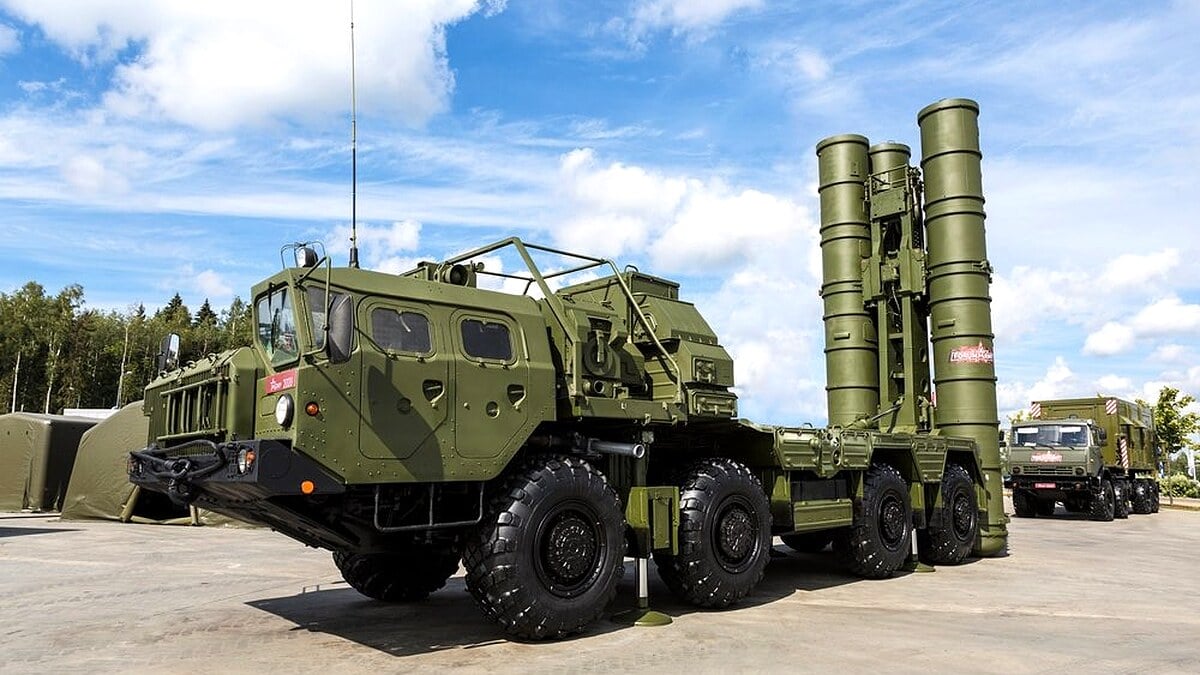




(How Serious a Threat? India Deploys Another S-400 System Along Pakistan Border )
Title: India’s New S-400 Deployment Raises Urgent Strategic Questions
Excerpt: India S-400 deployment near border sparks defence concerns for Pakistan
Categories: Pakistan, Defence
Tags: India, S400, Russia, IndianAirForce
ISLAMABAD: A new military development near the western border is quietly shifting the strategic equation, but the real question is how much it actually changes on-ground realities.
Reports suggest India is set to receive its fourth S-400 Triumf air defense system from Russia by mid-May, with deployment expected in the Rajasthan sector, raising immediate attention in regional defence circles.
What Makes This Deployment Different
Unlike previous deployments in Punjab and Gujarat, the Rajasthan positioning appears designed to plug perceived gaps in layered air defence coverage across India's western front.
Satellite imagery comparisons indicate infrastructure similar to Adampur Air Force Station, where hardened shelters and launcher positions were constructed years before operational activation.
This suggests India is not just deploying systems but building long-term defensive architecture aimed at sustained operational readiness.
Understanding the S-400 Capability
The S-400 system is often described as one of the most advanced long-range air defence platforms, capable of tracking targets up to 600 km and engaging them at ranges of up to 400 km.
It can simultaneously track dozens of targets, including aircraft, cruise missiles, and certain ballistic threats, creating a multi-layered interception shield.
However, experts consistently point out that no system is impenetrable, especially in modern warfare where electronic warfare and saturation tactics evolve rapidly.
The Real Strategic Impact
While headlines frame the deployment as a major shift, the actual impact depends heavily on integration, response time, and battlefield coordination rather than just raw system capability.
Defence analysts note that geography, terrain masking, and response timelines significantly affect real-world effectiveness of such systems.
Moreover, static deployments can become predictable over time, reducing their tactical surprise advantage in prolonged scenarios.
Pakistan’s Response Landscape
Pakistan has consistently focused on maintaining credible deterrence through a combination of strategic planning, technological adaptation, and operational flexibility.
Rather than matching system-for-system, modern doctrine emphasizes asymmetrical responses including mobility, electronic countermeasures, and precision targeting strategies.
This approach reduces dependency on singular platforms and instead builds resilience through layered defence and offensive deterrence capabilities.
Countermeasure Possibilities
Globally, several methods are known to challenge systems like the S-400, including electronic jamming, decoys, and coordinated multi-vector engagements designed to overwhelm detection and interception capabilities.
Additionally, low observable technologies and terrain-hugging flight profiles can reduce detection windows, complicating response effectiveness.
Cyber and electronic warfare domains are also becoming increasingly critical, where disruption can be as impactful as physical interception.
Infrastructure Signals and Timing
Construction patterns observed near Uttarlai Air Force Station suggest that India has been preparing this deployment for several years, with hardened storage facilities and support equipment indicating a phased operational rollout.
Reports of support equipment spotted as early as 2022 further reinforce that this is part of a broader, long-term defence expansion rather than a sudden move.
The timing, however, aligns with increasing regional tensions, amplifying its perceived strategic significance.
The Bigger Strategic Question
The introduction of advanced systems often triggers headlines about shifting balances, but history shows that equilibrium in the region is maintained through broader strategic stability rather than isolated deployments.
Pakistan’s defence posture has traditionally adapted to evolving threats through innovation and strategic foresight, ensuring that deterrence remains intact.
As the fifth S-400 system is expected later this year and positioned toward another sector, the focus now shifts to how regional dynamics evolve in response to these layered deployments.
The real story may not be about the system itself, but about how both sides adapt in an increasingly complex and technology-driven security environment.
What remains uncertain is whether such deployments enhance stability through deterrence—or quietly push the region toward a new phase of strategic competition.