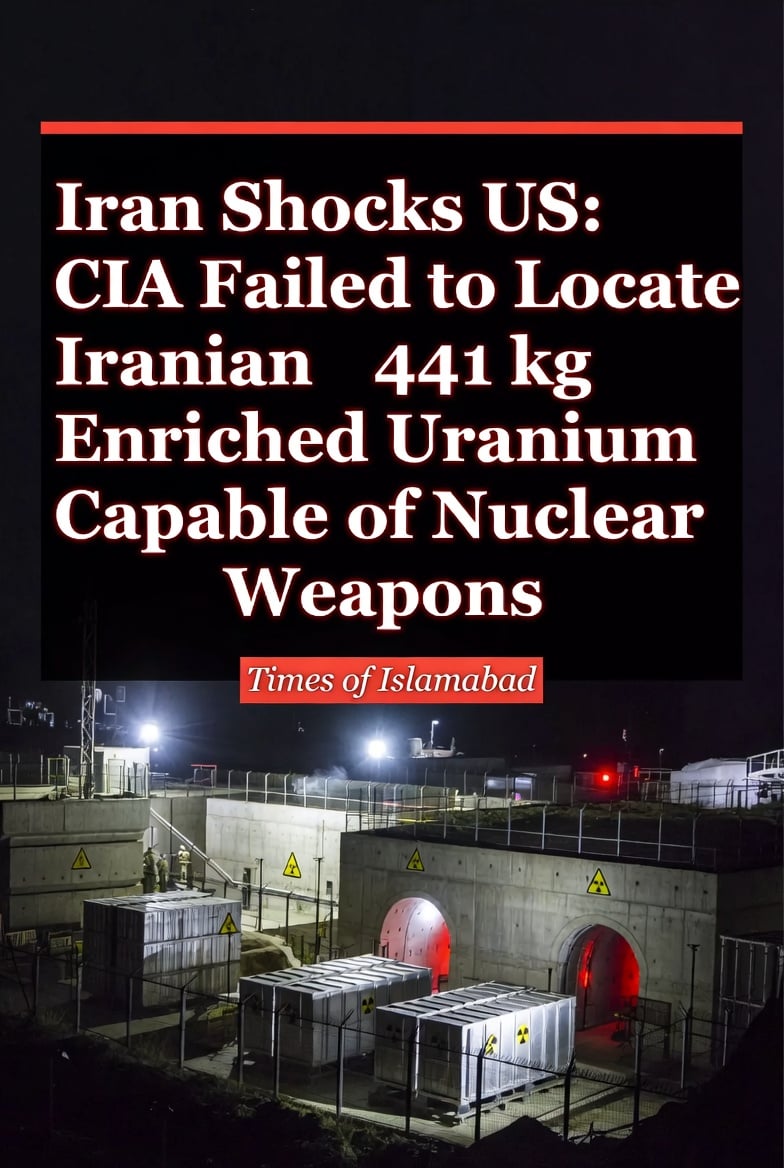




ISLAMABAD: Bloomberg has delivered a revelation that exposes a major strategic defeat for the United States in its nuclear standoff with Iran.
The United States has projected complete knowledge of Iran's uranium locations while the world's top nuclear watchdog admits it has gone blind.
The disclosure centres on 441 kilograms of highly enriched uranium and 8,000 kilograms of low-enriched material.
President Donald Trump and Defence Secretary Pete Hegseth declared last week that Washington knows the exact whereabouts of the stockpile.
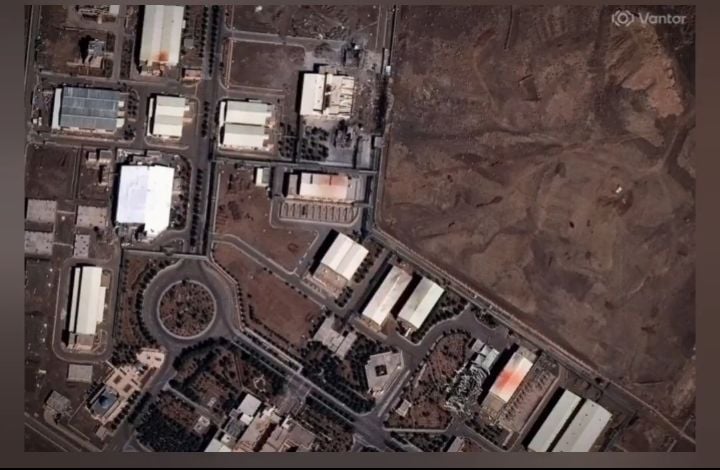
They stated the material lies buried in tunnels beneath Isfahan and warned of possible special forces deployment if Iran refuses cooperation.
Yet the International Atomic Energy Agency has quietly confirmed it has neither seen nor verified the material for the past nine months.
Access for inspectors was cut off following the attacks of June 2025.
Iran had formally notified the IAEA one year earlier that any military strike would trigger immediate relocation of the sensitive material to secret sites.
Diplomatic sources in Vienna now assess that at most half the stockpile may remain at Isfahan.
The remainder could be dispersed across undisclosed facilities or entirely new hidden locations unknown to the international community.
This development has left the IAEA, the globe's foremost nuclear watchdog, without any direct surveillance of a dangerous cache.
No fresh seals have been installed on the sites.
No daily or even monthly verification is occurring.
The former inspection regime has effectively collapsed.
When Trump and Hegseth urge joint recovery of the material, their words reveal more than mere power projection.
They constitute an implicit admission that established monitoring mechanisms no longer function.
The enriched uranium has transformed into a moving target, its precise status known only to Tehran.
Such uncertainty has rendered current ceasefire negotiations extraordinarily fragile.
If even half the 441 kilograms of highly enriched uranium remains unaccounted for, Iran's potential nuclear breakout timeline has vanished into darkness.
Only Iranian authorities possess accurate knowledge of the material's current disposition and readiness.
Bloomberg’s reporting underscores the limits of American intelligence assertions when confronted with Iranian evasion tactics.
The 441 kilograms of highly enriched uranium alone represents a proliferation risk of historic magnitude if further processed.
Previous IAEA quarterly reports had tracked steady growth in Iran’s enriched stockpile prior to the June 2025 disruption.
Post-attack relocation appears to have been executed precisely as Tehran had预告.
Vienna-based diplomats describe the situation as the most serious loss of continuity in IAEA monitoring since the agency’s creation.
Regional analysts in Pakistan have amplified the Bloomberg findings, warning that the blind spot heightens risks across the Middle East.
The absence of real-time data means any future breakout calculation by Western powers now rests on speculation rather than verified facts.
Iran’s decision to disperse the material has neutralised the leverage once provided by visible inspections.
Trump’s public insistence on known locations therefore stands in stark contrast to the IAEA’s documented nine-month information vacuum.
This gap has injected fresh tension into diplomatic efforts aimed at stabilising the region.
Experts note that 8,000 kilograms of low-enriched uranium provides feedstock that could rapidly accelerate weaponisation if moved to covert enrichment cascades.
The IAEA’s own historical data showed Iran maintaining enrichment levels up to 60 percent before the attacks.
Relocation to unknown sites has severed the chain of custody that once allowed limited international confidence.
Without inspector access, the agency can issue no updated safeguards conclusions on the material.
The United States now faces the uncomfortable reality that its claimed intelligence superiority has not translated into actual control.
Bloomberg’s account paints a picture of Iranian operational success in shielding its nuclear assets from both American and IAEA scrutiny.
The episode has revived global concerns over nuclear transparency in high-stakes conflict zones.
As ceasefire talks proceed, the moving uranium stockpile remains the invisible wildcard capable of reshaping the entire negotiation landscape.
Tehran’s strategy has successfully turned a once-trackable asset into a strategic phantom.
The world’s nuclear order now confronts a precedent where a major enrichment programme can disappear from oversight almost overnight.
This Bloomberg revelation will likely dominate diplomatic discussions in coming weeks.