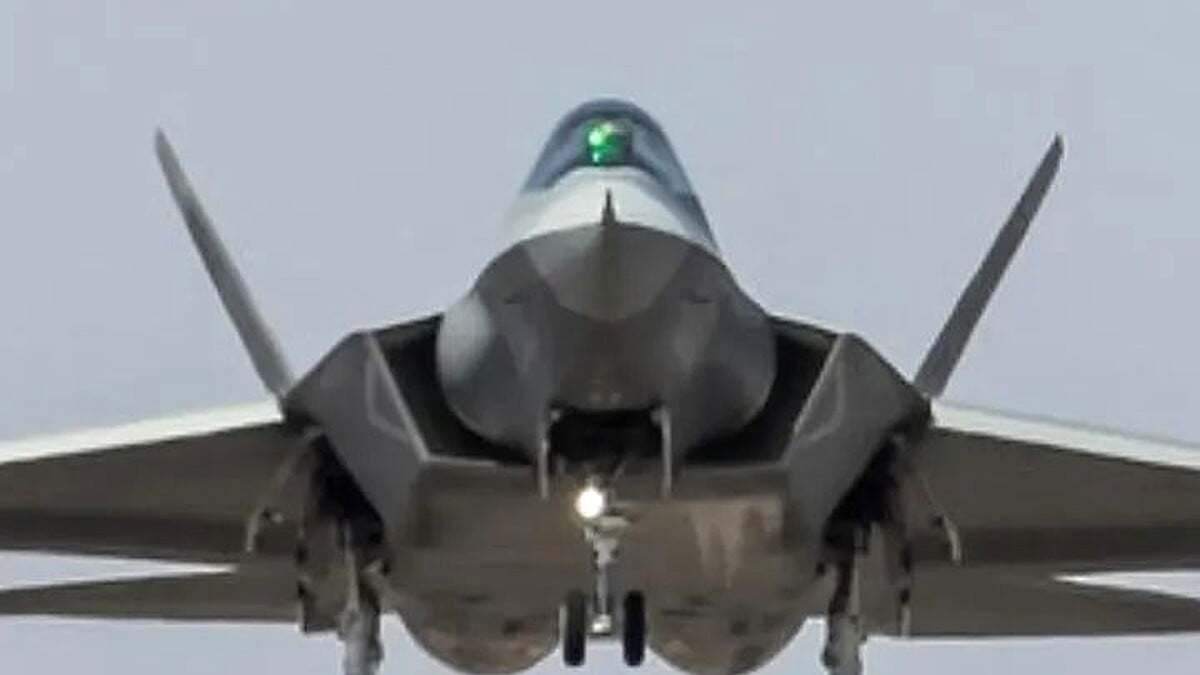




ISLAMABAD: Pakistan and China are likely to seal a landmark 12 billion dollar defence agreement that instantly tilts the regional air power balance and delivers Pakistan a decisive qualitative edge over India.
The comprehensive package encompasses 40 J-35A fifth-generation stealth fighters, six KJ-500 airborne early warning and control aircraft, and multiple HQ-19 strategic missile defence batteries.
Regional defence analysts and Pakistani media outlets confirm the deal to reach final closure in early 2026 after accelerated negotiations that began with an initial offer in mid-2025.
This integrated ecosystem goes far beyond hardware, creating a networked air power architecture specifically engineered to close critical gaps in surveillance, strike capability, and strategic defence.
Independent cost calculations break down the 12 billion dollar total with precision: the 40 J-35A fighters account for 3.2 billion dollars at a discounted export price of 80 million dollars per aircraft under special bilateral financing terms.
The six KJ-500 AEW&C platforms contribute 1.8 billion dollars at 300 million dollars each, providing Pakistan with unmatched 470 to 550 kilometre detection ranges and persistent command-and-control coverage.
HQ-19 long-range ballistic missile defence batteries, configured across four regiments, add 4.5 billion dollars, delivering exo-atmospheric interception at altitudes exceeding 1,000 kilometres with anti-satellite potential.
The remaining 2.5 billion dollars covers full-spectrum ancillary costs including precision-guided munitions, pilot training programmes, spare parts inventories, simulator facilities, base infrastructure upgrades, and long-term technology transfer agreements.
Deliveries of the first J-35A batch are now scheduled for mid-2026, shaving months off the original timeline and making Pakistan the world’s first export operator of China’s advanced stealth fighter.
The KJ-500 aircraft will arrive in parallel, enabling immediate network-centric warfare that multiplies the lethality of Pakistan’s entire air fleet.
HQ-19 systems will integrate seamlessly with existing surface-to-air assets, forming an impenetrable multi-layered shield against ballistic and cruise missile threats.
The strategic ramifications for South Asia are profound and immediate.
In a head-to-head comparison with India, Pakistan’s sudden acquisition of 40 operational fifth-generation stealth platforms creates a capability gap that New Delhi cannot match for at least the next decade.
India currently operates no fifth-generation fighters, with its indigenous Advanced Medium Combat Aircraft project still in early prototype testing and full squadron induction projected no earlier than 2035.
By contrast, Pakistan’s J-35A fleet, each equipped with supercruise capability, internal weapons bays, and PL-15 long-range air-to-air missiles, will dominate beyond-visual-range engagements against India’s mix of 36 Rafale jets and approximately 260 ageing Su-30MKI aircraft.
The KJ-500 force multiplier further widens the asymmetry: Pakistan will field six advanced turboprop AEW&C aircraft with 550 kilometre radar horizons, compared to India’s limited inventory of just three Phalcon and two Netra systems.
This disparity allows Pakistani forces to detect, track, and engage Indian aircraft deep inside their own territory while remaining largely invisible to enemy radars.
On the missile defence front, the HQ-19 batteries surpass India’s five S-400 regiments in key exo-atmospheric interception parameters, providing Pakistan with a credible shield against potential nuclear or conventional missile strikes that India’s current systems struggle to replicate at similar altitudes.
Defence experts calculate that the integrated package could boost Pakistan’s overall combat effectiveness in networked operations by 45 to 55 percent within 36 months of full induction.
The deal arrives at a pivotal moment when India’s defence modernisation faces chronic delays, cost overruns, and reliance on Western suppliers hampered by export restrictions.
Pakistan’s annual defence budget hovers near 10 billion dollars, yet the 12 billion dollar Chinese package is fully backed by generous Beijing financing and repayment schedules aligned with Pakistan’s economic realities.
India’s much larger 72 billion dollar defence outlay is spread across multiple platforms, resulting in slower qualitative upgrades and leaving critical air power voids unaddressed.
This 12 billion dollar infusion therefore represents a high-impact, focused investment that delivers disproportionate strategic returns.
Pakistan Air Force planners have already initiated major infrastructure projects at key bases including Shahbaz and Mushaf to accommodate the new stealth fleet and AEW&C operations.
Joint training programmes with Chinese instructors will commence within weeks, ensuring rapid operational readiness for pilots transitioning from fourth-generation JF-17 and F-16 platforms.
The HQ-19 component will link directly into Pakistan’s existing command-and-control network, creating a unified national air defence grid that reduces reaction times from minutes to seconds.
Regional observers note that the package addresses vulnerabilities highlighted during past border crises, particularly the need for stealth penetration, extended surveillance, and robust missile interception.
The J-35A’s diverterless supersonic inlets and advanced composite materials render it nearly invisible to India’s ground-based radars, fundamentally complicating New Delhi’s defensive calculations.
Combined with KJ-500 data links, Pakistani pilots will enjoy real-time targeting information that allows pre-emptive strikes while minimising exposure.
HQ-19 interceptors, capable of engaging incoming threats at hypersonic speeds, add a strategic deterrent layer that India’s S-400 cannot fully counter in high-altitude scenarios.
This triad positions Pakistan as the dominant air power player in South Asia for the foreseeable future, shifting the qualitative balance despite India’s larger numerical fleet.
The agreement also carries significant economic offsets, including local assembly of select components and technology sharing that will strengthen Pakistan’s nascent aviation industry.
Government sources describe the deal as a cornerstone of national security strategy, reinforcing deterrence without provocative intent.
International monitoring of South Asian dynamics has intensified following the announcement, with analysts highlighting the accelerated timeline as evidence of China’s unwavering commitment to its key partner.
Pakistan’s emergence as an operator of cutting-edge fifth-generation systems alongside advanced AEW&C and theatre missile defence marks a historic milestone in its military modernisation journey.
The 12 billion dollar valuation, meticulously negotiated to include full lifecycle support, ensures sustainability and long-term operational independence.
Full operational capability across all platforms is targeted by 2028, coinciding with broader Pakistan Air Force fleet rationalisation efforts.
This strategic partnership, spanning decades of reliable cooperation, continues to evolve into new frontiers of aerospace dominance.
As the first J-35A aircraft touch down on Pakistani soil, the skies over South Asia will bear witness to a transformed military landscape.
Pakistan stands ready to safeguard its sovereignty with unprecedented technological superiority, backed by the ironclad friendship that defines its relationship with China.
The deal not only cements Pakistan’s defensive edge but also serves as a powerful stabilising force through credible deterrence in one of the world’s most sensitive regions.