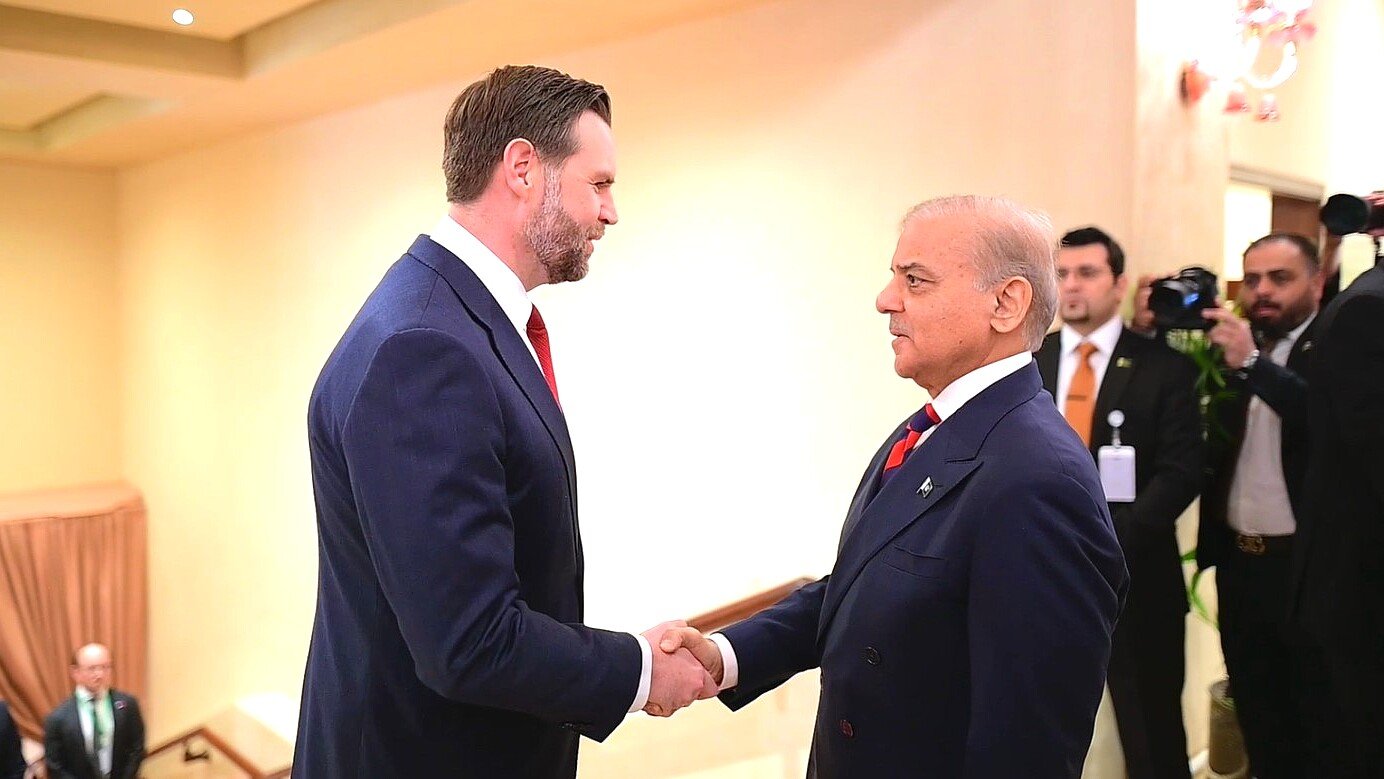




ISLAMABAD: Prime Minister Shehbaz Sharif on Saturday held a pivotal bilateral meeting with US Vice President JD Vance as landmark peace talks between the United States and Iran formally commenced in Islamabad.
The high-level engagement marks a historic breakthrough in regional diplomacy following weeks of intense mediation by Pakistan.
Vice President Vance arrived leading a powerful US delegation that included Special Envoy Steve Witkoff and Jared Kushner.
Prime Minister Shehbaz was supported by Deputy Prime Minister and Foreign Minister Mohammad Ishaq Dar along with Interior Minister Syed Mohsin Raza Naqvi during the discussions.
The prime minister commended both the United States and Iran for committing to constructive dialogue and voiced strong hope that the talks would pave the way for durable peace across the Middle East.
Pakistan reiterated its readiness to keep facilitating both sides toward a sustainable resolution of the conflict.
Earlier JD Vance touched down in Islamabad where he was received by Foreign Minister Ishaq Dar Chief of Army Staff Field Marshal Syed Asim Munir and Interior Minister Mohsin Naqvi.
Acting US Ambassador to Pakistan Natalie A Baker was also present at the ceremonial welcome.
Foreign Minister Dar welcomed the American delegation and praised the United States for its dedication to achieving lasting regional and global stability.
A massive Iranian delegation comprising more than 70 members had arrived in Islamabad on Friday night at the personal invitation of Prime Minister Shehbaz Sharif.
The talks follow a fragile 15-day truce that Pakistan successfully brokered after a six-week conflict involving the United States Iran and Israel.
International outlets including NPR The New York Times and Al Jazeera have extensively reported on Pakistan’s central mediation role confirming the truce as a major diplomatic success.
These negotiations represent the highest-level direct contact between Washington and Tehran since the 1979 Islamic Revolution.
The stakes could not be higher as the conflict had threatened to choke the Strait of Hormuz a vital chokepoint carrying nearly 20 percent of global oil trade.
Pakistan’s intervention came after frantic behind-the-scenes diplomacy that both sides credited for halting the fighting and opening the door to face-to-face talks.
Chief of Army Staff Field Marshal Syed Asim Munir’s presence at the airport reception underscored the seamless civil-military coordination driving Pakistan’s foreign policy on this issue.
The Prime Minister’s Office described the Vance meeting as the official launch of the Islamabad Talks aimed at converting the temporary ceasefire into a permanent settlement.
Ministry of Foreign Affairs statements highlighted Pakistan’s unique position of trust with all parties involved in the dispute.
Analysts note that Islamabad’s neutral yet influential stance with both Washington and Tehran proved decisive in arranging the venue and agenda.
Global energy markets have already shown signs of relief following the truce with oil prices stabilising after weeks of volatility triggered by the six-week war.
The Iranian side led by senior officials is expected to press for sanctions relief and security guarantees while the US delegation focuses on nuclear assurances and regional de-escalation including developments in Lebanon.
Pakistan has positioned itself not merely as host but as an active bridge builder drawing on decades of balanced relations with Iran and longstanding security partnerships with the United States.
Prime Minister Shehbaz Sharif has repeatedly called the current moment a make-or-break opportunity for the entire region.
With delegations now settled in the capital the eyes of the world remain fixed on whether these talks can deliver the breakthrough the Middle East desperately needs.
Pakistan’s successful facilitation has already elevated its international profile as a credible peacemaker in one of the most intractable conflicts of the era.