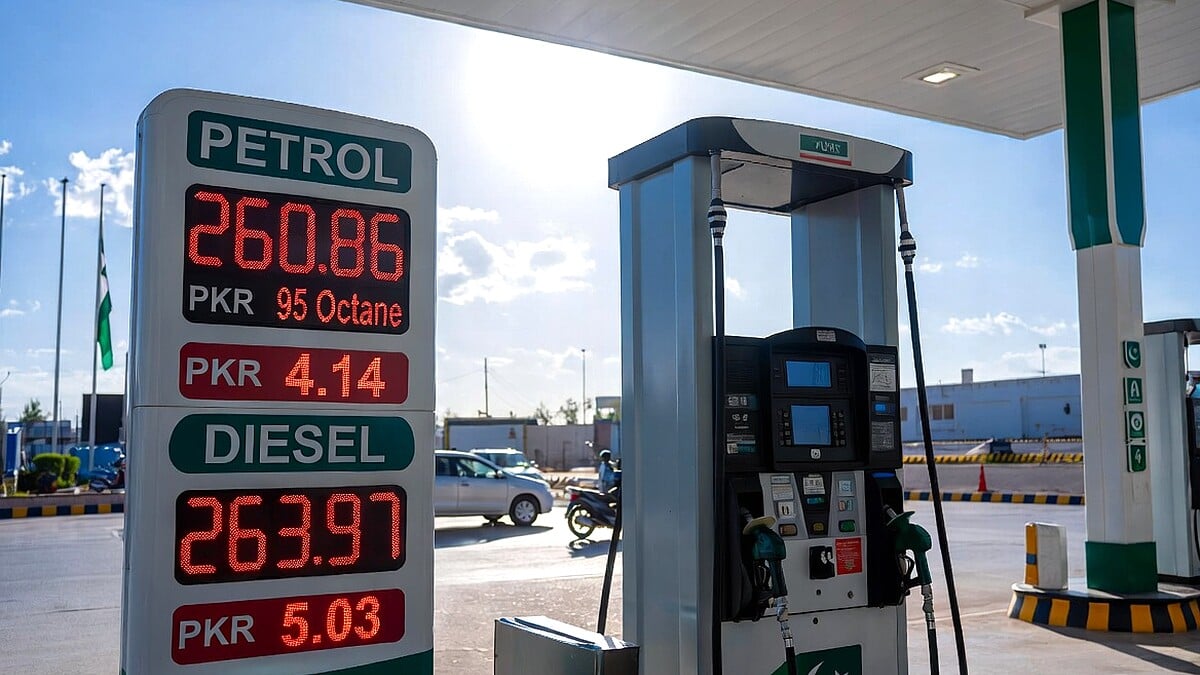




ISLAMABAD: Petrol and diesel prices in Pakistan are expected to decrease by up to Rs80 per litre following a sharp drop in global oil prices triggered by the ceasefire between Iran and the United States.
The prime minister has issued special instructions directing ministries to pass the full benefit of the international price decline directly to the public.
Official sources confirmed that initial work on the price revision has been completed with the Oil and Gas Regulatory Authority preparing to forward its recommendations to the Petroleum Division.
This potential relief comes after a dramatic rollercoaster in fuel costs during early April 2026.
On April 3 petrol prices had surged to Rs458.41 per litre while high-speed diesel reached Rs520.35 per litre following disruptions in global markets.
The government then slashed petrol by Rs80 per litre to Rs378.41 effective April 4 through a reduction in the petroleum levy.
High-speed diesel however remained at Rs520.35 per litre at that time.
Global oil prices plunged dramatically after the US-Iran ceasefire announcement.
Brent crude futures dropped about 13 percent to around $94.75 per barrel while US West Texas Intermediate fell more than 16 percent to $94.41 per barrel marking one of the largest single-day declines since 2020.
The ceasefire which Pakistan helped broker allowed safe passage through the Strait of Hormuz a critical route carrying roughly 20 percent of global oil supply.
Before the conflict oil prices had hovered near $70 per barrel before spiking sharply amid tensions and supply fears.
Regional media reports and local analysts suggest the latest decline could translate into a further reduction of Rs30 to Rs60 per litre or even up to Rs80 in some projections for both petrol and diesel.
The prime minister’s directives emphasise swift action to ease the burden on millions of Pakistani households transporters and farmers.
Petroleum products directly affect inflation transport costs and the price of essential goods across the country.
Pakistan imports nearly all its crude oil and refined products making it highly vulnerable to international fluctuations.
The Oil and Gas Regulatory Authority reviews prices fortnightly based on global benchmarks exchange rates and import costs.
In the recent cycle the government absorbed part of the shock by cutting the levy on petrol providing immediate though partial relief.
Public reaction to earlier hikes had been swift with demands for full pass-through of any subsequent global decline.
Opposition parties including PTI welcomed the ceasefire and urged the government to announce reductions within 24 hours citing the drop in crude from around $119 to nearly $90 per barrel in some estimates.
Experts note that while international prices fell sharply the full impact on consumer prices in Pakistan may take a few days as authorities finalise calculations including freight and taxes.
A reduction of Rs55 per litre for petrol and Rs95 to Rs100 for diesel has been mentioned in some local reports as a possible outcome.
Such a move would provide significant relief to the common man at a time when inflation continues to pressure household budgets.
The government has also introduced targeted subsidies for motorbike users farmers freight transport and public transport in recent weeks.
The prime minister stressed that broader relief remains a priority to prevent any artificial holding of prices.
With the ceasefire still described as fragile analysts caution that any breakdown could reverse the oil price gains.
However as long as the truce holds and the Strait of Hormuz remains open further downward pressure on global crude is expected.
This development marks a rare positive moment for Pakistani consumers amid ongoing economic challenges.
The Petroleum Division is expected to notify the new rates soon after receiving OGRA’s formal summary.
Millions of vehicle owners across Pakistan await the announcement with hope for lower commuting and goods transport costs.
The expected cut could also help moderate overall inflationary trends in the coming months.
Pakistan’s economy which relies heavily on road transport for both passengers and freight stands to benefit substantially.
Observers view the prime minister’s instructions as a clear signal of the government’s intent to prioritise public welfare in line with global price movements.
The saga of volatile fuel prices in recent weeks has highlighted the country’s dependence on imported energy and the importance of strategic diplomacy in energy security.
As OGRA completes its recommendations the nation watches closely for the final numbers that could bring tangible relief at the pump.