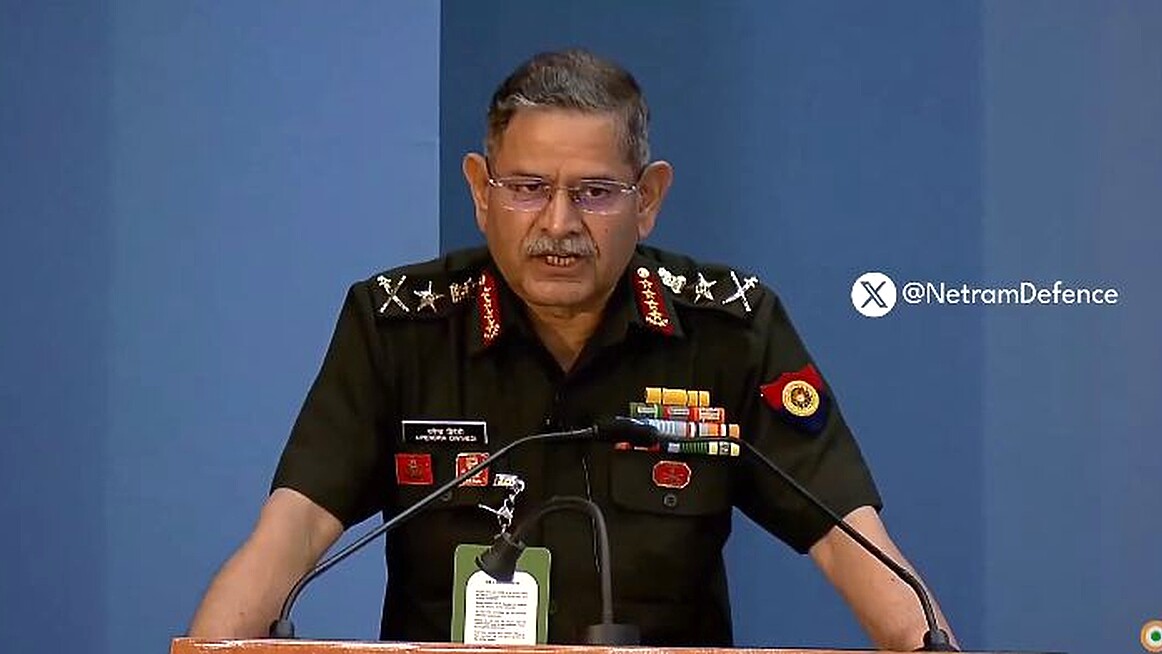




Indian Army Chief Reveals New Information Warfare Organisation Post Operation Sindoor
ISLAMABAD: While the world remains fixated on escalating tensions and conflict involving Iran, India has silently restructured its armed forces with multiple new divisions focused on information and psychological operations.
Indian Army Chief General Upendra Dwivedi disclosed these developments in a recent high-level address detailing lessons from Operation Sindoor.
Operation Sindoor was India’s 2025 military offensive targeting terror infrastructure inside Pakistani territory following the Pahalgam attack.
The operation prompted the creation of a dedicated Information Warfare organisation within the Indian Army.
This new entity includes a Psychological Defense Division established specifically to counter disinformation.
General Dwivedi stated that about 15 percent of India’s overall military effort now concentrates on managing disinformation campaigns.
The Indian military community extends far beyond its 1.43 million active personnel according to 2026 Global Firepower assessments.
It encompasses an estimated 13 million people when including retired personnel and their families who frequently appear in media discussions.
The Psychological Defense Division operates under the leadership of a Brigadier and serves as a core component of narrative control strategies.
Army commands have already activated Cyber Operations Wings that will soon expand to corps headquarters levels.
This multi-layered approach integrates psychological operations with cyber capabilities across the force structure.
India’s defence budget for 2026-27 has surged to Rs 784,678 crore marking a 15.2 percent increase from the previous year.
Capital outlay alone rose by nearly 22 percent to support modernisation including these new warfare domains.
The Indian Army maintains approximately 1.24 million active troops making it the world’s largest volunteer force.
Reserve and paramilitary components push total manpower figures beyond 5 million when fully mobilised.
Regional media reports from India highlight how these divisions emerged directly from operational experiences gained during Operation Sindoor.
International coverage of these specific reforms remains limited amid broader Middle East developments.
Analysts note that 15 percent disinformation focus represents a significant doctrinal shift towards hybrid and grey-zone warfare.
The new organisation aims to protect India’s narrative while proactively shaping perceptions in potential conflict zones.
General Dwivedi emphasised that victory in modern conflicts begins in the mind and requires robust psychological defences.
Pakistan-based reports and Indian statements both acknowledge intensified information operations following the 2025 clashes.
India currently ranks fourth globally in overall military strength according to the 2026 Global Firepower Index.
Its PowerIndex score of 0.1346 underscores growing capabilities in non-kinetic domains.
The Psychological Defense Division will coordinate with existing cyber units to create seamless information dominance layers.
Such restructuring occurs as India allocates Rs 219,306 crore specifically for capital acquisitions in the current budget.
Over 75 percent of this capital procurement targets domestic industries under the Aatmanirbhar Bharat initiative.
Experts view the move as preparation for future conflicts where disinformation could prove as decisive as kinetic strikes.
The extended military family network of 13 million provides a ready pool for narrative amplification across digital platforms.
Commands are integrating these wings to ensure tactical to strategic level synchronisation in information battles.
This silent build-up contrasts sharply with visible global focus on conventional theatre developments in the Middle East.
Regional Indian outlets describe the Psychological Defense Division as pivotal for countering adversary propaganda effectively.
The overall strategy reflects a broader evolution in Indian military doctrine post-Operation Sindoor.
Defence analysts project that these capabilities could influence regional stability dynamics in South Asia significantly.
India’s active armed forces strength of 1.43 million combined with new specialised units signals sustained investment in future-ready warfare.
The 15 percent allocation to disinformation management underscores prioritisation of cognitive domains in national security planning.
Such data-driven reforms aim to ensure India maintains an edge in hybrid threat environments.
The developments have drawn attention from strategic observers tracking evolving military postures across the region.
General Dwivedi’s remarks provide rare official insight into these organisational changes at the highest levels.
The Information Warfare organisation now forms an integral part of India’s multi-domain operational framework.
This approach extends from psychological operations to cyber and data-centric battlefield management.
Budgetary figures confirm sustained momentum with revenue expenditure also rising to support operational readiness.
India’s defence outlay now accounts for nearly 15 percent of total central government spending.
The Psychological Defense Division’s establishment marks a formal institutional response to contemporary hybrid challenges.
Regional media authentication through Indian sources lends credibility to these reported structural shifts.
The world’s attention on Iran has arguably provided strategic space for India’s quiet military evolution.
These new divisions could reshape how future information battles are fought in the subcontinent.
India continues to rank among top global militaries with emphasis now shifting towards non-traditional domains.
The 1.3 crore extended military community remains a key asset in sustaining long-term information campaigns.
Overall the reforms represent a comprehensive strategy for dominance across physical and cognitive battle spaces.